Egyptian team begins new phase of research into hidden void in Great Pyramid

Key facts
- Mohamed Mohy Elkarmoty is an associate professor at Cairo University’s Faculty of Engineering and deputy coordinator of the ScanPyramids mission.1
- Cosmic-ray muon radiography is a non-destructive imaging technique that uses subatomic particles from space to detect differences in density inside.1
- ScanPyramids was launched in 2015 in cooperation with universities and research institutions in Germany, France, Canada and Japan.1
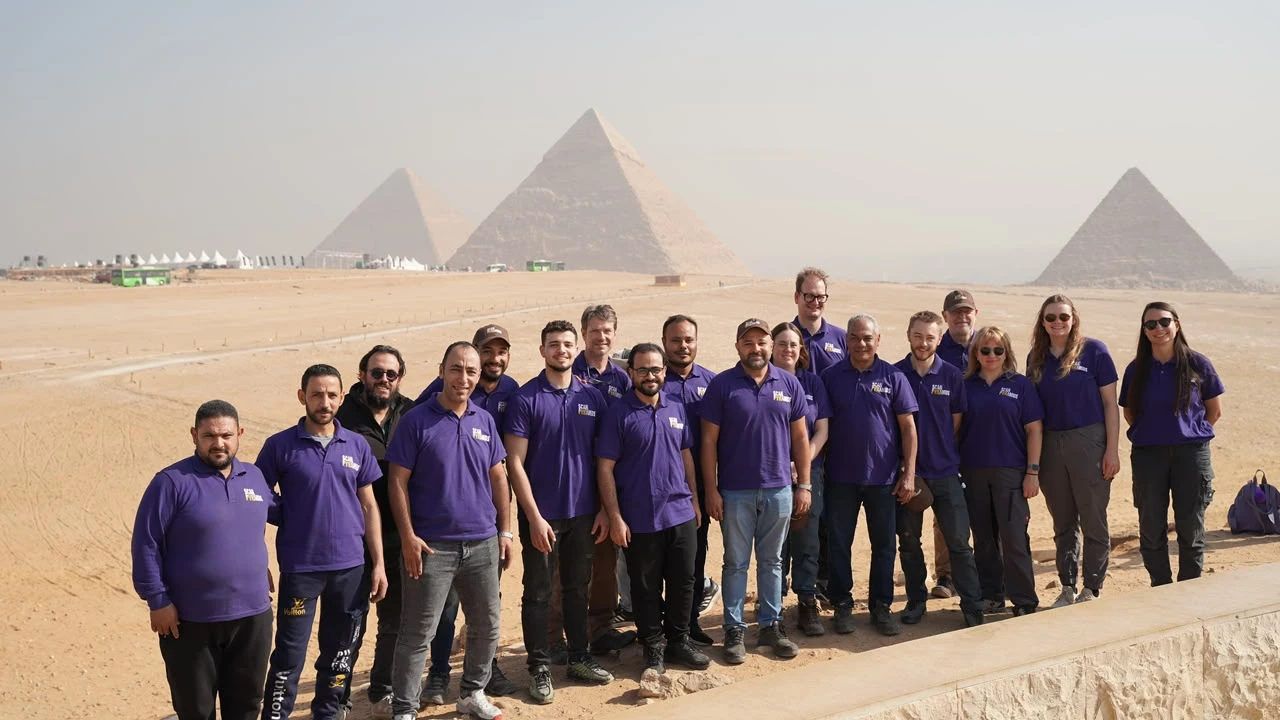
The ScanPyramids project entered a new phase of research inside the Pyramid of Khufu at Giza this week.1
The project uses advanced acoustic imaging to study a large void discovered above the Grand Gallery.1
The cavity is known as the Big Void.1
The Big Void was first detected in 2017.1
The latest research aims to determine more precisely the Big Void’s location, dimensions and spatial extent.1
Mohamed Mohy Elkarmoty, an associate professor at Cairo University’s Faculty of Engineering and deputy coordinator of the ScanPyramids mission, told Arab News that the project sought to identify cavities or voids within the Great Pyramid and other Giza pyramids.1
A history of discovery
In 2017 three research teams — two from Japan and one from France, detected a cavity inside the Great Pyramid of Khufu using cosmic-ray muon radiography, a non-destructive imaging technique that uses subatomic particles from space to detect differences in density inside an object.1
In 2023 the project announced the discovery of a hidden corridor behind a gabled structure on the northern face of the Pyramid of Khufu, a few meters above the pyramid’s main entrance.1
The corridor was initially detected using cosmic-ray muon radiography.1
Researchers used ground-penetrating radar, ultrasound tomography and image-fusion analysis to confirm the corridor’s presence.1
The corridor is about 9 meters long, with a cross-section measuring 2.10 by 2.30 meters and a chevron-shaped ceiling similar to that of the Queen’s Chamber.1
Researchers accessed the corridor using an 8 mm diameter endoscope inserted through gaps between the stone blocks.1
The images captured were the first ever taken of the corridor, which had remained hidden for about 4,500 years.1
New technology
The latest work is conducted with the Technical University of Munich.1
The latest work aims to independently confirm the void’s existence using acoustic imaging.1
Mohamed Mohy Elkarmoty said the Big Void is located about 20 meters above the Grand Gallery and is estimated to be between 30 and 40 meters long.1
Sources
Every number in the story points here. Each links to the original reporting.
LocalArab News
See a sentence its source doesn’t back up?
Tell us the source number and what’s wrong. We check every report. If we change the story, the fix goes on the corrections page with the old wording.