Read the original on CelebYachts →
This report is from CelebYachts, which tracks the superyachts of public figures.1
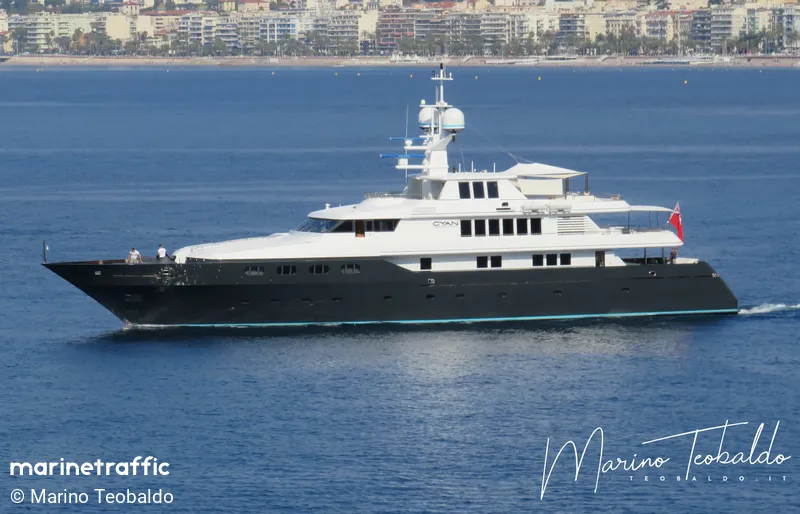
Cyan measures forty-eight point seven metres and displaces enough steel to anchor her in shallow bays rather than open seas. Her AIS broadcast over the last six weeks shows a vessel that never leaves the Greek coast, proving that hull geometry dictates itinerary more than owner preference.1
The hull designated Cyan presents a specific hydrodynamic profile that restricts her operating radius to sheltered coastal waters. Built by Codecasa in 1997, she measures forty-eight point seven metres in length with a beam of ten metres. The resulting beam-to-length ratio of nearly one-to-five maximises interior volume but severely penalises top speed. A displacement hull of this proportion cannot plane efficiently; it must push water aside rather than ride over it. The recorded maximum speed of fifteen knots confirms this physical limit. She is engineered for stability and shallow-water access, not for blue-water transit.1
Her ownership structure reflects a different set of priorities. The vessel is registered to Paul David Hewson, known publicly as Bono, an Irish musician and activist born in Dublin in 1960. His wealth derives from decades of global touring, album sales, and managing equity through Elevation Partners. The yacht carries an estimated market value of $11,500,000. While her home port is listed as London and her flag is United Kingdom, these administrative details do not match her actual movements. The AIS data places her exclusively within Greek territorial waters during the last tracking window. The layout of the decks remains unpublished; the specification table lists gross tonnage but omits cabin configuration.1
The hull form and the speed cap
The engineering constraints of a 1990s luxury cruiser become obvious when comparing her dimensions to modern super-yachts. Modern vessels often exceed sixty metres while maintaining beams below fourteen metres, achieving higher speeds through finer hull lines. Cyan retains a fuller bow and a wider waterline, characteristics that prioritise passenger comfort and deck space over velocity. The gross tonnage of 584 tonnes sits comfortably within the capacity of a ten-metre beam, allowing for spacious interiors without demanding excessive propulsion power.1
Codecasa, founded in Viareggio in 1825 by Giovanni Battista Codecasa, has always specialised in custom builds between thirty and ninety metres. The yard operates out of a dock covering more than 6,500 square metres, handling both new construction and refitting. Cyan fits squarely into the lower end of their production range, a size that balances manageable crew requirements with substantial guest accommodation. The decision to retain a ten-metre beam on a forty-eight-metre hull reflects a design philosophy that favours roominess over hydrodynamic refinement. A vessel of this vintage relies on traditional displacement theory rather than active stabilisation systems or hybrid propulsion. The beam itself acts as a passive stabiliser, reducing roll in moderate seas and allowing the yacht to hold position at anchor without constant thruster adjustment.1
Pushing a hull of this displacement beyond twelve knots requires exponential increases in engine output due to wave-making resistance. The AIS records show she rarely exceeds thirteen knots during sustained runs. On 28 July 2026, she departed Vouliagmeni in Attica bound for Isthmia in the Peloponnese. The passage covered 37 nautical miles in four hours and twelve minutes, yielding an average speed of 12.5 knots and a peak of 13.3 knots. This route crosses the Saronic Gulf and enters the Corinth Canal system, a man-made shortcut that bypasses the lengthy Cape Matapan route around the southern tip of the Peloponnese. Taking the canal saves roughly 80 nautical miles and several hours of transit time. For a vessel capped at fifteen knots, avoiding the open Aegean approach to the canal entrance minimises exposure to choppy swell and reduces fuel consumption.1
The next leg followed immediately. On 29 July, she left Nafpaktos in Western Greece and headed for Argostoli on Kefalonia. This crossing spans 58 nautical miles across the Gulf of Corinth. She completed it in four hours and fifty-three minutes, averaging 13.7 knots with a maximum of 15 knots. This represents the fastest sustained run logged in the archive. Even at this pace, she remains well below the theoretical top speed of a comparable modern motor yacht, which would typically cruise at eighteen to twenty knots. The difference is purely a function of hull form and construction era. The AIS signal maintained 80% coverage throughout this leg, indicating clear line-of-sight transmission across the relatively narrow gulf.1
The August track
The vessel’s itinerary throughout August reinforces the coastal strategy. Between 6 August and 8 August, she executed three separate passages, none exceeding 31 nautical miles. On 6 August, she travelled from Corfu to Gaios on Paxos, covering 37 nautical miles at an average of 9.1 knots. Two days later, she moved from Parga in Epirus to Lefkada, a 31 nautical mile run averaging 7.6 knots. The final tracked movement occurred on 8 August, taking her from Vrachneika in Achaea to Vathy on Ithaca, a distance of 23 nautical miles completed at 9.3 knots.1
These figures reveal a deliberate routing pattern. Cyan avoids open sea crossings. The Ionian archipelago provides a chain of protected harbours and narrow channels that shield larger vessels from swell. Her beam allows her to anchor in shallow coves that deeper-draft yachts must bypass. The average speed across all five tracked passages in late July and early August sits at 10.8 knots, with a median of 9.1 knots. She spends more time manoeuvring in confined waters than transiting between distant ports. The lower coverage percentages on the shorter hops—49% for the Corfu to Gaios run and 56% for the final Vrachneika to Vathy transfer—correspond directly to the mountainous terrain surrounding the Ionian islands, which fragments terrestrial AIS reception.1
The operational reality of Cyan is defined by her physical limitations and the geography she chooses to navigate. A forty-eight-metre hull with a ten-metre beam does not cross oceans; it navigates gulfs and straits. The data shows a vessel that treats the Greek coastline as a series of connected rooms rather than a barrier to be crossed. Her last recorded position holds her stationary at 39.65° N, 19.85° E in the Ionian Sea. The track ends there, consistent with a months-long stay in a single harbour. The hull was built for exactly this environment, and the AIS data proves she still uses it that way.1
Read this on celebyachts.com, where the figures are checked against the live register.1