The speculative hull and the automated rig

This report is from CelebYachts, which tracks the superyachts of public figures.1
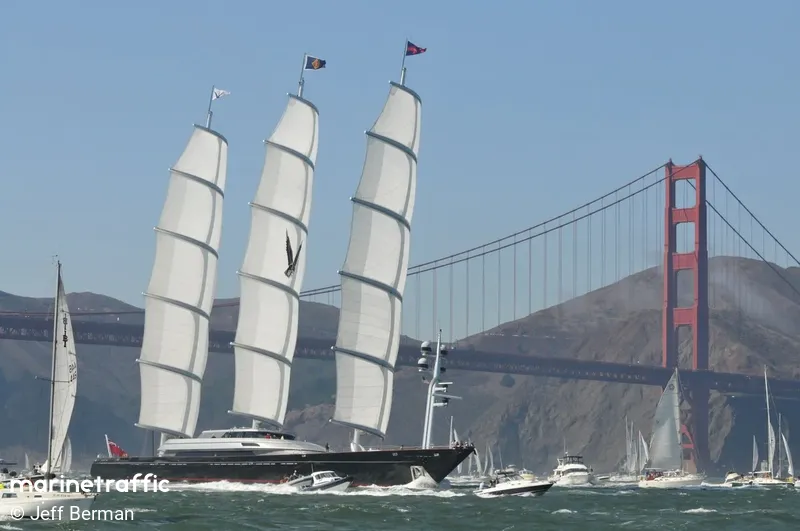
The Maltese Falcon was never designed to compete with conventional superyachts on resale value or traditional seamanship. Built on a speculative shell that sat unfinished in Turkey until 2001, the vessel demonstrates how a rigid square-rig technology, manufactured by a British specialist rather than the shipyard, forces a complete redesign of the bridge controls, the load paths, and the operational crew requirements.1
The Maltese Falcon measures 87.35 metres in length and displaces 1100 gross tonnes. She carries a beam of 12.46 metres and flies the Maltese flag from her home port of Valletta. These figures describe a vessel that looks like a sailing yacht but functions as an industrial testbed. The hull was constructed on speculation by Perini Navi between 1989 and 1990 at its newly acquired shipyard in Tuzla, Istanbul. The yard completed the bare shell and launched it, but the collapse of the market following the Gulf War left the project stranded. For sixteen years the unfinished vessel remained in Turkish waters, carrying no registered owner and generating no revenue. The engineering risk was entirely absorbed by the builder, who held the asset until Tom Perkins, a keen yachtsman and owner of the Andromeda La Dea Perini ketches, identified the hull in 2001.1
The speculative hull
Perkins hired Dutch designers at Dykstra Naval Architects to examine nineteenth-century clippers and propose a three-mast square rig. He selected the DynaRig concept, a 1960s invention by German hydraulics engineer Wilhelm Prölss that was originally intended to operate cargo ships with fuel-saving efficiency and minimal crews. The project was signed into production in Tuzla, but the critical components were not delivered by the shipyard. The three self-standing rotating carbon-fibre masts were manufactured and fitted at the Perini Navi premises under the direct responsibility of Perkins and the supervision of Insensys, Ltd, a British carbon-fibre specialist. Ken Freivokh designed the interior decoration, and Perini Navi handled the final fitting out. The vessel was completed in 2006.1
The financial scale of the project remains difficult to pin down. On 4 November 2007, Perkins suggested the yacht cost more than $150 million but less than $300 million, refusing to provide a precise figure. The vessel was still listed for sale in 2009 by Camper & Nicholsons with an asking price of €115 million, while reports indicated it had already been sold by Burgess for €70 million. By that point, the yacht had logged 1899 hours on her engines. She dropped her British Virgin Islands flag in 2008 and was purchased by Pleon Ltd, which converted the asset for charter use. The current owner, Luca Rovati, is an Italian businessman and former pharmaceutical Executive who directed investment activities through the family office Fidim after the 2014 sale of the family company Rottapharm. He serves as a University Lecturer and holds Board positions at Pirelli & C. SpA and Camfin. The yacht now operates primarily as a charter vessel, registered in Malta.1
The carbon spars and the bridge
The DynaRig system imposes severe constraints on the deck layout and the bridge architecture. Each of the three masts stands approximately 57 metres above the bottom bearing and rotates freely about deck and keel bearings. The masts feature symmetrical elliptical sections to maintain aerodynamic efficiency regardless of wind direction. Unlike conventional square riggers, each mast supports six rigid yards with a built-in camber of 12%. The fifteen square sails are set between the yards so that, when deployed, they form a continuous airfoil with no gaps. The furling sails are stored inside the mast and can be deployed along tracks on the yards in six minutes. Because there is no standing rigging, the masts and yards rotate without restriction for all points of sail, enabling the vessel to function as an upwind clipper.1
The structural loads are managed through a monitoring system integrated directly into the spars. Damon Roberts of Insensys, Ltd oversaw the design, testing, and manufacturing of the rig over a three-year period. Exhaustive finite element analysis and carbon-fibre testing ensured the assembly could sustain the loads under sail. Insensys incorporated a fibre-optic strain monitoring system into the structure. A fibre Bragg grating system was embedded during the wet layup of the carbon-fibre material. The sensors transmit real-time load data to the bridge monitors, allowing the crew to track stress levels across the entire rig. The yacht’s sophisticated computer detects parameters such as wind speed automatically and displays the key data. An operator must always activate the controls, yet the system is designed so that a single person can operate the yacht. In a December 2007 radio interview for the BBC World Service’s Global Business programme, Perkins stated that he personally wrote some of the unique control software.1
The charter reality
Her recent movements confirm a pattern of low-speed transit through the Aegean Sea. AIS broadcasts place her near Rhodes, Kos, Patmos, Astypalaia, Santorini, and Naxos throughout August 2026. A passage from Astypalaia to Patmos covered 49.4 nautical miles at an average speed of 11.7 knots, while a shorter run between Santorini and Naxos averaged 8.8 knots over 28.6 nautical miles. The vessel maintains a maximum recorded speed of 13.2 knots during local manoeuvres. She sits at anchor off the coast of Kos at coordinates 37.3° N, 26.57° E. The slow cruising speeds and frequent stops reflect the operational profile of a charter yacht rather than a racing machine, despite the awards she collected earlier in her life. She won the Best Sailing Yacht award from Boat International in 2007, took the Showboats international Award for best sailing yacht over 40 metres that same year, and secured the Perini Navi Cup regattas on two occasions as well as the Palma Superyacht Cup in 2010.1
The vessel’s history includes minor incidents that underscore her unconventional nature. On 4 October 2008, she collided with a 40 ft sloop while sailing on the San Francisco Bay during the Leukemia Cup. The collision occurred shortly after her acquisition by Pleon Ltd and highlighted the challenges of handling a full-rigged ship in crowded harbours. Perini Navi, the original builder, pioneered automation and furling systems in large sailing yachts since its founding in 1983 by Fabio Perini. The yard eventually went bankrupt in 2021 and was bought by The Italian Sea Group for €80 million at auction. The Maltese Falcon remains one of the world’s largest sailing yachts, operating independently of the commercial pressures that typically dictate superyacht development cycles.1
Read this on celebyachts.com, where the figures are checked against the live register.1
Sources
Every number in the story points here. Each links to the original reporting.
Not ratedCelebYachts
See a sentence its source doesn’t back up?
Tell us the source number and what’s wrong. We check every report. If we change the story, the fix goes on the corrections page with the old wording.