

Donald Trump
President of the United States (2017–2021; since 2025)
Donald John Trump (born June 14, 1946) is an American politician, media personality, and businessman who is the 47th president of the United States. A member of the Republican Party, he served as the 45th president from 2017 to 2021.2
From Wikipedia’s article on Donald Trump (this version), CC BY-SA 4.0.
Born Jun 14, 1946.1
Net worth $2.5B (as of Mar 26, 2022, per forbes.com).68 Richest people
About
Born into a wealthy New York City family, Trump graduated from the University of Pennsylvania in 1968 with a bachelor's degree in economics. He became the president of his family's real estate business in 1971, renamed it the Trump Organization, and began acquiring and building skyscrapers, hotels, casinos, and golf courses. He launched side ventures, many licensing the Trump name, and filed for six business bankruptcies in the 1990s and 2000s. From 2004 to 2015, he hosted the reality television show The Apprentice, bolstering his reputation as a wealthy tycoon. Presenting himself as a political outsider, Trump won the 2016 presidential election against Democratic Party nominee Hillary Clinton.
During his first presidency, Trump imposed a travel ban on seven Muslim-majority countries, expanded the Mexico–United States border wall, and enforced a family separation policy on the border. He rolled back environmental and business regulations, signed the Tax Cuts and Jobs Act, and appointed three Supreme Court justices. He withdrew the U.S. from agreements on climate and trade and started a trade war with China. In response to the COVID-19 pandemic in 2020, he downplayed its severity, contradicted health officials, and signed the bipartisan CARES Act. After losing the 2020 presidential election to Joe Biden, Trump refused to concede defeat and attempted to overturn the result, resulting in the January 6 Capitol attack in 2021. He was impeached twice—in 2019 for abuse of power and obstruction of Congress and in 2021 for incitement of insurrection—and acquitted by the Senate both times.
In 2023, Trump was found liable in New York state civil cases for sexual abuse and defamation and for business fraud. In May 2024, he was found guilty in a New York state court on 34 counts of falsifying business records, making him the first U.S. president convicted of a felony. After winning the 2024 presidential election against Vice President Kamala Harris, he was given a no-penalty sentence, and two federal felony indictments for retention of classified documents and obstruction of the 2020 election were dismissed without prejudice.
Trump began his second presidency by initiating mass layoffs of federal workers. He imposed tariffs on nearly all countries at the highest level since the Great Depression and signed the One Big Beautiful Bill Act. His administration's actions—including the targeting of political opponents and civil society, restriction of transgender rights, mass deportation of undocumented immigrants, and extensive use of executive orders—have drawn over 550 lawsuits challenging their legality. In Latin America, he pursued a campaign to attack alleged drug traffickers and ordered a military raid into Venezuela to capture the country's president. In the Middle East, he authorized joint U.S.–Israeli strikes on Iran that began the 2026 Iran war.
From Wikipedia’s article on Donald Trump, shared under CC BY-SA 4.0.2
Companies
Early life and education
- 1959 to 1964New York Military Academy3
- 1964The Kew-Forest School3
- 1964 to 1966Fordham University3
- 1966 to 1968The Wharton School Bachelor of Science; economics3
- Date not recordedUniversity of Pennsylvania3
Donald John Trump was born on June 14, 1946, at Jamaica Hospital in the New York City borough of Queens, the fourth child of Fred Trump and Mary Anne MacLeod Trump. He is of German and Scottish descent. He grew up with his older siblings, Maryanne, Fred Jr, and Elizabeth, and his younger brother, Robert, in a 23-room mansion in the Jamaica Estates neighborhood of Queens.
As favorite son, Donald competed with his taskmaster father yet considered him to be his best friend. Fred passed along to Donald his work ethic and the axiom to bring in projects "on time and under budget". He told him repeatedly to be "a killer" and that he was "a king". Although Trump never chose to acknowledge his debt, he would rely on his father's business sense and financial backing for years to come. To sidestep taxes, Fred paid his children each about $20,000 a year, equivalent to $265,000 a year in 2024. Trump was a millionaire in inflation-adjusted dollars by age eight.
Trump attended the private Kew-Forest School through seventh grade. His father enrolled him in the New York Military Academy, a private boarding school, from eighth to twelfth grade. The academy pushed students into sports and taught the imperative of winning.
Trump considered attending film school in California but, to be closer to home, enrolled at Fordham University in 1964. He participated in the Reserve Officers' Training Corps during his first year, attending classes in a military uniform every Wednesday, but dropped it in his second year. In his junior year, he transferred to the Wharton School of the University of Pennsylvania, most often commuting to his father's office on weekends, and graduated in May 1968 with a Bachelor of Science in economics. Contrary to his statements that he was top of his class with the highest grades possible, Wharton's published academic honors and dean's list do not include his name. By the time he went to Wharton, he was considering a career in real estate. He was exempted from the draft during the Vietnam War due to a claim of bone spurs in his heels.
Read more
Trump University
In 2005, Trump cofounded Trump University, a company that sold real estate seminars for up to $35,000. After New York State authorities notified the company that its use of "university" violated state law because it was not an academic institution, its name was changed to the Trump Entrepreneur Initiative in 2010. In 2013, the State of New York filed a $40 million civil suit against Trump University, alleging that the company made false statements and defrauded consumers. Additionally, two class actions were filed in federal court against him and his companies. Internal documents revealed that employees were instructed to use a hard-sell approach, and former employees testified that Trump University had defrauded or lied to its students. Shortly after winning the 2016 presidential election, he agreed to pay a total of $25 million to settle the three cases.
From Wikipedia’s article on Donald Trump (this version), CC BY-SA 4.0.
Career
Occupation: game show host, real estate entrepreneur, film producer, writer, merchant, entrepreneur, actor, businessperson.32 33
- Since 2026Chair, Board of Peace31
- Since 2025President of the United States23
- 2024 to 2025President-elect of the United States23
- 2017 to 2021President of the United States23 26
- 2016 to 2017President-elect of the United States23
- 1971 to 2017President, The Trump Organization23
- Since 1971Chief executive officer, The Trump Organization23 24
- Since 1968Worked at The Trump Organization4
- Date not recordedFounded 1776 Commission5
- Date not recordedFounded Truth Social6
- Date not recordedFounded Trump Media & Technology Group7
- Date not recordedFounded World Liberty Financial8
More of their career (19)
- Date not recordedFounded Department of Government Efficiency9
- Date not recordedFounded White House Task Force on Celebrating America's 250th Birthday10
- Date not recordedFounded MAHA Commission11
- Date not recordedFounded Board of Peace12
- Date not recordedFounded Genesis Mission13
- Date not recordedFounded Trump Entertainment Resorts14
- Date not recordedFounded Donald J. Trump Foundation15
- Date not recordedFounded Trump Home16
- Date not recordedFounded American Manufacturing Council17
- Date not recordedFounded National Emergency Concerning the Southern Border of the United States18
- Date not recordedFounded Trump University19
- Date not recordedFounded Trump Mortgage20
- Date not recordedFounded Trump Winery21
- Date not recordedFounded Trump Model Management22
- Date not recordedDirector23 25
- Date not recordedChair, TD Trump Deutschland27
- Date not recordedChair, The Trump Organization28
- Date not recordedChair, Donald J. Trump Foundation29
- Date not recordedChair, first cabinet of Donald Trump30
Known for: Trump: The Art of the Deal, The Apprentice, Crippled America.26 34
Business career
Real estate
Starting in 1968, Trump was employed at Trump Management, his father's real estate company, which oversaw more than fourteen thousand middle-class apartments in complexes Fred had built in Queens, Staten Island, and Brooklyn. For about five years, he managed apartments, made repairs, and collected rent. Trump asked his father to expand to Manhattan, where prices were higher, but his father was content in the outer boroughs. In 1971, he moved to Manhattan, where he planned to relocate the business and commuted to his father's office. That year, his father made himself chairman and Trump president. Trump began using the Trump Organization as an umbrella for the corporate names of his father's businesses.
Roy Cohn, Trump's most important early influence after his father, was his fixer, lawyer, and mentor for 13 years in the 1970s and 1980s. Cohn taught Trump that life is transactional, that popular opinion is more important than a court of law, that fabrication can drown out facts, to leave no paper trail, and to evade paying bills and taxes. Trump showed a propensity for litigation, no matter the outcome and cost; even when he lost, he described the case as a win.In 1973, Cohn helped Trump countersue the U.S. government for $100 million (equivalent to $725 million in 2025) over its charges that Trump's properties had discriminated against Black applicants and tenants. The case was settled in a consent decree agreeing to desegregate, which the Trumps ended up in court four years later for violating. Cohn was a consigliere and intermediary with whom Trump continued his father's connection to the New York Mafia, benefiting from its control of the building trade unions.
Between 1991 and 2009, Trump filed for Chapter 11 bankruptcy protection for six of his businesses: the Plaza Hotel in Manhattan, the casinos in Atlantic City, New Jersey, and the Trump Hotels & Casino Resorts company.
In 1992 and 1994, Trump, working with several relatives, formed a shell company for paying the vendors providing services and supplies for Trump's rental units, then billing those services and supplies to Trump Management with significant markups; the increased costs were used to get state approval for increasing the rents of his rent-stabilized units. Besides inflating rents, the schemes served to transfer assets from Fred to his children and nephew and lower their tax burden.
Read more
Manhattan and Chicago developments
Trump gained public attention in 1978 with the launch of his family's first Manhattan venture: the renovation of the derelict Commodore Hotel, adjacent to Grand Central Terminal. Lacking the wherewithal to finance the venture, Trump was able to call on his father and Hyatt to guarantee the $70 million construction loan. With Cohn's help and their political connections, he received a 40-year tax break—which is still, as of 2016, New York City's longest tax abatement—a prize worth over $410 million. The hotel reopened in 1980 as the Grand Hyatt Hotel.
That same year, he obtained rights to develop Trump Tower, a mixed-use skyscraper in Midtown Manhattan. The building houses the headquarters of the Trump Corporation and Trump's political action committee (PAC) and was his primary residence until 2019. Cohn obtained the zoning and building permits, brought in his mob partners to pour concrete, and sold apartments, creating a market for luxury Trump spaces. He delivered oral arguments to appellate court, securing a $20 million tax abatement.
In 1988, Trump acquired the Plaza Hotel with a loan from a consortium of 16 banks. The hotel filed for bankruptcy protection in 1992, and a reorganization plan was approved a month later, with the banks taking control of the property.
In 1995, Trump defaulted on over $3 billion of bank loans, and the lenders seized the Plaza Hotel along with most of his other properties in a "vast and humiliating restructuring" that allowed him to avoid personal bankruptcy. Trump's last major construction project was the 92-story mixed-use Trump International Hotel and Tower in Chicago, which opened in 2008. In 2024, The New York Times and ProPublica reported that the Internal Revenue Service was investigating whether he had twice written off losses incurred through construction cost overruns and lagging sales of residential units in the building he had declared to be worthless on his 2008 tax return.
Atlantic City casinos
In 1984, Trump opened Harrah's at Trump Plaza, a hotel and casino, with financing and management help from the Holiday Corporation. It was unprofitable, and he paid Holiday $70 million in May 1986 to take sole control. In 1985, he bought the unopened Atlantic City Hilton Hotel and renamed it Trump's Castle. Both casinos filed for Chapter 11 bankruptcy protection in 1992. Trump bought a third Atlantic City venue in 1988, the Trump Taj Mahal. It was financed with $675 million in junk bonds and completed for $1.1 billion, opening in April 1990. He filed for Chapter 11 bankruptcy protection in 1991. Under the provisions of the restructuring agreement, Trump gave up half his initial stake and personally guaranteed future performance. To reduce his $900 million of personal debt, he sold the Trump Shuttle airline; his megayacht, the Trump Princess, which had been leased to his casinos and kept docked; and other businesses. In 1995, Trump founded Trump Hotels & Casino Resorts (THCR), which assumed ownership of the Trump Plaza. THCR purchased the Taj Mahal and the Trump Castle in 1996 and went bankrupt in 2004 and 2009, leaving him with 10 percent ownership. He remained chairman until 2009.
Golf clubs
In 1985, Trump acquired the Mar-a-Lago estate in Palm Beach, Florida. In 1995, he converted the estate into a private club with an initiation fee and annual dues. Trump continued to use a wing of the house as a private residence. He declared the club his primary residence in 2019. Trump began building and buying golf courses in 1999, owning 17 golf courses globally by 2016.
Licensing the Trump name
The Trump Organization often licensed the Trump name for consumer products and services, including foodstuffs, apparel, learning courses, and home furnishings. Over 50 licensing or management deals involved his name, generating at least $59 million for his companies. By 2018, only two consumer goods companies continued to license Trump's name. During the 2000s, he licensed his name to real estate developments. Forty of the projects he announced were not completed.
Side ventures
In 1970, Trump invested $70,000 of his father's wealth to receive billing as coproducer of a Broadway comedy—and lost the money. After making low-ball bids for the New York Mets and the Cleveland Indians baseball teams, in 1983 for about $6 million, he purchased the New Jersey Generals, a team in the United States Football League. The league folded after the 1985 season, largely due to his attempt to move to a fall schedule (when it would have competed with the National Football League for audience) and his attempt to force a merger with the NFL by bringing an antitrust suit. In 1989 and 1990, he lent his name to the Tour de Trump cycling stage race, an attempt to create an American equivalent of European races such as the Tour de France or the Giro d'Italia.
From 1986 to 1988, he purchased significant blocks of shares in various public companies while suggesting that he intended to take over the company and then sold his shares for a profit, leading some observers to think he was engaged in greenmail. The New York Times found that he initially made millions of dollars in such stock transactions but "lost most, if not all, of those gains after investors stopped taking his takeover talk seriously".
In 1988, Trump purchased the Eastern Air Lines Shuttle, financing the purchase with $380 million (equivalent to $1.03 billion in 2025) in loans from a syndicate of 22 banks. He renamed the airline Trump Shuttle and operated it until 1992. He defaulted on his loans in 1991, and ownership passed to the banks. In 1996, he purchased the Miss Universe pageants, including Miss USA and Miss Teen USA. Due to disagreements with CBS about scheduling, he took both pageants to NBC in 2002. In 2007, he received a star on the Hollywood Walk of Fame for his work as producer of Miss Universe. NBC and Univision dropped the pageants in June 2015 in reaction to his comments about Mexican immigrants.
Media career
Trump has published 19 books under his name, most written or cowritten by ghostwriters. His first book, the 1987 Art of the Deal, was ghostwritten by Tony Schwartz, who is credited as coauthor. It was a New York Times Best Seller and made Trump a celebrity beyond New York as a rich and successful entrepreneur. Trump had cameos in many films and television shows from 1985 to 2001. Trump acquired his style of politics from professional wrestling. From the late 1980s, he sporadically played himself as a super-rich boss at events staged by professional wrestling promotion WWE, including WrestleMania 23 in 2007. and being inducted into the WWE Hall of Fame in 2013. Starting in the 1990s, Trump appeared 24 times as a guest on the nationally syndicated Howard Stern Show. He had his own short-form talk radio program, Trumped!, from 2004 to 2008. From 2011 until 2015, he was a guest commentator on Fox & Friends. In 2021, Trump, who had been a member since 1989, resigned from SAG-AFTRA to avoid a disciplinary hearing regarding the January 6 attack; two days later, the union permanently barred him.
Producer Mark Burnett made Trump a television star when he created the reality show The Apprentice, which Trump hosted from 2004 to 2015 (including variant The Celebrity Apprentice). On the shows, he was a superrich chief executive who eliminated contestants with the catchphrase "you're fired". The New York Times called his portrayal "a highly flattering, highly fictionalized version" of himself. The shows remade Trump's image for millions of viewers nationwide. He made more than $400 million from the shows and related licensing agreements.
From Wikipedia’s article on Donald Trump (this version), CC BY-SA 4.0.
Personal life
- BornJun 14, 1946, New York City35
- CitizenshipUnited States36 37
- ResidenceQueens, Trump Tower, New York, Manhattan, Mar-a-Lago, Jamaica Estates, Palm Beach, White House38
- SpousesIvana Trump 1977 to 199039 40; Marla Maples 1993 to 199939 41; Melania Trump married 200539 42
- Children526 43
Relationship with news media
In the 2016 campaign, Trump benefited from a record amount of free media coverage, estimated at $2 billion. As a candidate and as president, he frequently accused the press of bias, calling it the "fake news media" and "the enemy of the people".
The first Trump presidency reduced formal press briefings from about one hundred in 2017 to two by 2019 and revoked the press passes of two White House reporters, which were restored by the courts. By 2024, Trump repeatedly voiced support for outlawing political dissent and criticism, and said that reporters should be prosecuted for not divulging confidential sources and media companies should possibly lose their broadcast licenses for unfavorable coverage of him.
In his second term, Trump's actions against the media were unprecedented in modern American history, and historians described them as mirroring actions by authoritarian leaders to censor political opponents and negatively impacting the freedom of speech and free press. The campaign to police speech drew comparisons to cancel culture, government censorship, and McCarthyism. The Federal Communications Commission launched investigations into media outlets accused of bias against him. As a result of Trump's threats, media executives instructed journalists and their staff to self-censor and reduce criticism of Trump. Many have characterized Trump as causing a significant decline in freedom of the press, including journalist advocacy groups and academic sources.
Read more
Family
In 1977, Trump married Ivana Zelníčková. They had three children: Donald Jr. (b. 1977), Ivanka (b. 1981), and Eric (b. 1984). Ivana played a crucial role in generating the "fawning press coverage" that shaped Trump's public image as a real estate mogul. The couple divorced in 1990, following his affair with model and actress Marla Maples. He and Maples married in 1993 and had one daughter, Tiffany (b. 1993), whom Maples raised in California. They divorced in 1999. In 2005, he married Slovenian model Melania Knauss. Their son Barron was born in 2006.
Relationship with Jeffrey Epstein
Trump had a 15-year friendship with Jeffrey Epstein. Persons who knew them at the time said they frequently "hit on" and competed for women. Media attention and public pressure mounted in 2025, when his administration did not release files relating to Epstein, despite Trump's promise to do so during the 2024 campaign. Some of the files were released in December 2025, mostly heavily redacted. Roughly three million additional pages released in 2026 included approximately 38,000 references to Trump, his wife, Mar-a-Lago, and other Trump-related terms. References to Trump included "salacious information" and uncorroborated statements about him from witnesses in transcripts made since the early 2000s.
Wealth
Trump has said he began his career with "a small loan of a million dollars" from his father and that he had to pay it back with interest. He borrowed at least $60 million from his father, did not repay many of the loans, and received $413 million (2018 equivalent, adjusted for inflation) from his father's real estate company. Posing as a Trump Organization official named "John Barron", Trump called journalist Jonathan Greenberg in 1984, trying to get a higher ranking on the Forbes 400 list of wealthiest Americans.Trump self-reported his net worth over a wide range, from minus $900 million in 1990, to $10 billion in 2015. After his business bankruptcies in the 1990s, his lenders forgave more than 80% of his personal debt and allowed him to keep some of his real estate. In 2015, Forbes estimated his net worth at $4.5 billion, based on interviews with more than 80 sources. In 2026, the magazine set that number at $6.5 billion and ranked him the 645th wealthiest person in the world.
Based on the New York Times's reporting of Trump's financial disclosures during his presidential terms, the $594 million in revenue received by Trump's businesses in 2017 was generated mostly from his domestic golf and real estate portfolio. In 2025, the revenue had increased to $2.24 billion, with more than half derived from cryptocurrency and meme coins; the domestic golf and real estate portfolio's share was down to about a quarter of the total and had increased by a modest 4 percent since 2017, compared with the 18-fold increase in revenue from merchandise and publishing.
Health
Trump says he has never drunk alcohol, smoked cigarettes, or used drugs, and that he sleeps about four or five hours a night. He has called golfing his "primary form of exercise", but usually does not walk the course. He considers exercise a waste of energy, believing the body is "like a battery, with a finite amount of energy" which is depleted by exercise.
In 2015, his campaign released a letter from his longtime personal physician, Harold Bornstein, stating that he would "be the healthiest individual ever elected to the presidency". In 2018, Bornstein said Trump had dictated the contents of the letter and that three of Trump's agents had seized his medical records in a February 2017 raid on Bornstein's office. Beginning in 2025, Trump appeared to fall asleep during meetings, raising concerns over his stamina.
Religion
Trump said he was a Presbyterian and a Protestant in 2016. In 2020, he said he was a nondenominational Christian. In his first term, Trump appointed his personal pastor and spiritual advisor, televangelist Paula White-Cain, to the White House Office of Public Liaison. During his second term, he appointed her as senior advisor of the newly created White House Faith Office.
A survey during his first presidency showed that 63 percent of Americans did not believe that he was religious and that 44 percent believed he was a Christian. 70 percent of respondents to an April 2026 survey said that he was "not too religious" or "not at all religious". Some of Trump's comments on the Bible or Christian practice have led critical observers to suggest that his knowledge of Christianity is superficial or erroneous, and few biographers have described him as deeply or even particularly religious.
In April 2026, Trump posted an AI-generated image depicting him as Jesus Christ. The post was deleted following criticism. He later said he had believed the image portrayed him as a doctor.
From Wikipedia’s article on Donald Trump (this version), CC BY-SA 4.0.
Philanthropy
Foundation
The Donald J. Trump Foundation was a private foundation established in 1988. From 1987 to 2006, Trump gave his foundation $5.4 million, which had been spent by the end of 2006. After donating a total of $65,000 in 2007–2008, he stopped donating any personal funds to the charity, which received millions from other donors, including $5 million from Vince McMahon. The foundation gave to health and sports-related charities, conservative groups, and charities that held events at Trump properties. In 2016, The Washington Post reported that the charity had committed several potential legal and ethical violations, including self-dealing and tax evasion. Also in 2016, the New York attorney general stated the foundation had violated state law by soliciting donations without submitting to required annual external audits and ordered it to cease its fundraising activities in New York immediately. Trump said in December 2016 that the foundation would be dissolved but was prevented from doing so "amid concerns about the handling of the foundation's documents and assets".
In June 2018, the New York attorney general's office filed a civil suit against the foundation, Trump, and his adult children, seeking $2.8 million in restitution and additional penalties. In December 2018, the foundation ceased operation and disbursed its assets to other charities. In November 2019, a New York state judge ordered Trump to pay $2 million to a group of charities for misusing the foundation's funds, in part to finance his presidential campaign.
From Wikipedia’s article on Donald Trump (this version), CC BY-SA 4.0.
Politics
Early political aspirations
Trump registered as a Republican in Queens in 1969 and in Manhattan in 1987; a member of the Independence Party, the New York state affiliate of the Reform Party, in 1999; a Democrat in 2001; a Republican in 2009; unaffiliated in 2011; and a Republican in 2012.
In 1987, Trump placed full-page advertisements in major newspapers, expressing his views on foreign policy and how to eliminate the federal budget deficit. In 1988, he approached Lee Atwater, asking to be put on the ticket as Republican nominee George H. W. Bush's running mate. Bush found the request "strange and unbelievable". Trump was a candidate in the 2000 Reform Party presidential primaries for three months before he withdrew in February 2000. In 2011, Trump considered challenging President Barack Obama in the 2012 election. He spoke at the Conservative Political Action Conference in February and gave speeches in states with early primaries. In May 2011, he said that he would not run.
Targeting political opponents
During his second presidency, the Trump administration took a series of actions using the government to target political opponents and civil society. He threatened, signed executive actions, and ordered investigations into his political opponents, critics, and organizations aligned with the Democratic Party. He ended the post-Watergate norm of Justice Department (DOJ) independence, weaponizing it and agencies across the federal government to target his political enemies. Under pressure to bring charges against his opponents, prosecutors advanced weak cases that were rejected by grand juries and admonished by judges who accused them of misconduct, leading to an erosion of the DOJ's credibility. Trump's actions against civil society were described by hundreds of legal experts and political scientists as authoritarian, contributing to democratic backsliding, and negatively impacting the rule of law.
Read more
Rhetoric, behavior, and political practice
Starting with his advocacy of birther conspiracy theories in the 2010s, Trump helped bring once-fringe far-right ideas and organizations into the mainstream.
The alt-right movement coalesced around and supported his candidacy due in part to opposition to multiculturalism and immigration.
During his 2016 campaign, Trump's politics and rhetoric led to the formation of a political movement known as Trumpism, which has been compared to a cult of personality.
His political positions have been described as populist or right-wing populist, and favoring an expansion of presidential power under a maximalist interpretation of the unitary executive theory.
Many of his actions and rhetoric have been described as authoritarian and contributing to democratic backsliding, as well as establishing an "us versus them" narrative. Trump's rhetoric has been described as using fearmongering and demagogy which intensified during his 2024 presidential campaign. He appeals to evangelical Christians and Christian nationalists, and regularly calls his political opponents "evil".
Race and gender
Many of Trump's comments and actions have been characterized as racist. Several studies and surveys found that racist attitudes fueled Trump's political ascent and were more important than economic factors in determining the allegiance of Trump voters. He explicitly and routinely disparages racial, religious, and ethnic minorities, and scholars consistently find that racist and Islamophobic attitudes regarding Black people, immigrants, and Muslims are strong indicators of support for Trump.
Trump has been accused of racism for running full-page newspaper advertisements and insisting that a group of five Black and Latino teenagers were guilty of raping a white woman in the 1989 Central Park jogger case, even after they were cleared of suspicion in 2002. Trump's comments on the 2017 Unite the Right rally, condemning "this egregious display of hatred, bigotry, and violence on many sides" and stating that there were "very fine people on both sides", were criticized as implying a moral equivalence between the white supremacist demonstrators and the counter-protesters. In a January 2018 discussion of immigration legislation, he reportedly referred to El Salvador, Haiti, and African nations as "shithole countries", remarks widely condemned as racist. In July 2019, a House of Representatives resolution condemned Trump for racist remarks about four minority Democratic congresswomen. His 2024 campaign made extensive use of dehumanizing language and racial stereotypes.
In June 2020, during the George Floyd protests, federal law-enforcement officials used tear gas and other crowd control tactics to remove a largely peaceful crowd of lawful protesters from Lafayette Square, outside the White House. Trump then posed with a Bible for a photo op at the nearby St. John's Episcopal Church, with religious leaders condemning both the treatment of protesters and the photo opportunity itself.
Trump has a history of belittling women when speaking to the media and on social media. He made lewd comments, disparaged women's physical appearances, and referred to them using derogatory epithets. In October 2016, a 2005 "hot mic" recording surfaced in which he bragged about kissing and groping women without their consent, saying that, "when you're a star, they let you do it. You can do anything... Grab 'em by the pussy." He characterized the comments as "locker-room talk". After widespread public outrage, including among Republicans, Trump issued a video with a rare public apology and an attack on Clinton.
Link to violence and hate crimes
Trump has been identified as a key figure in increasing political violence in the U.S., both for and against him. He is described as embracing extremism, conspiracy theories such as QAnon, and far-right militia movements more than any other modern American president. He has repeatedly accused his political opponents of treason and called for their imprisonment or execution, leading to accusations of promoting violence.
Research suggests that Trump's rhetoric is associated with an increased incidence of hate crimes, and that he has an emboldening effect on expressing prejudicial attitudes due to his normalization of explicit racial rhetoric. Researchers have also argued that Trump's "negative characterisations of, and false claims made about, those who became the targets" of the mob at the January 6 riot was a case of stochastic terrorism. Numerous defendants investigated or prosecuted for violent acts and hate crimes cited his rhetoric in arguing that they were not culpable or deserved leniency. A nationwide review by ABC News in May 2020 identified at least 54 criminal cases, from August 2015 to April 2020, in which he was invoked in direct connection to violence or threats of violence against predominantly minorities, with the perpetrators involved being primarily white men. Trump's refusal to condemn the white supremacist Proud Boys during a 2020 presidential debate and his comment, "Proud Boys, stand back and stand by", were said to have led to increased recruitment for the pro-Trump group. Counterterrorism researchers described his normalization and revisionist history of the January 6 Capitol attack and grant of clemency to all January 6 rioters as encouraging future political violence.
False or misleading statements and conspiracy theories
Trump frequently makes false statements in public remarks, to an extent unprecedented in American politics. His false and misleading statements were documented by fact-checkers, including at The Washington Post, which tallied 30,573 false or misleading statements made by him during his first presidency, increasing in frequency over time. His falsehoods are a distinctive part of his political identity and have been described as firehosing.
During his second term, Trump relied on false, misleading, and exaggerated claims to justify his executive actions and policies. He continued to make untrue statements as frequently as before but with less variety while increasing the frequency of repeating a "core set" of falsehoods. Many of his false statements during his second term focus on claims relating to artificial intelligence, affordability, and taxes and tariffs.
Some of Trump's falsehoods were inconsequential, while others had more far-reaching effects, such as his unproven promotion of antimalarial drugs as a treatment for COVID-19, contributing to a U.S. shortage of these drugs and panic buying in Africa and South Asia. His attacks on mail-in ballots and other election practices weakened public faith in the integrity of the 2020 presidential election, while his disinformation about the COVID-19 pandemic delayed and weakened the national response to it. He habitually does not apologize for his falsehoods. Until 2018, the media rarely referred to his falsehoods as lies, including when he repeated demonstrably false statements.
Since before his first presidency, Trump has promoted conspiracy theories. In 2011, Trump became the leading proponent of the "birther" conspiracy theory that Obama was not born in the United States, and he claimed credit for pressuring the government to publish Obama's birth certificate, which he considered fraudulent. In September 2016, he publicly acknowledged Obama's birthplace and falsely claimed that the rumors had been started by Clinton during her 2008 presidential campaign. Trump often prefaced his conspiracies by claiming he heard them from someone else, and promoted conspiracies such as climate change denial, alleged Ukrainian interference in U.S. elections, and vaccines and autism. After the 2020 presidential election, he promoted conspiracy theories for his defeat that were characterized as "the big lie".
Social media
From 2009 until he was banned in January 2021, Trump posted on Twitter more than 57,000 times. After years of criticism for allowing Trump to post misinformation and falsehoods, Twitter began to tag some of his tweets with fact-checks in May 2020. He was banned from Facebook, Instagram, Twitter, and other platforms after the January 6 attack. The loss of his social media presence diminished his ability to shape events and correlated with a dramatic decrease in the volume of misinformation on Twitter. In February 2022, he launched social media platform Truth Social, where he attracted a fraction of his Twitter following. Twitter reinstated his account in November 2022. The two-year ban at Meta Platforms lapsed in January 2023, allowing him to return to Facebook and Instagram.
From Wikipedia’s article on Donald Trump (this version), CC BY-SA 4.0.
Legal issues and controversies
Legal affairs and bankruptcies
According to a review of state and federal court files conducted by USA Today in 2018, Trump and his businesses had been involved in more than 4,000 lawsuits, liens, and other filings, often filed for nonpayment against him by employees, contractors, real estate brokers, and his own attorneys. While Trump has not filed for personal bankruptcy, his over-leveraged hotel and casino businesses in Atlantic City and New York filed for Chapter 11 bankruptcy protection six times between 1991 and 2009. They continued to operate while the banks restructured debt and reduced his shares in the properties. During the 1980s, more than 70 banks had lent Trump $4 billion. After his corporate bankruptcies of the early 1990s, most major banks, with the exception of Deutsche Bank, declined to lend to him. After the January 6 Capitol attack, Deutsche Bank also decided not to do business with him or his affiliated company in the future.
Investigations
After he assumed office, Trump was the subject of increasing Justice Department and congressional scrutiny, with investigations covering his election campaign, transition, and inauguration, actions taken during his presidency, his private businesses, personal taxes, and his charitable foundation. There were ten federal criminal investigations, eight state and local investigations, and twelve congressional investigations.
In July 2016, the FBI launched Crossfire Hurricane, an investigation into possible links between Russia and Trump's 2016 campaign. After Trump fired Comey in May 2017, the FBI opened a second investigation into Trump's personal and business dealings with Russia. In January 2017, three U.S. intelligence agencies jointly stated with "high confidence" that Russia interfered in the 2016 presidential election to favor Trump. Crossfire Hurricane was later transferred to Robert Mueller's special counsel investigation; the investigation into Trump's ties to Russia was ended by Deputy Attorney General Rod Rosenstein after he told the FBI that Mueller would pursue the matter. At the request of Rosenstein, the Mueller investigation examined criminal matters "in connection with Russia's 2016 election interference". Mueller's final report in March 2019 found that Russia interfered in 2016 to favor Trump and that Trump and his campaign welcomed and encouraged the effort, but that the evidence "did not establish" that Trump campaign members conspired or coordinated with Russia. Trump falsely claimed the report exonerated him despite Mueller writing that it did not. The report also detailed potential obstruction of justice by Trump but "did not draw ultimate conclusions" and left the decision to charge the laws to Congress.
Read more
Legal issues
In 2022, New York filed a civil lawsuit against Trump accusing him of inflating the Trump Organization's value to gain an advantage with lenders and banks. He was found liable and ordered to pay nearly $355 million plus interest. In August 2025, the appeals court upheld his liability and nonmonetary penalties but voided the monetary penalty as excessive.
In connection with Trump's efforts to overturn the 2020 election and his involvement in the January 6 attack, in December 2022 the U.S. House committee on the attack recommended criminal charges against him for obstructing an official proceeding, inciting or assisting an insurrection, and conspiracy to defraud the United States. In August 2023, a grand jury in Fulton County, Georgia, indicted him on 13 charges, including racketeering, for his efforts to subvert the 2020 election in the state. The case was dismissed in November 2025 after the new prosecutor declined to pursue the charges.
In January 2022, the National Archives and Records Administration retrieved 15 boxes of documents Trump had taken to Mar-a-Lago after leaving the White House, some of which were classified. In the ensuing Justice Department investigation, officials retrieved more classified documents from his lawyers. On August 8, 2022, FBI agents searched Mar-a-Lago for illegally held documents, including those in breach of the Espionage Act, collecting 11 sets of classified documents, some marked top secret. A federal grand jury constituted by Special Counsel Jack Smith indicted Trump in June 2023 on 31 counts of "willfully retaining national defense information" under the Espionage Act, among other charges. Trump pleaded not guilty. In July 2024, judge Aileen Cannon dismissed the case, ruling Smith's appointment as special prosecutor was unconstitutional. After his reelection, the 2020 election obstruction case and the classified documents case were dismissed without prejudice (a legal term meaning charges could be refiled after the end of Trump's second term) due to Justice Department policy against prosecuting sitting presidents.
In May 2024, Trump was convicted on 34 felony counts of falsifying business records. The case stemmed from evidence that he booked Michael Cohen's hush-money payments to adult film actress Stormy Daniels as business expenses to cover up his alleged 2006–2007 affair with Daniels during the 2016 election. On January 10, 2025, Judge Juan Merchan gave Trump a no-penalty sentence, saying that punitive requirements would have interfered with presidential immunity.
Sexual misconduct allegations and E. Jean Carroll lawsuits
In 2019, journalist E. Jean Carroll accused Trump of raping her in the 1990s and sued him for defamation over his denial. Carroll sued him again in 2022 for battery and further defamation. He was found liable for sexual abuse and defamation and ordered to pay $5 million in one case and $83.3 million in the other. Federal appeals courts upheld both findings and awards in December 2024 and September 2025, respectively. The U.S. Supreme Court rejected Trump's appeal in the first case.
As of October 2024, since the 1970s, at least 28 women have accused Trump of various acts of sexual misconduct, including rape, sex with minors, sexual assault, physical abuse, kissing and groping without consent, looking under women's skirts, and walking in on naked pageant contestants.
From Wikipedia’s article on Donald Trump (this version), CC BY-SA 4.0.
Awards
- 2026Israel Prize44
- 2025FIFA Peace Prize44 66
- 2025Grand Order of Mugunghwa44
- 2025Order of Zayed44 64
- 2025Order of the Nile44 65
- 2025Time 10044 63
- 2024Time Person of the Year44 62
- 2021Order of Mohammed44 61
- 2021Time 10044
- 2020Ig Nobel Prize44 60
More awards (19)
- 2020Order of Freedom44 59
- 2020Time 10044 58
- 2019Doublespeak Award44 50
- 2019Time 10044 57
- 2018Time 10044 56
- 2017King Abdulaziz Medal44 55
- 2017Time 10044 54
- 2016Doublespeak Award44 50
- 2016Financial Times Person of the Year44 52
- 2016Time 10044 51
- 2016Time Person of the Year44 53
- 2013WWE Hall of Fame44
- 2012Presidential Order of Excellence44
- 2007star on Hollywood Walk of Fame44 49
- 1995Gaming Hall of Fame44 48
- 1991Golden Raspberry Award for Worst Supporting Actor - Razzie Award for Ghosts Can't Do It44 47
- 1986Ellis Island Medal of Honor44 46
- 1983Jewish National Fund Tree of Life Award44 45
- Date not recordedPresidential Medal of Distinction44
Net worth over time
Planes and yachts
A position is the aircraft’s or vessel’s, not the person’s. Being on board isn’t confirmed.
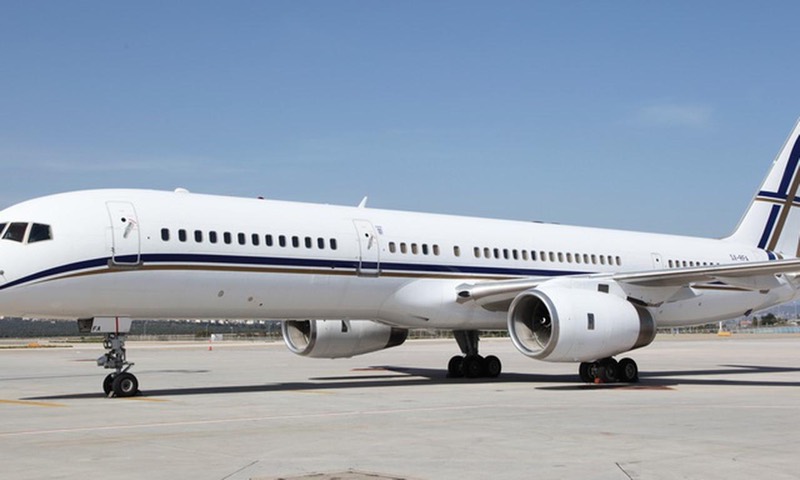
Flights, photos and icons: CelebPlanes, from ADS-B data (adsb.lol, ODbL; ADSB.fi). Maps: Esri.
Flight and yacht reports
- Donald Trump's Boeing 757 lands in Palm Beach after a Shannon turnaround
 CelebPlanes report On the record, Sep 14, 2026If aboard, the timing lines up with a quiet week at Mar-a-Lago and a possible Ryder Cup connection via Shannon.
 - Trump's Boeing 757 circles Palm Beach in brief local flight, hinting at maintenance cycleCelebPlanes report On the record, Aug 4, 2026If aboard, Donald Trump's aircraft logged a short circuit from KPBI to KPBI, the kind of hop that often follows a period on the ground.
In the news
29 recent articles from 16 outlets we read name Donald Trump. We match the full name, and check the article also names one of their companies or that they are well known.
- Quién es Katie Zacharia y por qué su designación como secretaria de prensa de Trump ha generado controversia - BBC News MundoBBC News, center, Oct 15, 2026…toda la vida". Así se define Katie Zacharia, la novel portavoz de la Casa Blanca, quien fue nombrada por el presidente Donald Trump el pasado 9 de octubre. "Es un gran honor para mí haber nombrado recientemente a Katie Zacharia como secreta…
- White House laughs off 'beclowned' Jimmy Kimmel after crude personal jabs at new press secretaryFox News, right, Oct 15, 2026…House press secretary, Katie Zacharia," Kimmel said. Kimmel also suggested Zacharia was appointed to keep President Donald Trump "awake and interested," saying that "every six months they bring in a new fawning blonde dolt to add to the rot…
- Trump, Natalie Harp ordered to answer Truth lawsuit before midtermsNewsweek, center, Oct 14, 2026…President Donald Trump and White House aide Natalie Harp have been ordered to respond to a lawsuit, filed by Intercept, over a $100,000-a-month Truth Social subscriber program, before the November midterm elections. Trump, Harp and White Ho…
- Surgen preguntas sobre el currículum de la nueva secretaria de prensa de la Casa BlancaChicago Tribune, Oct 14, 2026…sobre su trayectoria y currículum a medida que asume su nuevo papel como el rostro público del gobierno del presidente Donald Trump. Katie Zacharia se ha descrito desde hace tiempo como una abogada, y ha trabajado para consolidarse como ana…
- Surgen preguntas sobre el currículum de la nueva secretaria de prensa de la Casa BlancaHouston Chronicle, Oct 14, 2026…sobre su trayectoria y currículum a medida que asume su nuevo papel como el rostro público del gobierno del presidente Donald Trump. Katie Zacharia se ha descrito desde hace tiempo como una abogada, y ha trabajado para consolidarse como ana…
- Surgen preguntas sobre el currículum de la nueva secretaria de prensa de la Casa BlancaSan Antonio Express-News, Oct 14, 2026…sobre su trayectoria y currículum a medida que asume su nuevo papel como el rostro público del gobierno del presidente Donald Trump. Katie Zacharia se ha descrito desde hace tiempo como una abogada, y ha trabajado para consolidarse como ana…
- Trump's new press secretary faces first major test as White House briefing room enters new eraFox News, right, Oct 13, 2026…Her appointment follows Leavitt's departure from the White House in August. During his first administration, President Donald Trump had four White House press secretaries: Sean Spicer, Sarah Huckabee Sanders, Stephanie Grisham and Kayleigh…
- Trump tests his brand-new flak Katie Zacharia, 41Daily Mail, right, Oct 13, 2026…job in the country lands amid a torrent of merciless headlines and a sour political environment for her boss, President Donald Trump. Replacing Karoline Leavitt, the 41-year-old lawyer and veteran political commentator is being thrown strai…
- Live updates: Trump to rally for GOP candidates in AlaskaNBC News, leans left, Oct 13, 2026…Katie Zacharia, is holding her first press briefing this morning. What to know today - ALASKA RALLY: President Donald Trump will hold a rally for GOP candidates in Wasilla, Alaska, continuing a string of campaign stops in the final weeks of…
- Katie Zacharia battles through nerves in first press briefingDaily Mail, right, Oct 13, 2026…podium. Kimberly Guilfoyle, President Trump's nominee to be the US ambassador to Greece, speaks alongside US President Donald Trump, during a Greek Independence Day celebration in the East Room of the White House in Washington, DC, on March…
More articles (19)
- White House asks Kimberly Guilfoyle to resign as Greece ambassador, press secretary saysFox News, right, Oct 13, 2026…White House press secretary Katie Zacharia confirmed that President Donald Trump has asked Kimberly Guilfoyle to resign as U.S.
- The Latest: Kimberly Guilfoyle, Trump’s ambassador to Greece, is asked to resign, White House saysWRAL, Oct 13, 2026…Guilfoyle denied doing anything wrong. Other WRAL Top Stories Most Americans think Donald Trump is profiting off the presidency in unethical or illegal ways and is focused more on his wealth than helping people like them, a new AP-NORC poll…
- Live updates: Trump to rally for Republican candidates in OhioNBC News, leans left, Oct 12, 2026…The DOJ said a search warrant was executed as part of a criminal probe. What to know today - OHIO RALLY: President Donald Trump will hold a midterm rally in Ohio today, where Sen.
- Trump Media advisor Katie Zacharia named White House press secretaryCNBC, center, Oct 11, 2026…President Donald Trump on Sunday named Katie Zacharia, a lawyer and conservative commentator at Trump Media & Technology, to be the next White House press secretary. "I am pleased to announce that Katie Zacharia will be beginning her term a…
- Trump Says Katie Zacharia Will Start as Press Secretary on Columbus DayBreitbart, right, Oct 11, 2026…President Donald Trump announced on Sunday that his newly selected press secretary, Katie Zacharia, will be starting on Columbus Day. The president issued his announcement via his Truth Social account, adding that her first news conference…
- Katie Zacharia hits ground running, promises Trump diesel deal delivers cheaper gas for AmericansFox News, right, Oct 10, 2026…And he is delivering what he always does, which are solutions," Zacharia said Saturday. "President Donald Trump has never been unambiguous.
- Trump names conservative commentator as new White House press secretaryNBC News, leans left, Oct 10, 2026…Trump names conservative commentator as new White House press secretary President Donald Trump campaigned in New York for the GOP candidate in the governor’s race, while Vice President JD Vance held a rally in Ohio for Sen.
- Katie Zacharia Offered White House Press Secretary PositionBreitbart, right, Oct 10, 2026…ET: President Donald Trump announced Katie Zacharia as the next press secretary via a post on Truth Social. He wrote: It is my Great Honor to have just appointed, as Press Secretary, Katie Zacharia.
- White House names Katie Zacharia as new press secretaryMSNBC, left, Oct 9, 2026…President Donald Trump has tapped conservative commentator Katie Zacharia as his new White House press secretary, filling a key administration role left vacant following Karoline Leavitt’s departure, the White House confirmed Friday. Zachar…
- Trump selects Katie Zacharia as next White House press secretary | CNN PoliticsCNN, left, Oct 9, 2026…President Donald Trump has selected Katie Zacharia, a conservative commentator who worked briefly at the Department of Homeland Security, as his new press secretary. Zacharia thanked Trump in a social media post Friday, writing, “Serving Pr…
- Trump Names Replacement For Karoline LeavittThe Daily Caller, right, Oct 9, 2026…and former Department of Homeland Security spokeswoman, will serve as the next White House press secretary. President Donald Trump announced Zacharia’s role on Truth Social, saying, “It is my Great Honor to have just appointed, as Press Sec…
- Who is Trump’s new press secretary Katie Zacharia? A California native mom-of-four with a Hollywood husbandNew York Post, leans right, Oct 9, 2026…California conservative commentator Katie Zacharia is headed to the White House briefing room after President Donald Trump tapped her to become his next press secretary. Zacharia, a former Department of Homeland Security spokesperson and mo…
- Trump names Leavitt successor after weeks of speculation — and she's no stranger to MAGAFox News, right, Oct 9, 2026…President Donald Trump tapped a trusted ally from the company behind his Truth Social platform to become his next White House press secretary Friday, naming attorney and television commentator Katie Zacharia to succeed Karoline Leavitt. Two…
- Katie Zacharia: 'Honor of a Lifetime' to Serve as White House Press SecretaryBreitbart, right, Oct 9, 2026…selected to serve in the role is “the honor of a lifetime.” Zacharia took to X and Truth Social to thank President Donald Trump for the opportunity after he officially announced her appointment earlier in the afternoon. “Serving President T…
- Who Is Tyler Zacharia? What to Know About Katie Zacharia's HusbandNewsweek, center, Oct 9, 2026…Zacharia told Pepperdine University, according to the school's website. Why Is Katie Zacharia in the News? President Donald Trump announced Friday that Katie Zacharia will become the next White House press secretary, replacing Karoline Leav…
- Katie Zacharia will be the next White House press secretaryNBC News, leans left, Oct 9, 2026…commentator Katie Zacharia will be named the next White House press secretary, replacing Karoline Leavitt, President Donald Trump confirmed Friday. “It is my Great Honor to have just appointed, as Press Secretary, Katie Zacharia,” Trump wro…
- Katie Zacharia appointed White House press secretary, Trump saysABC News, leans left, Oct 9, 2026…open since Karoline Leavitt left in August. Katie Zacharia has been appointed White House press secretary, President Donald Trump announced Friday afternoon. "She has an unblemished record of support, and has been a loyal and brilliant supp…
- Commentator Katie Zacharia picked as new White House press secretaryBBC News, center, Oct 9, 2026…Commentator Katie Zacharia picked as new White House press secretary Donald Trump has chosen conservative commentator Katie Zacharia to be the next White House press secretary. Zacharia, who currently works for Trump Media & Technology Grou…
- Senate candidates face off in debates in key midterm statesNBC News, leans left, Oct 9, 2026…tonight as they enter the final weeks of campaigning before the November elections. - TRUMP'S SCIENCE SUMMIT: President Donald Trump gave National Medals of Science to Elon Musk and other tech leaders today at a summit the White House bille…
Links
Sources
The numbers on this page point here. Each one links to the record it came from.
- 1WikidataDonald Trump on Wikidata
- 2WikipediaDonald Trump on Wikipedia
- 3
- 4
- 5
- 6
- 7
- 8
- 9
- 10
- 11
- 12
- 13
- 14
- 15
- 16
- 17
- 18
- 19
- 20
- 21
- 22
- 23
- 24
- 25WikidataDirector, as reported
- 26
- 27
- 28
- 29
- 30
- 31
- 32
- 33
- 34
- 35
- 36
- 37Wikidatacitizenship, as reported
- 38
- 39
- 40Wikidataspouse, as reported
- 41Wikidataspouse, as reported
- 42Wikidataspouse, as reported
- 43
- 44WikidataDonald Trump: award, on Wikidata
- 45Wikidataaward, as reported
- 46Wikidataaward, as reported
- 47Wikidataaward, as reported
- 48Wikidataaward, as reported
- 49Wikidataaward, as reported
- 50Wikidataaward, as reported
- 51Wikidataaward, as reported
- 52Wikidataaward, as reported
- 53Wikidataaward, as reported by Time
- 54Wikidataaward, as reported
- 55Wikidataaward, as reported
- 56Wikidataaward, as reported
- 57Wikidataaward, as reported
- 58Wikidataaward, as reported
- 59Wikidataaward, as reported
- 60Wikidataaward, as reported
- 61Wikidataaward, as reported
- 62Wikidataaward, as reported
- 63Wikidataaward, as reported
- 64Wikidataaward, as reported
- 65Wikidataaward, as reported
- 66Wikidataaward, as reported
- 67
- 68
- 69Wikidatanet worth 2018, as reported
- 70
- 71WikidataDonald Trump: X, on Wikidata
- 72
- 73
- 74
- 75
- 76
- 77
- 78WikidataDonald Trump: IMDb, on Wikidata
- 79
- 80
- 81
- 82CelebPlanesN757AF on CelebPlanes