
 CelebYachts reportData
Dragonfly crosses to Gibraltar
The passage from Palma to the Strait reveals how a new Lürssen handles open water, where the signal drops, and why her average speed stayed fixed at twelve…
By On the record · Sep 16, 2026 · Data from CelebYachts1
A vessel’s position is the boat’s, not the owner’s. Ownership is as reported, not certified.
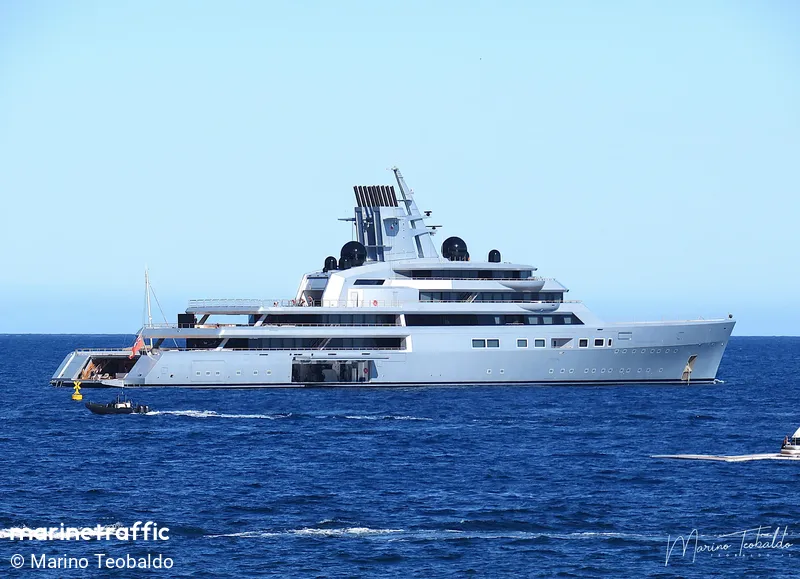
A 142-metre hull leaves the Balearic Islands for the first time in weeks, tracking across the Mediterranean under satellite AIS. The data shows a steady cruise, a fifty-one-nautical-mile gap near the Spanish coast, and an arrival that follows a week of tight anchorages around Ibiza.
Dragonfly cast off from Palma de Mallorca on 20 August 2026 at 17:15, beginning a transit that would take her across the Mediterranean to Gibraltar. Owned by Sergey Brin, the vessel is a 142.15-metre motor yacht built by Lürssen in 2024, flying the Cayman Islands flag with a gross tonnage of 9,408. For the ten days prior to departure she had been operating exclusively within the Balearic archipelago, making short runs between Ibiza, Sóller, and Formentera. The passage to Gibraltar marked a deliberate shift in operational tempo. She left the sheltered coastal waters to cross the open sea, maintaining a constant average speed of 12.4 knots over a total distance of 463 nautical miles. The AIS feed recorded sixty-four fixes during the crossing, painting a clear picture of a hull designed for efficient displacement rather than high-speed performance. Her maximum speed never exceeded 14 knots, indicating a bridge team managing power output to match fuel consumption and passenger comfort.
Leaving the sheltered sea
The departure timing was calculated to maximise daylight hours while minimising night navigation in unfamiliar channels. She cleared the harbour mouth shortly after sunset, turning westward into deeper water. The initial leg followed a straight bearing away from the Spanish coastline, allowing the stabilisers to engage fully before the hull encountered any significant swell. AIS transmissions arrived at regular intervals, confirming a consistent heading and speed. The transition from pilotage waters to open-water routing required no sudden changes in engine load. Her propulsion system settled into a steady rhythm, holding the 12.4-knot average without deviation. That figure is notably low for a vessel of her size and recent build date, suggesting a hull form optimised for range and quiet running. The lack of speed spikes also points to calm sea conditions along the track, as heavy weather would typically force either a reduction in pace or a course alteration to avoid rolling.
The signal gap
The track held clear until she passed the eastern tip of Spain. Around the midpoint of the route, the broadcast stopped. The system logged 412 nautical miles of observed movement before the signal dropped, leaving 51 nautical miles unrecorded. The gap fell just before the Strait of Gibraltar, where coastal terrain and maritime interference often block VHF-based AIS transmissions. Satellite receivers picked up the next fix only after she had cleared the headland. This coverage pattern is standard for the region and reflects the limitations of terrestrial repeaters against the curvature of the earth. The delay did not alter her speed. When the data returned, she was still holding 12.4 knots. The maximum speed recorded during the entire passage remained 14 knots. She did not accelerate to test the machinery, nor did she drop below ten knots to conserve fuel. The constant pace indicates a programmed cruise setting, likely managed by the bridge team to maintain a predictable ETA.

Approaching the rock
She made landfall at Gibraltar on 22 August at 06:18. The final leg brought her into the busy harbour channel, where shipping lanes converge and traffic density rises sharply. The AIS points clustered tightly as she reduced speed to match the port authority's requirements. The total distance covered was 463 nautical miles. The crossing took thirty-seven hours. She arrived in the morning light, having left the Balearics in the late afternoon two days earlier. The route followed a direct line across the Mediterranean, avoiding unnecessary deviations. Her position upon arrival sat at 36.15° N, 5.37° W. The vessel settled into the anchorage area, preparing for the next phase of her itinerary. The passage confirmed the hull's stability in moderate seas. There were no reports of heavy weather along the track, and the steady speed suggests calm conditions. The lack of speed variation also points to a well-balanced load distribution. A yacht of 9,408 tonnes carries significant weight in fuel, water, and tenders. Maintaining a flat trim at 12.4 knots requires careful management of the tanks and the stabilisers. The data shows exactly that balance.
The anchorages behind her
Before departing for the Strait, Dragonfly spent ten days anchored in the Balearic archipelago. The movement log records a series of brief hops. On 11 August she moved eleven nautical miles around Ibiza. The following day she repeated a similar run. By 13 August she had logged fourteen nautical miles in a single outing. On 14 August she covered twenty-seven nautical miles, still within the same cluster. The 15th saw two separate departures, each covering just over eleven nautical miles. On 17 August she completed another twenty-nine nautical mile circuit. The 19th produced no movement. On 20 August, shortly before the Gibraltar run, she executed a sixty-two nautical mile trip from Ibiza to Sóller. These short legs served a different purpose than the long crossing. They allowed the crew to manage provisions, refresh water, and rotate guests without committing to a multi-day transit. The anchorages provided sheltered water where the draft and beam of a 142-metre hull are less critical.
The contrast between those local runs and the open-water passage highlights the vessel's dual role. In the islands she operated as a floating residence, moving slowly between safe harbours. On the crossing she functioned as a transport, holding a fixed speed and ignoring the coastline. The transition between the two modes happened cleanly. She left Palma, crossed the open sea, and arrived in Gibraltar without changing her operational tempo. The data captures both phases without ambiguity. The AIS coverage stood at 89 per cent, meaning the vast majority of the journey was witnessed directly. The remaining 11 per cent fell in a zone where geography dictates signal loss. Every other detail of the passage aligns with a routine transit executed by a professional crew managing a new delivery. The hull settled into the strait, ready for whatever comes next.
Reporting and data: CelebYachts, republished by On the record.
Sources
The numbers on this page point here. Each one links to the record it came from.
- 1CelebYachtsCelebYachts: Dragonfly crosses to Gibraltar