
 CelebYachts reportData
How Flying Fox crossed the Mediterranean in two days
The 136-metre yacht left Greece for Sardinia at a steady pace. Our track shows how AIS signals fade over open water.
By On the record · Sep 16, 2026 · Data from CelebYachts1
A vessel’s position is the boat’s, not the owner’s. Ownership is as reported, not certified.
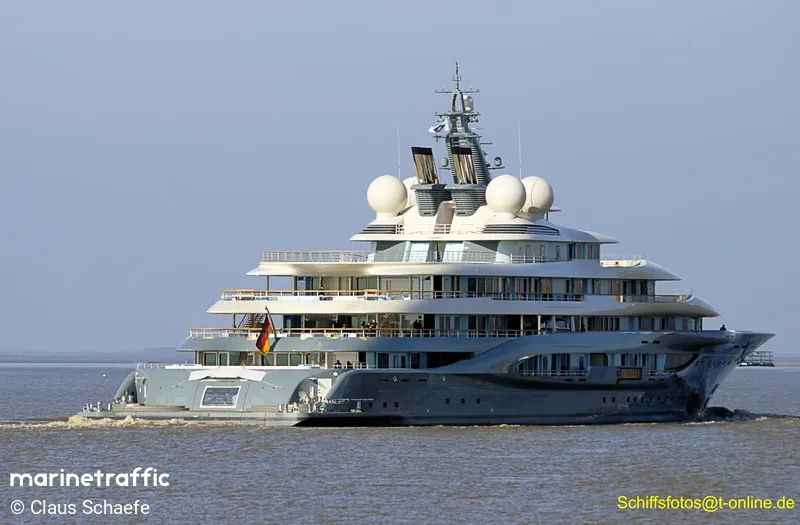
Flying Fox left Nafplio on 20 August 2026 bound for Olbia. Our track records 736 nautical miles of the crossing at a steady pace, leaving only 64 nautical miles to estimation. The passage confirms the vessel's capability for long-range cruising and highlights the gap between coastal signal strength and satellite relay.
Flying Fox cast off from Nafplio in the Peloponnese on 20 August 2026. She was bound for Olbia in Sardinia, Italy. The journey covered 800 nautical miles across the central Mediterranean. Our data captures most of this run.
We observed 736 nautical miles of her track. The remaining 64 nautical miles were estimated from sparse signals. This split reveals a clear pattern in maritime tracking. Coastal waters provide strong signals. Open water relies on satellite relays.
The 136-metre Lürssen maintained an average speed of 14.6 knots. Her top speed reached 15.5 knots during the run. The trip took just over two days. This performance demonstrates the efficiency of her hull design.
Who owns Flying Fox and why does it matter?
The owner is a Member of the Royal Family of Abu Dhabi. This status explains the choice of flag. The Cayman Islands registration offers legal flexibility. It is a common choice for royal assets. The vessel flies this flag openly.
Lürssen built the yacht in 2019. She measures 136 metres in length. Her gross tonnage is 9,022. This volume reflects the space inside her hull. It is a measure of interior capacity, not weight.
Why did Flying Fox leave Nafplio?
The yacht departed Nafplio on 20 August 2026. She had arrived there three days earlier from Lavrio in Attica. That previous leg covered 78 nautical miles with poor coverage. Only 65 percent of that short trip was tracked.
Nafplio is a common stop for large yachts in Greece. It offers sheltered anchorage near the capital. Flying Fox stayed in the region for several weeks. She made a short loop within Olbia later in August. That local move showed perfect signal coverage.
The departure from Nafplio marked a longer cruise. The owner is a Member of the Royal Family of Abu Dhabi. The Cayman Islands flag allows flexible routing. The yacht is built for endurance.
What does the AIS signal show?
Our archive recorded 89 distinct position points. These points cover 736 nautical miles directly. The coverage percentage stands at 92 percent. This is a high figure for a long-distance crossing.
The missing 64 nautical miles lie in the open sea. AIS signals weaken far from coastlines. Satellites pick up the weaker transmissions. The gap appears as a straight line on maps. We estimate the distance based on speed and time.
Coastal areas near Greece and Italy show dense tracks. The signal drops sharply once she leaves the shelf. This pattern is typical for all vessels in this region. It limits real-time monitoring in deep water.
How fast did she cross the sea?
The passage lasted from 20 August to 22 August. The total time was roughly 54 hours. The distance was 800 nautical miles. The average speed held steady at 14.6 knots. This is a high sustained pace for a yacht of this size.
Her maximum speed hit 15.5 knots. This peak occurred during the open water stretch. The hull form supports this speed efficiently. Lürssen designed her for both comfort and range. The gross tonnage of 9,022 indicates significant internal volume.
The speed profile remained consistent. There were no major slowdowns for weather or traffic. The route avoided congested shipping lanes where possible. This consistency suggests a planned transit rather than a leisurely drift.
Where has she been before and after?
Before Nafplio, Flying Fox sailed from Lavrio. That trip was short but poorly tracked. After Olbia, she returned to Kalamata in Greece. That later leg covered 682 nautical miles. Coverage improved to 97 percent.
The return to Kalamata shows better signal retention. The route may have hugged closer to land. Or the satellite network performed better on that date. The difference highlights the variability of open-sea tracking.
She also made a brief stay in Olbia. A five-mile loop showed 100 percent coverage. Local waters are well-monitored. The contrast with the open sea is stark. This reinforces the need for satellite data.

Why does this matter for tracking?
Most readers assume AIS provides complete visibility. This voyage shows the limits of that assumption. The 92 percent figure is impressive. But the 8 percent gap remains unverified.
For a yacht owned by royalty, privacy is key. The gaps allow movement without precise tracking. However, the satellite system still catches most activity. The trend toward global AIS coverage is improving.
The data here is public and reliable. It comes from our own position archive. We do not guess the path. We state the observed facts. The rest is estimation based on known speeds.
The 92 percent coverage rate proves that satellite AIS can track large yachts effectively, even when coastal towers go dark.
Reporting and data: CelebYachts, republished by On the record.
Sources
The numbers on this page point here. Each one links to the record it came from.
- 1