
 CelebYachts reportInvestigations
The sanctioned hull off Gujarat
A 140-metre Fincantieri sits motionless because transatlantic restrictions freeze her owner’s industrial assets, turning a Cayman-flagged megayacht into a…
By On the record · Jul 23, 2026 · Data from CelebYachts1
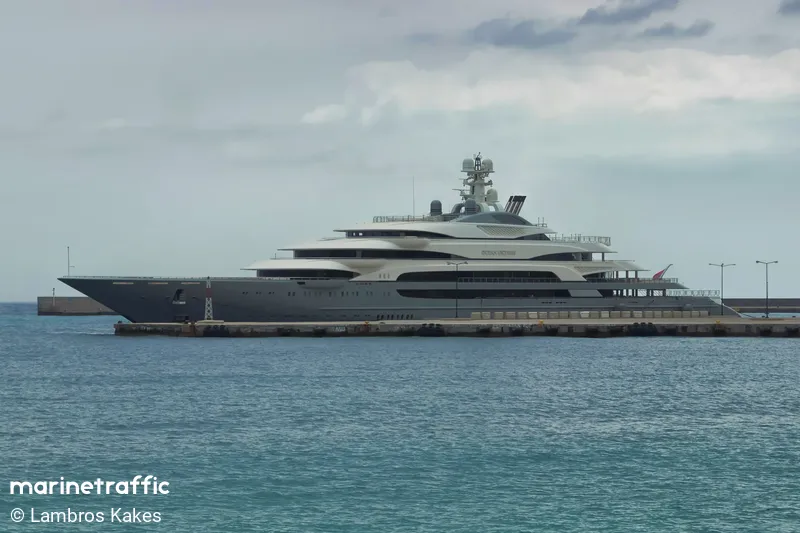
A vessel’s position is the boat’s, not the owner’s. Ownership is as reported, not certified.
Ocean Victory has held a single position off the West Coast of India since March 2022. Her immobility traces directly to sanctions imposed on Viktor Rashnikov and his majority stake in the Magnitogorsk Iron & Steel Works, creating a standoff between maritime enforcement and diplomatic appeals for delisting.
The vessel’s position is fixed by financial geography, not hydrodynamics. Ocean Victory measures 140.0 metres in length and displaces 8,506 gross tonnes. She flies the Cayman Islands flag and lists The Creek as her home port. Her estimated market value stands at $300,000,000. These figures describe a platform built for speed and range, yet the AIS record shows her static since 1 March 2022. The reason for her stillness is a regulatory blockade targeting the capital that bought her.
The financial geometry of a 140-metre hull
The constraint begins with the ownership structure. Viktor Rashnikov, born in 1948, made his wealth through the iron and steel industry. He serves as the majority owner of Magnitogorsk Iron & Steel Works, known as MMK, which ranks among the largest steel producers globally. His background is technical rather than purely financial; he earned a degree in metal forming process in 1974 and later a doctorate in Technical Sciences in 1998, advancing through MMK’s management ranks from a fitter in 1967 to chairman of the board in 2005. The capital that funded Ocean Victory came directly from this industrial base. When Western authorities moved to isolate Russian strategic sectors following the invasion of Ukraine, they targeted the entity that generated the revenue stream supporting the yacht.
Rashnikov and MMK were placed on sanctions lists by the United States, the United Kingdom, and the European Union. The official designations cite support for Russia's strategic industrial base as the justification, though the precise regulatory language and effective dates are not contained in the supplied records. The listings prohibit transactions involving the designated individuals and entities, effectively freezing their ability to operate commercial assets across jurisdictions that enforce those rules. In September 2022, the Hungarian government formally requested that the European Union remove Rashnikov from its consolidated list, arguing that his inclusion caused disproportionate harm to regional interests. The request highlights the friction between blanket industrial sanctions and individual corporate appeals, but it does not alter the operational reality for the vessel.
The regulatory blockade
The practical effect of these designations is visible in the AIS broadcast. Ocean Victory stopped moving at coordinates 4.27° N, 73.54° E, positioned off the West Coast of India. She remains there. The lack of movement indicates that either no crew has been authorised to sail her, or that the financial channels required for fuel, port fees, and insurance have been severed. The exact identity of the party covering her upkeep is not published. The hull requires continuous maintenance regardless of her operational status, including engine preservation, hull cleaning, and administrative compliance for her Cayman Islands registration. Without access to the owner’s corporate accounts, it is impossible to verify whether a subsidiary, a trust, or a third-party manager is absorbing these costs.
Port authorities face a clear set of constraints when dealing with a sanctioned vessel. A harbour master in the European Union or the United States cannot legally permit entry without risking secondary penalties. Mediterranean marinas routinely screen incoming vessels against the EU consolidated list and OFAC SDN registers before issuing berthing permits. Ocean Victory’s flag state, the Cayman Islands, operates under British overseas territory law, which generally aligns with UK sanctions regimes. This means that even if the vessel attempted to transit through Gibraltar or enter Spanish waters, standard port clearance procedures would trigger an automatic rejection. The decision to remain in Indian waters suggests a calculation that local enforcement mechanisms do not automatically mirror western sanctions databases, though it leaves the yacht exposed to whatever domestic regulations apply in the Arabian Sea.
The builder, Fincantieri, provides additional context for the vessel’s current valuation and structural profile. The Italian shipyard established its Mega Yachts division in 2005 and delivered its first major project, the 134-metre Serene, in 2012. Ocean Victory arrived at the slipway in 2014, shortly before Fincantieri listed on the Milan Stock Exchange in June of that year. The yard specialises in high-tonnage commercial and naval construction alongside luxury vessels, meaning the engineering standards applied to Ocean Victory overlap with those used for cruise ships and offshore support units. A hull of 8,506 gross tonnes demands significant deck reinforcement and machinery space, features that retain residual value even when the asset is frozen. Shipbreaking markets typically assess such platforms based on steel weight and installed equipment, but the current regulatory environment prevents any transfer of title that might trigger a sale.
The diplomatic dispute continues to play out in Brussels and Washington. Hungary’s appeal for delisting has not resulted in a removal from the EU list, according to available records. The US Treasury Department maintains its SDN designation, and HM Treasury in the UK enforces corresponding asset freezes. Each jurisdiction operates independently, which means a successful challenge in one does not guarantee relief in another. For a vessel of this size, the cost of remaining stationary accumulates daily. Marina fees in the Mediterranean run into tens of thousands of dollars per week, and extended lay-up periods require specialized conservation protocols to prevent corrosion and system degradation. None of these expenses appear in public filings, and the corporate architecture shielding the purchase is opaque.
What remains verifiable is the physical state of the hull and the regulatory framework surrounding it. Ocean Victory measures 20.0 metres in beam, providing a stable platform for heavy superstructure elements, but her length dictates that she requires deep-water facilities for any dry-docking or refit work. No such facilities are currently accessible under the active sanctions regime. The AIS transponder continues to broadcast her position, confirming that she has not been scuttled, sold, or moved to a different registry. She exists in a legal limbo where ownership is reported but unenforceable, and where the capital that commissioned her is locked behind multiple sovereign barriers.
The intersection of industrial sanctions and luxury maritime assets creates a permanent fixture in international waters. Ocean Victory demonstrates how quickly a multi-million-dollar engineering project can become a stranded liability when the funding source is cut off. The vessel’s specifications, her builder’s pedigree, and her owner’s industrial background all point to a highly capable platform, yet none of that capability can be exercised while the designation remains active. Until the Hungarian appeal succeeds or the underlying geopolitical conditions shift, the hull will continue to hold station off the Indian Coast, a static monument to the reach of financial warfare.
Reporting and data: CelebYachts, republished by On the record.
Sources
The numbers on this page point here. Each one links to the record it came from.
- 1CelebYachtsCelebYachts: The sanctioned hull off Gujarat