
 CelebYachts reportData
Siren tracks a Ligurian circuit
A seven-day analysis of AIS broadcasts shows a 73-metre superyacht shifting between three coastal clusters, revealing how tonnage dictates routing more than…
By On the record · Sep 17, 2026 · Data from CelebYachts1
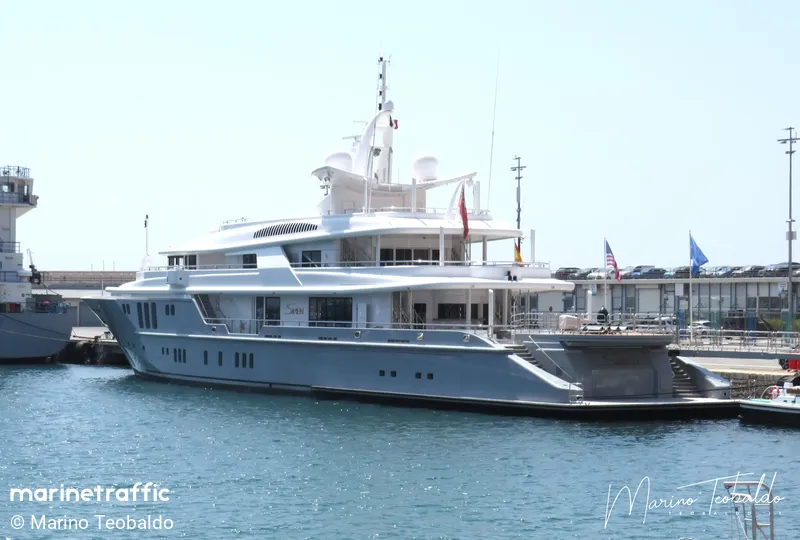
A vessel’s position is the boat’s, not the owner’s. Ownership is as reported, not certified.
Siren logged six passages in August 2026, covering 390 nautical miles across the western Mediterranean. The data shows a vessel operating within strict hydrographic limits, favouring short hops between established marinas over open-water transit.
Siren (IMO 9417438) logged six passages in August 2026, covering 395 nautical miles across the western Mediterranean. The data shows a vessel operating within strict hydrographic limits, favouring short hops between established marinas over open-water transit. Her maximum speed reached 15.1 knots, but her average speed across the period sat at 10.0 knots. The movement record breaks into three geographic clusters: the French Riviera, the northern coast of Sardinia, and the Tyrrhenian coast of Lazio. The pattern reveals a 73-metre hull utilising coastal corridors to avoid deep-water basins, a routing strategy dictated by her beam of 12.6 metres and estimated gross tonnage of 1,585.
The French transit
The earliest recorded broadcasts place Siren off the French coast. On 5 August, she departed Saint-Tropez for Antibes, covering 31 nautical miles in two hours and forty-seven minutes at an average speed of 11.2 knots. The AIS signal went dark shortly after departure, resuming only when she left Nice for La Maddalena later that evening. That passage lasted sixteen hours and thirty-six minutes, starting at 18:29 UTC on 5 August and ending at 11:05 UTC on 6 August. She covered 204 nautical miles at an average speed of 11.8 knots, maintaining a steady course along the continental shelf. The route skirts the edge of the Gulf of Lion, staying within range of French ports rather than cutting across to Corsica or Sardinia directly. Coverage for this leg stood at 92 per cent, indicating reliable broadcasting throughout the night crossing.
The sardinian cluster
Once in the Mediterranean archipelago, the movement profile changes drastically. Between 12 August and 24 August, Siren made four separate trips around Olbia and Palau. The distances shrank to single digits. On 12 August she ran 8 nautical miles from Olbia to Porto Cervo at 4.2 knots, with AIS coverage dropping to 3 per cent almost immediately after departure. This near-total loss of signal suggests interference or intentional shutdown, common in sensitive anchorages. On 15 August she moved 6 nautical miles from Palau to La Maddalena at 7.6 knots. On 17 August she covered 21 nautical miles to San Teodoro at 10.0 knots. On 24 August she executed a 6 nautical mile loop around Olbia, averaging 7.4 knots. The vessel spent twelve days in this region, moving less than 40 nautical miles in total. The low speeds and short distances indicate anchoring in shallow bays where a 73-metre hull requires careful tidal planning and proximity to sheltered harbours.
The Italian run
By late August, Siren had crossed back to the Italian mainland. On 26 August she departed from a position 49 nautical miles off Anzio and ran 49 nautical miles to San Felice Circeo in four hours and twenty-nine minutes, averaging 11.9 knots. The following day she completed a 70-nautical-mile run to Naples at 11.9 knots. These passages were faster than the Sardinian legs, indicating open water transit, but they remained strictly coastal. Her final recorded broadcast placed her at 43.27° N, 6.66° E in the Ligurian Sea. The sequence of movements suggests a deliberate pacing, prioritising safe harbour access over speed, consistent with a vessel that values privacy and stability over long-range cruising.
The vessel's registration in George Town places her under Cayman Islands maritime law, a jurisdiction commonly used for tax efficiency and regulatory flexibility among private yachts. Her gross tonnage of 1,585 units requires docking facilities capable of supporting significant weight distribution, limiting her to major ports such as La Maddalena and Porto Cervo. Smaller marinas in the Sardinian archipelago often lack the draft depth for a hull of this displacement, forcing the crew to anchor offshore and transfer guests via tenders. This operational requirement explains the repeated short-hop pattern observed between Palau, Olbia, and San Teodoro, where distances rarely exceed 25 nautical miles. The avoidance of longer crossings during the Sardinian leg underscores the practical constraints of a 2008-era hull operating in a modern, regulated environment.
The capital and the yard
The capital behind Siren comes from David and Simon Reuben, who were ranked the second-richest family in British history in 2026, with a combined net worth of £27.9 billion according to the Sunday Times Rich List. Their fortune originated in the 1990s through Trans-World, a commodities firm that entered the Russian aluminium market when smelters faced debt crises. The brothers paid for raw materials and delivered them to factories in exchange for finished metal, which they sold globally. The investment totalled US$1.5 billion, generating sales above US$8 billion by 1995. They later diversified into property and retail, including a joint venture with British Marine that held eight vessels in 2014, and a sale of their stake in luxury leisure operator Belmond Ltd in 2019 for £233 million.
Siren was constructed at Nobiskrug in Rendsburg, Germany, carrying hull number 778. The yard sits on the Eider River and has operated since 1905, originally building pontoons and barges before switching to luxury yachts in the late twentieth century. The facility underwent severe financial stress in the twenty-first century, filing for insolvency in 2021 amid pandemic-related disruptions. It was acquired by Flensburger Schiffbau-Gesellschaft in July 2021, only to file for insolvency again in 2024 and pass to Lürssen. Siren predates these corporate shifts, launched in 2008 during a period when Nobiskrug was delivering custom motor yachts such as Mogambo and Dytan. The 73-metre hull reflects the yard's capacity for mid-size engineering rather than the massive dry docks required for 100-metre-plus projects.
Siren flies the flag of the Cayman Islands, with George Town registered as her home port. The vessel carries an estimated value of US$63,450,000, reflecting the depreciation of a 2008 launch in a market that has shifted toward newer builds with hybrid propulsion. While Nobiskrug's 2020 delivery Artefact introduced diesel-electric variable-speed Azipod propulsion and wastewater recycling, Siren relies on conventional mechanical systems typical of the late 2000s. Her gross tonnage of 1,585 places her firmly in the mid-superyacht category, requiring marinas with depths exceeding 4 metres and berths capable of handling a 12.6-metre beam. The absence of helicopter deck specifications in the register suggests a design focused on tender storage and swim platforms rather than aviation integration, a constraint that aligns with her observed preference for coastal anchorages over offshore loitering.

Reporting and data: CelebYachts, republished by On the record.
Sources
The numbers on this page point here. Each one links to the record it came from.
- 1CelebYachtsCelebYachts: Siren tracks a Ligurian circuit