
 CelebYachts reportYards & Design
Why Radiant's shape shows Lürssen, not the owner
Radiant’s proportions show how a shipyard’s building shed limits hull dimensions more than any owner’s brief.
By On the record · Oct 13, 2026 · Data from CelebYachts1
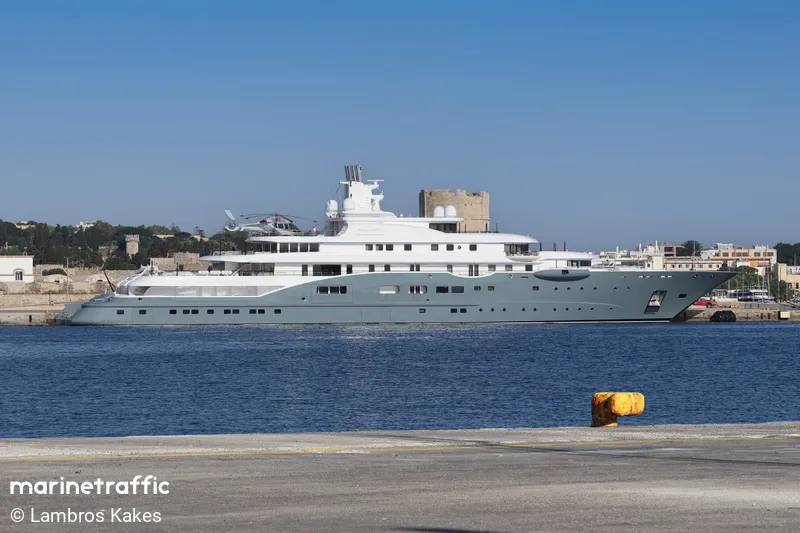
A vessel’s position is the boat’s, not the owner’s. Ownership is as reported, not certified.
Radiant measures 110 metres in length and carries 5,082 gross tonnes. The interior has never been published. Data shows the vessel’s proportions were determined by the dry dock at Lemwerder, not by the original commissioner’s specifications, leaving a hull whose geometry reveals the engineering priorities of the yard rather than the tastes of its owners.
What does Radiant look like on the outside?
Radiant is an 110-metre superyacht built by Lürssen. She carries 5,082 gross tonnes of internal volume. Her beam is 18.85 metres. These numbers are fixed. They do not change with ownership.
Boris Berezovsky started the project for Radiant. He sold the hull before it was finished. Abdulla Al Futtaim bought the unfinished boat in 2013. He paid to finish the inside. The outside shape stayed the same.
The interior design has never been published. No floor plans exist in public records. We cannot see the cabins or the saloons. We can only measure what remains visible from the outside.
Radiant measures 110 metres in length. Her beam is 18.85 metres. This gives her a gross tonnage of 5,082. These figures are fixed. They do not change with ownership.
How did Lürssen’s slipway limit Radiant’s size?
Lürssen builds yachts at its Lemwerder facility near Bremen. This site has a large floating dock. The dock sets a hard limit on hull width. Radiant’s beam of 18.85 metres fits this constraint tightly.
A wider beam would require a different dock. It would also change the balance of the boat. The naval architects had to work within these physical boundaries. They could not simply widen the hull.
The length of 110 metres also reflects the dock’s capacity. Longer yachts need longer slipways. Lürssen has the infrastructure for vessels of this scale. Other yards might not have offered the same options.
Gross tonnage measures the total internal volume. Radiant holds 5,082 GT. This is a high volume for her length. It means the builders maximised every available space inside the beam limits.
The ratio of length to beam creates a slender profile. This shape reduces water resistance. It helps the yacht achieve higher speeds with less power. The hull form prioritises performance over sheer breadth.
These constraints apply to all yachts built in this dock. They are not unique to Radiant. However, they define the envelope within which every owner’s brief must sit. The steel is cut first. The fit-out follows.
The slipway at Lürssen’s Lemwerder facility sets the limits. This shipyard is in Germany. It builds the world’s largest yachts. The floating dock there determines the maximum beam. Radiant’s 18.85-metre width fits this limit closely.
A wider hull would need a bigger dock. Lürssen does not have one at Lemwerder. The naval architects worked within these bounds. They maximised the volume inside the beam. The length of 110 metres also suits the slipway.
Gross tonnage measures the total internal volume. Radiant holds 5,082 GT. This is high for her length. The builders used every cubic metre allowed. The resulting profile is slender. This shape reduces water resistance. It helps the yacht move faster.
Who owned Radiant before Abdulla Al Futtaim?
Boris Berezovsky initiated the project for Radiant. He was a Russian billionaire. His involvement dates back to the early stages of construction.
Berezovsky faced legal troubles in Russia. These events disrupted his personal projects. The sale of Radiant was part of this broader restructuring of his assets. He needed liquidity quickly.
Abdulla Al Futtaim purchased the unfinished hull. He is an Emirati businessman based in Dubai. He owns the Al-Futtaim Group, a major retail and automotive conglomerate in the Middle East.
Al-Futtaim is the cousin of Majid Al Futtaim. Both men are billionaires. Their wealth comes from diversified business operations. They have no direct link to the oil industry, unlike many regional peers.
Al Futtaim completed the yacht in 2016. He hired new interior designers to finish the fit-out. The exterior lines remained exactly as Berezovsky had ordered them from Lürssen.
The transfer of ownership changed the flag and the registration. Radiant now flies the Cayman Islands flag. Her home port is George Town. The hull number and IMO remain constant.
AIS data shows Radiant in the Piraeus Area. Her coordinates are 37.93° N, 23.68° E. This is off the coast of Greece. She has stayed here for long periods. Recent voyages show trips to Italy and Monaco. She returned to Piraeus in September 2026.
Where is Radiant today?
AIS data places Radiant in the Piraeus Area. Her coordinates are 37.93° N, 23.68° E. This location is off the coast of Greece. She has held a static position here for extended periods.
Recent voyages show movement between Italy and Monaco. She travelled from Siracusa to Portoferraio in September 2026. She then moved to Sanremo and on to Monaco.
She returned to Piraeus in late September 2026. The distance covered was short. The average speed was low. This pattern suggests she is preparing for winter lay-up or undergoing maintenance.
Greek ports are popular bases for superyachts. They offer secure anchorage and good facilities. The waters provide sheltered areas during the summer season.
Her current stillness contrasts with her earlier movements. She was active in the region throughout the summer months. Now she sits quietly off Piraeus.
The lack of interior details is normal. Owners of this class keep their designs secret. They do not publish floor plans. This protects their privacy. It also stops rivals from copying features. We can only guess at the layout.
The external structure gives clues. The deck layout suggests multiple living zones. The bridge placement shows standard navigation needs. The tender garage is likely at the stern. This is common for yachts of this size. It allows easy access to the water.
A helicopter deck, if present, would be on top. This requires reinforced flooring. It adds weight high up. This affects stability. Without seeing inside, we rely on hull metrics. The gross tonnage tells us there is space. The beam tells us how it is spread.
The interior of Radiant is private. Owners of this class often keep their designs secret. They do not publish floor plans or material specifications.
This opacity is common among ultra-high-net-worth individuals. It protects their privacy. It also prevents competitors from copying specific features.
We can infer some things from the external structure. The deck layout suggests multiple living zones. The bridge placement indicates standard navigation requirements.
The tender garage is likely located at the stern. This is a common configuration for yachts of this size. It allows easy access to the water without disrupting the main decks.
The helicopter deck, if present, would be on the uppermost level. This requires reinforced flooring. It adds weight high up, affecting stability.
Without seeing inside, we rely on the hull metrics. The gross tonnage tells us there is plenty of space. The beam tells us it is spread out carefully.
Why does this matter for superyacht design?
Radiant demonstrates the power of the builder. Lürssen sets the parameters. The owner chooses from what is possible within those limits.
This dynamic is true for most custom yachts. The shipyard’s expertise dictates the feasible range of sizes. An owner cannot demand a beam that exceeds the dock width.
It also shows the fluidity of ownership. A yacht can change hands while under construction. The new owner inherits the existing shell.
They pay for the fit-out, not the steel. This can be cheaper than starting from scratch. It also means accepting someone else’s initial vision.
The result is a vessel that reflects both parties. It bears the imprint of the original commissioner. It also carries the style of the current owner.
In Radiant’s case, the exterior is pure Lürssen. The interior is Al Futtaim. The two influences are separated by the hull plating.
This separation is rare in smaller yachts. On larger vessels, the structural constraints are so dominant that they override individual whims.
The data confirms this. The proportions are tight. They leave little room for deviation. The shipyard wins the argument about shape.
Reporting and data: CelebYachts, republished by On the record.
Sources
The numbers on this page point here. Each one links to the record it came from.
- 1