
 CelebYachts reportInvestigations
The administrative life of El Mahrousa
Institutional ownership turns a vessel into a ledger entry, preserving hulls through name changes and flag transitions that commercial registers cannot…
By On the record · Sep 22, 2026 · Data from CelebYachts1
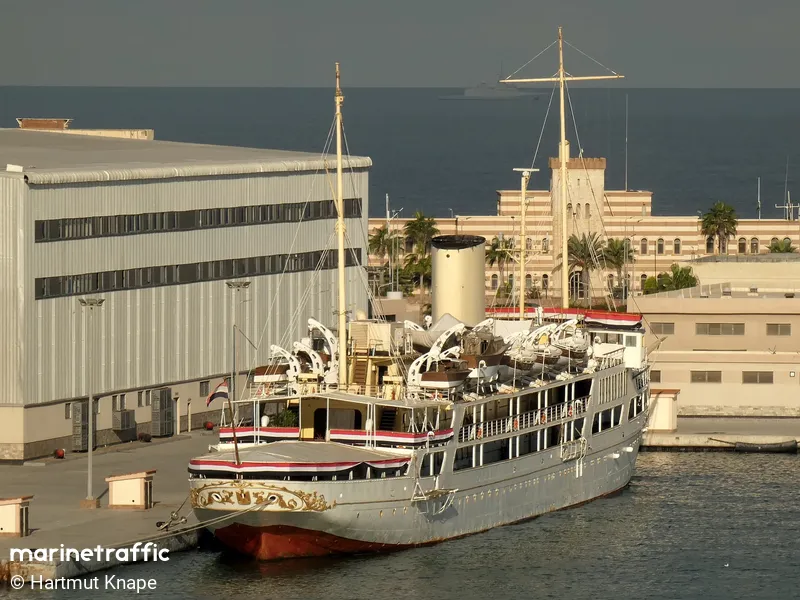
A vessel’s position is the boat’s, not the owner’s. Ownership is as reported, not certified.
El Mahrousa carries two names because successive administrations required different identifiers for diplomatic clearance. The hull itself, built at a London yard that survived three fatal explosions, demonstrates how state ownership bypasses the commercial pressures that shorten the average superyacht lifespan.
Samuda Brothers occupied a narrow strip of land on the Goodluck Hope Peninsula, Leamouth, London, when they launched Mahroussa in 1865. The yard had already endured two catastrophic failures within its first two years of operation. In November 1844, the Gipsy Queen exploded during a trial trip, killing Jacob Samuda alongside nine employees. A second blast at the same site in 1845 claimed three more lives. These incidents did not halt production; they forced a relocation. The firm moved to Cubitt Town on the Isle of Dogs in 1852, leaving behind premises hemmed in by competing industrial operations. By 1863, the Cubitt Town yard was reportedly generating double the output of all other London shipyards combined.
The Khedive of Egypt placed the order for Mahroussa while the yard was operating at peak capacity. The vessel entered the water the following year, sharing a slipway schedule with HMS Tamar for the Royal Navy and BAP Independencia for Peru. Samuda Brothers specialised in iron and steel warships and steam packets, a technical focus that dictated the construction methods used on the Egyptian hull. The yard also fabricated components for the abandoned Waterloo & Whitehall Railway, demonstrating the breadth of engineering work running parallel to naval contracts. When the 1866 financial crisis struck, the firm relied on orders from Germany, Russia and Japan to maintain cash flow. SMS Kronprinz, SMS Kaiser and SMS Deutschland left the slips during this period, alongside the Imperial Japanese Navy’s Fusō. When Joseph Samuda died in 1885, attempts to sell the business as a going concern failed. The yard closed in the 1890s, leaving Yarrows and Thames Ironworks as the only remaining significant builders in the capital.
The weight of the name
The register lists the hull under two titles: El Mahrousa and El Horriya. A dual name on a single IMO record almost always signals a transfer between jurisdictions or a shift in diplomatic protocol rather than a cosmetic update. The precise date of the change and the administrative trigger that mandated it are not published. Where the details have not been released, the record shows a vessel that has remained under continuous state control since construction. Commercial superyachts typically change hands every seven to ten years, each sale requiring a new registration, a new flag, and a new name to satisfy buyers who treat the vessel as a liquid asset. Institutional owners do not face that cycle. The Egyptian Presidency and the Navy hold the hull as a fixed asset, which removes the commercial pressure to alter its identity for marketing purposes.
The original name, Mahroussa, appears in the Samuda Brothers ship list exactly as spelled in the nineteenth century. Modern maritime databases standardise the spelling to El Mahrousa, reflecting contemporary Arabic transliteration and the definite article adopted by subsequent administrations. The addition of El Horriya corresponds to a period when the vessel was repurposed for different official duties, though the exact timeline remains unrecorded in open sources. The hull flies the Egyptian flag and operates from Alexandria. Her current classification places her in the category for Middle East royalty and heads of state, a designation that tracks her diplomatic function rather than her commercial value. An estimated value is not recorded because state-owned vessels do not appear on secondary markets.
The modern registry
The physical dimensions recorded in the register diverge sharply from those of a typical 1865 launch. The hull measures 145.72 metres in length and 13.0 metres in beam, carrying a gross tonnage of 4560. These figures indicate extensive structural modifications over the vessel's service life. The original 1865 displacement would have been substantially lower, constrained by the boiler technology and propulsion systems available at Samuda Brothers. The register classifies the hull type as motor, confirming that the original steam plant was replaced during a major refit. The vessel now carries the international maritime identifier 8642816, an IMO number assigned globally starting in 1987 to track commercial and state vessels across borders. She does not broadcast a Maritime Mobile Service Identity signal, which aligns with her status as a government ship that opts out of public tracking.
The timeline of the yard's output reveals how tightly the Egyptian order sat within a broader European naval expansion. SS Carnatic left the slips for P&O in 1862, followed by HMS Tamar for the Royal Navy in 1863 and BAP Independencia for Peru in 1864. Mahroussa entered the water in 1865, immediately preceding the launch of Bordein, a Nile steamer constructed around the same year. The yard's ability to sustain simultaneous contracts for private liners, foreign navies and Egyptian royalty depended on the Cubitt Town facility's capacity to handle iron and steel fabrication at scale. When the Waterloo & Whitehall Railway project collapsed in 1866 due to the financial crisis, the firm pivoted entirely to maritime orders. SMS Kronprinz departed in 1867, Muin-i Zafer for the Ottoman Navy in 1869, and SMS Kaiser in 1874. The firm also completed HMS Belleisle in 1876, originally intended as Peyk-i Şeref for the Turkish Navy, and HMS Orion in 1879, initially designated Büruç-u Zafer. These sequential deliveries demonstrate that the yard's survival relied on converting political demand into steel output, a process that preserved the hull records even after the company dissolved.
The absence of an MMSI code reinforces the vessel's separation from commercial traffic management. Government vessels frequently retain static registries that do not require real-time broadcasting, particularly when they operate within restricted waters or serve exclusively diplomatic functions. The IMO number 8642816 serves as the permanent anchor for these records, linking the 1865 construction data to modern classification societies. Because the hull flies the Egyptian flag and calls Alexandria home, her movements are governed by bilateral agreements rather than commercial routing algorithms. The register categorises her under Middle East royalty and heads of state, a bucket designed for vessels that carry visiting dignitaries or host state ceremonies. That classification dictates how she is logged in transit reports and how she appears in fleet analyses, regardless of her actual propulsion system or interior layout.
Reporting and data: CelebYachts, republished by On the record.
Sources
The numbers on this page point here. Each one links to the record it came from.
- 1