
 CelebYachts reportInvestigations
The Alblasserdam conversion
Sunrays was extruded through a shipyard retooling itself for scale, funded by the ongoing cash flow of a diversified Indian industrial empire.
By On the record · Oct 27, 2026 · Data from CelebYachts1
A vessel’s position is the boat’s, not the owner’s. Ownership is as reported, not certified.
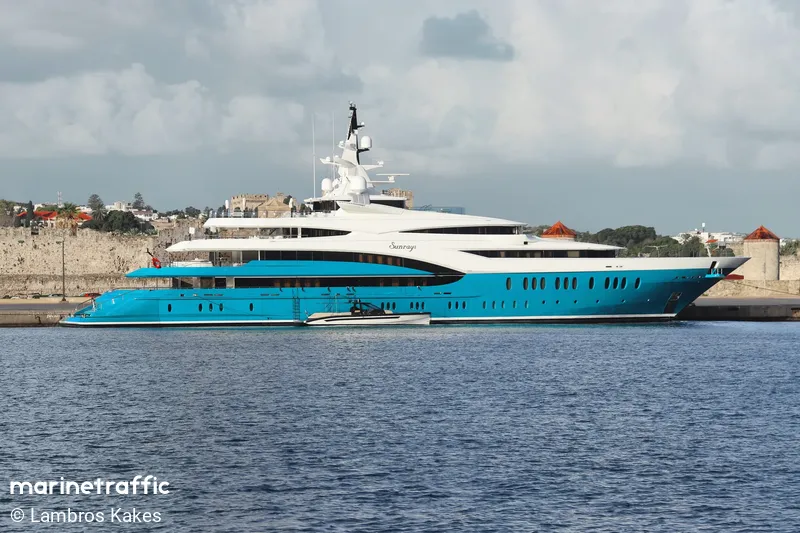
The making of Oceanco’s eighty-five-metre hull Y705 cannot be separated from the yard’s own physical transformation in 2010. As the builder demolished its original slips to pour a new dry dock, Ravi Ruia’s capital from the Essar Group financed the steel and aluminium that became Sunrays.
The construction of Sunrays coincided with a structural shift at Oceanco that dictated what could be built, how fast it could be built, and where it would leave the water. The yard had operated since 1987 on a split model: casting hulls and superstructures in Durban, South Africa, then transporting the sections to finishing facilities in the Netherlands. Theodore Angelopoulos took control in 2002 and pivoted the company toward an integrated European operation focused exclusively on the 80-metre niche market. By the time Mohammed Al Barwani acquired Oceanco in March 2010, with Marcel Onkenhout remaining as chief executive, the company had consolidated its operations into a single extended production facility spanning 8.2 hectares in Alblasserdam, roughly 20 kilometres from Rotterdam.
That same month, the yard began demolishing its old buildings and slipways to make way for a new covered dry dock capable of handling vessels up to 140 metres. Sunrays entered the building shed during this exact window. The vessel carried the yard number Y705 and measured 85.43 metres in length with a beam of 14.24 metres. The physical constraints of the Alblasserdam site meant that hulls were fabricated entirely on-site rather than shipped in sections. The yard maintained capacity to construct five yachts simultaneously in the 80-metre-plus category, delivering approximately two superyachts per year. Sunrays was one of those deliveries, completed while the surrounding infrastructure was being ripped out and replaced.
The Alblasserdam conversion
The transition from a Durban-to-Rotterdam assembler to a dedicated Alblasserdam megayacht factory required precise scheduling. The yard's direct access via inland waterways to the North Sea allowed heavy components to arrive without road transport restrictions. In 2008, Oceanco had acquired additional land adjacent to the present yard, clearing the ground that would become the new dry dock. The demolition started in 2010, the same year Sunrays was launched and fitted out. The vessel sat in a shed that was actively being reconfigured around it, a fact that explains why the public record contains no specific date for keel laying or launch. Those milestones are absent from available documentation, likely subsumed into the broader yard-wide reconstruction that prioritised the new 140-metre slip over individual project timelines.
The capital that commissioned Y705 originated from the Essar Group, a multinational conglomerate founded in 1969 by Shashi Ruia and his younger brother Ravi Ruia. Ravi Ruia, born in April 1949, managed the group’s globalisation plans, including new ventures in South East Asia, Africa and the Middle East. Essar operated across steel, oil and gas, power, communications, shipping, ports and logistics, projects and minerals, employing 75,000 people and generating revenues of US$17 billion. The wealth that paid for Sunrays did not come from a single privatisation event in 2010; it rested on the ongoing cash flow of a diversified industrial empire. The estate remained intact through a major divestment in April 2013, when Essar Energy completed the sale of Essar Oil to Rosneft and a consortium led by Trafigura and UCP at an enterprise valuation of US$12.9 billion. That transaction represented Russia’s largest ever foreign investment and India’s largest foreign direct investment. The legal environment surrounding the capital was equally stable; after a Central Bureau of Investigation probe commenced in December 2011 concerning the sale of India’s 2G spectrum, Indian courts acquitted Ravi Ruia of any impropriety in December 2017, holding that the prosecution had failed to prove any charge.
The capital behind the steel
Sunrays was constructed as a full-displacement motor yacht with a steel hull and an aluminium superstructure finished with teak laid decks. The exterior lines were drawn by Björn Johansson, and the interior layout was executed by Terence Disdale. The vessel displaced 2,867 gross tonnes and sat at a draught of 3.95 metres. It accommodated sixteen guests and carried a complement of twenty-eight crew. Propulsion came from two MTU 16V 595 TE70 main engines, rated at 4,680 horsepower each. These units drove the shafts to achieve a maximum speed of twenty knots. The Lloyd’s registered Cayman Islands-flagged yacht was delivered in March 2010 and registered under IMO identifier 1010351 and MMSI 319015100. Her home port is George Town. The estimated value stands at US$129 million.
The machinery specification reflects the engineering priorities of the early 2010s for vessels in this tonnage range. The MTU engines provided a reliable power curve for coastal cruising rather than high-speed ocean transits. The beam of 14.24 metres offered stability for the aluminium superstructure and the interior volumes designed by Disdale, while the draught limited her to sheltered anchorages and deep-water marinas. The classification society inspected the welds and machinery installations before issuing the certificates required for Cayman Islands registration. No further details regarding the internal arrangement or the exact sequence of machinery installation have been published.
Since leaving the Alblasserdam slip, Sunrays has operated primarily in the Mediterranean. The latest AIS broadcast places her at 43.29° N, 10.09° E. Her recent passages show a pattern of short coastal hops rather than blue-water transits. A voyage from Livorno to La Spezia covered 18 nautical miles at an average of 12.7 knots. She moved from La Spezia to Portofino, covering 32 nautical miles at 12.1 knots. A longer run from Genoa to Monaco logged 83 nautical miles at 13.0 knots. Subsequent movements kept her within the French and Italian Riviera circuit, including a 17-nautical-mile leg from Nice to Monaco at 12.1 knots. She then ran from Monaco to La Maddalena, covering 198 nautical miles at 13.5 knots. A shorter hop from Porto Rotondo to La Maddalena covered 11 nautical miles at 5.6 knots. The most recent tracked movement saw her depart Palau in Sardinia for Sorrento, covering 212 nautical miles at 11.6 knots.

The operational radius matches the beam and draught of an 85-metre hull designed for sheltered anchorage rather than open-ocean endurance. The engine load during these passages consistently sits between 11 and 14 knots, well below the twenty-knot maximum. This profile suits a vessel owned by an industrialist whose primary assets remain fixed on land. The Essar Group continues to operate across five continents, and the liquidity that bought Sunrays remains tied to steel, energy and logistics contracts rather than maritime speculation. The yacht functions as a mobile residence within the Mediterranean basin, moving between established ports and rarely venturing beyond the western Med. The AIS data confirms a steady, low-velocity circulation pattern that aligns with the specifications of a displacement hull built for comfort rather than range.
Reporting and data: CelebYachts, republished by On the record.
Sources
The numbers on this page point here. Each one links to the record it came from.
- 1CelebYachtsCelebYachts: The Alblasserdam conversion