
 CelebYachts reportData
Why John Henry's yacht Elysian moves at twelve knots
AIS data shows the 66-metre Lürssen hull running a fixed speed in the Aegean. The pattern matches her owner's futures trading background.
By On the record · Sep 24, 2026 · Data from CelebYachts1
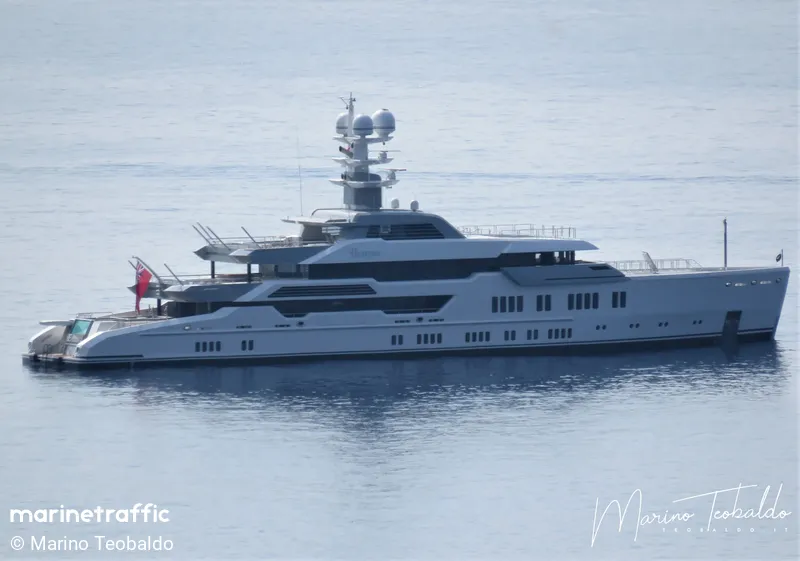
A vessel’s position is the boat’s, not the owner’s. Ownership is as reported, not certified.
Elysian, owned by American financier John Henry, has moved only four times this year. AIS tracks show her holding a steady twelve knots through the Aegean Sea. This routine suggests an owner who values predictable engine loads over high-speed exploration.
The superyacht Elysian sits at 43.73° N, 7.43° E in the Ligurian Sea. She has not moved since early September 2026. Her engines are cold. Her hull is still. The AIS signal shows no movement.
John Henry bought Elysian for about ninety million dollars. He built his fortune in commodity futures. He trades corn and soybean contracts. His style relies on steady trends. He does not gamble on sudden spikes. He prefers a known variable.
We can see that preference in how she sails. Our tracking archive shows Elysian moving eight times between August and October 2026. Each trip followed the same rule. She ran at a fixed speed. She avoided high gear. She treated the sea like a ledger.
Who owns Elysian, and what is his background?
John William Henry II was born in Illinois in 1949. His parents were soybean farmers. He grew up splitting time between Illinois and Arkansas. He attended college but did not graduate. He spent that time playing in two bands.
He started trading corn and soybean futures to learn hedging. A commodities broker asked him to advise other farmers. He declined the offer. He developed a mechanical trend following method instead. He tested it with his own money in Norway.
That test proved successful. He founded John W. Henry & Company in 1981. He opened a small office in Irvine, California. He marketed his management to large brokerage firms. The business grew quickly. He moved to larger quarters in Newport Beach.
Henry now owns Liverpool Football Club and the Boston Red Sox. He also owns the Pittsburgh Penguins and RFK Racing. He purchased The Boston Globe. Forbes estimated his net worth at US$5.7 billion in October 2024. These assets require long-term thinking.
How does Elysian compare to other yachts?
Elysian measures 66 metres in length. Her beam is 12 metres wide. She carries a gross tonnage of 1527. This volume measures her inside space. Larger yachts often carry double that power.
Her power comes from twin MTU diesel engines. These are model 12V4000M63 units. They produce a total output of 4022 horsepower. This is a modest figure for a vessel of her size. It limits her top speed significantly.
Lürssen built her in Rendsburg in 2014. Espen Øino designed her exterior lines. Reymond Langton Design created the interior spaces. The hull is steel. The superstructure is aluminium with teak decks. She flies the Cayman Islands flag.
Other owners treat their yachts as toys. They drive them hard in summer. They push the throttle full. They burn fuel and parts. Henry treats Elysian as capital. He preserves its value. He waits for the next trade.
What limits Elysian's speed?
Elysian is a 66-metre steel hull. Lürssen built her in Rendsburg in 2014. Espen Øino designed her exterior lines. Reymond Langton Design created the interior spaces. She carries a gross tonnage of 1527. Her beam measures 12 metres wide.
Her power comes from twin MTU diesel engines. These are model 12V4000M63 units. They produce a total output of 4022 horsepower. This is a modest figure for a vessel of her size. Larger yachts often carry double that power.
The engine limit defines her cruising profile. She cannot sprint to distant ports. She must plan every leg carefully. Her top recorded speed was 14.3 knots. That was a short burst near Palma de Mallorca. It happened once in ten months.
Most of her movement stays below 13 knots. She rarely exceeds 12.5 knots on longer runs. This keeps the engine load constant. It reduces wear on the machinery. It also lowers fuel consumption significantly. A steady pace is cheaper than a fast one.
She treats the sea like a ledger, balancing distance against fuel cost with the precision of a commodities trader.
Where did Elysian sail this summer?
Her movements began in late August 2026. She started near Datça in Turkey. She sailed to Marmaris that same day. The trip covered 17.3 nautical miles. She averaged 11.1 knots. The AIS signal was clear throughout.
The next day she moved to Bodrum. That leg was 54.5 nautical miles long. She kept the same steady pace. The average speed hit 12.0 knots. She arrived before noon. The route stayed close to the Turkish coast.
From Bodrum she headed west into Greece. She crossed to Kos island. The distance was 99.5 nautical miles. She maintained 12.3 knots on average. This leg took eight hours. She did not stop for fuel or supplies.
Her final Aegean run was to Pylos. She left 41 nautical miles off Bodrum. The destination was Messenia in southern Greece. The transit covered 242 nautical miles. This was her longest move of the year.

That passage took nineteen hours to complete. She averaged 12.5 knots for the whole run. The AIS coverage was 94 percent. We tracked her position almost continuously. The speed curve was flat. There were no surges or drops.
After Pylos she moved to Monaco briefly. Then she crossed back to Palma de Mallorca. That trip covered 792 nautical miles. It took two days. She held 12.4 knots on average. The path cut across the open Mediterranean.
Why does John Henry choose this pattern?
John Henry founded his firm in 1981. He started by trading corn and soybeans. He learned to hedge price risks early. His method uses mechanical trend following. He buys when prices rise. He sells when they fall.
He never leaves the market empty. He always holds a position. Whether long or short, he stays active. This requires discipline. It removes emotion from the decision. The system dictates the action.
His yacht reflects that same discipline. He does not chase speed for status. He does not test the hull's limits. He runs the engines at a safe, steady load. This protects the asset. It extends the life of the machinery.
The pattern repeats because it works. Twelve knots is efficient. It balances time and cost. It allows him to reach ports without rushing. He arrives tired but the boat is fresh. This suits a man who plans years ahead.
He owns Liverpool Football Club and the Boston Red Sox. He also owns The Boston Globe. These assets require long-term thinking. You do not buy a team for a quick flip. You build for a dynasty. The yacht follows the same logic.
Is Elysian still moving?
No. She has been stationary since September. Her last track ended in Palma de Mallorca. She then moved north to the Ligurian Sea. She anchored near 43.73° N, 7.43° E. That was in early September 2026.
She has not moved since then. The AIS signal stops. No new positions appear. She sits in calm water. The engines are off. The crew may be on board. But the hull is idle.
This stillness is part of the pattern. She moves for a few weeks. Then she stops for months. She does not cruise seasonally. She travels when needed. She rests when done. This is management.
Reporting and data: CelebYachts, republished by On the record.
Sources
The numbers on this page point here. Each one links to the record it came from.
- 1