
 CelebYachts reportYards & Design
The arithmetic of ZEN’s hull
Gross tonnage measures enclosed volume, not weight, and it dictates a yacht’s architecture far more than length does. ZEN’s ratios reveal a deliberate shift…
By On the record · Aug 17, 2026 · Data from CelebYachts1
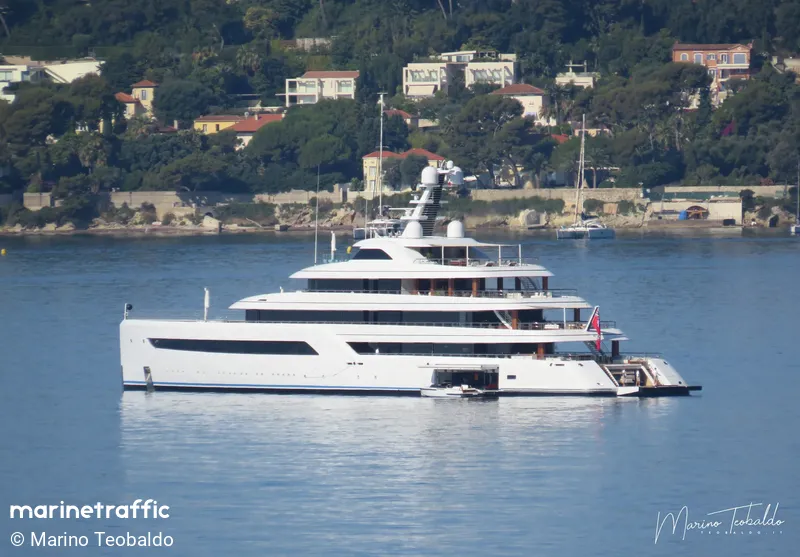
A vessel’s position is the boat’s, not the owner’s. Ownership is as reported, not certified.
Built by Feadship in 2021, ZEN carries a gross tonnage that defies the yard’s historical preference for slender, fast-displacement hulls. Her dimensions point to a buyer who prioritised deck space and stability over ocean-crossing pace, a choice that reshapes how we read her steel.
The arithmetic of a superyacht begins with gross tonnage, a measure of enclosed volume that carries more architectural weight than length overall. ZEN measures 88.38 metres from bow to stern, with a beam of 13.0 metres and a registered gross tonnage of 2,562. Dividing the tonnage by the length yields a ratio of approximately 29.0. For a Feadship of this era, that number sits well above the standard band. Yards that specialise in long-range performance typically keep their volume-to-length quotients closer to twenty-five. A higher figure means the designers were instructed to stack more square metres across the waterline. It translates directly into wider corridors, taller salons, and additional habitable decks without extending the hull itself.
The beam supports that calculation. At 13.0 metres, ZEN’s breadth-to-length ratio stands at roughly 0.147. That proportion grants substantial initial stability, which reduces rolling in heavy seas but increases wetted surface area. More surface area demands more engine power to maintain a given speed. The arithmetic here signals a clear trade-off: the owner accepted a modest top-end velocity in exchange for a roomier, more comfortable platform. Feadship has always balanced these competing demands, but ZEN’s proportions lean decisively toward interior capacity. The exact layout of the interior cabins has not been published, but the volume quotient leaves little doubt about the brief.
The yard and the design
Feadship operates through a cooperative structure linking Royal Van Lent Shipyard and Koninklijke De Vries Scheepsbouw, with naval architecture handled by De Voogt Naval Architects in Hoofddorp. The organisation maintains four construction sites across the Netherlands. One dry dock in Amsterdam handles vessels up to 160 metres, while a facility in Makkum accommodates hulls exceeding 120 metres. ZEN was constructed at the De Voogt facility, which falls comfortably within the standard capacity range for an eighty-eight-metre project. The yard’s history traces back to 1849, when the Akerboom family purchased a small shipyard off the Dutch coast, eventually merging with the Van Lent and De Vries families to form the modern cooperative in 1949. LVMH acquired Royal Van Lent in 2008, injecting capital that expanded the Amsterdam Westpoort dock and modernised the Kaag slipways. That investment cycle ran parallel to ZEN’s construction window, ensuring the yard had the heavy-lift cranes and composite workshops necessary to outfit a high-volume hull without compromising structural integrity.
The decision to build at a Feadship yard carries specific implications for the propulsion layout. Dutch custom builders traditionally favour diesel-electric or hybrid arrangements to minimise vibration and noise, particularly when the hull form prioritises comfort over raw speed. ZEN’s estimated value sits at 200,000,000 dollars, a figure that aligns with the complexity of fitting out a high-volume hull while maintaining the quiet-running standards expected at this end of the market. The registration lists Cayman Islands as her flag and George Town as her home port, indicating a structure optimised for international cruising rather than domestic registry. Cayman Islands registration provides a neutral jurisdiction for owners navigating complex tax treaties, a practical necessity for a vessel of this scale operating across multiple economic zones.
The capital behind the steel
The owner is reported as Jack Ma, a Chinese business magnate whose wealth originates from co-founding Alibaba Group in 1999. His net worth is recorded at 37,300,000,000 dollars. The origin of that fortune places strict boundaries on how such assets are deployed. Chinese regulatory scrutiny following the 2020 halt of Ant Group’s initial public offering tightened capital controls and reduced the visibility of offshore spending. A vessel of this scale requires a holding company that can navigate those restrictions without attracting attention. Ma launched his first commercial website, China Pages, in 1995 after recognising the absence of Chinese business listings online. That early pivot to digital infrastructure explains his familiarity with cross-border systems, but it does not dictate maritime preferences.
Ma’s background as a translator and lecturer before launching China Pages in 1995 explains his familiarity with cross-border digital infrastructure, but it does not dictate maritime preferences. The purchase of ZEN reflects a broader pattern among Asian billionaires who move away from ostentatious, high-profile designs toward quieter, more functional platforms. The 2021 delivery date coincides with a period when several high-net-worth individuals reassessed their asset allocation after pandemic-related disruptions. The timing suggests a calculated acquisition rather than a spontaneous luxury purchase. The capital required to fund a 200,000,000 dollar hull comes from diversified equity holdings rather than liquid cash reserves, meaning the yacht functions as a stored asset class rather than a consumable expense. The cooperative model of Feadship allowed the yard to source materials across its member facilities, mitigating supply chain bottlenecks that delayed many contemporary builds.
Where she sits in the register
Comparing ZEN to the wider fleet clarifies how unusual her proportions actually are. Most motor yachts between eighty and ninety metres cluster around a gross tonnage of two thousand to two thousand three hundred. ZEN exceeds that band by over three hundred tons. Only a handful of hulls in the same length bracket push past the twenty-eight mark on the volume-to-length ratio. Those outliers tend to share a common trait: they were ordered specifically for extended family living or charter operations, where interior capacity outweighs performance metrics. Her estimated value sits at 200,000,000 dollars, a figure that aligns with the complexity of fitting out a high-volume hull while maintaining the quiet-running standards expected at this end of the market.
Tracking the stillness
AIS broadcasts place ZEN off the coast of Alaska in the Gulf of Alaska at 56.15° N, 134.60° W. The latitude confirms a seasonal routing pattern consistent with northern hemisphere summer cruising. The absence of recent voyage tracks in the media pack indicates she may be undergoing maintenance or waiting in a sheltered anchorage. The last transmission timestamped at 1785814766 corresponds to late March 2026, suggesting a prolonged period of stillness that aligns with the winter lay-up schedule for Pacific Northwest waters. Her flag is listed as Cayman Islands, with George Town designated as her home port, indicating a registry optimised for international cruising rather than domestic compliance.
Reporting and data: CelebYachts, republished by On the record.
Sources
The numbers on this page point here. Each one links to the record it came from.
- 1CelebYachtsCelebYachts: The arithmetic of ZEN’s hull