
 CelebYachts reportYards & Design
The beam and the ledger
Comparing Kingdom 5KR and Luminosity shows how Benetti’s design priorities shifted from speed to volume, driven by different eras of wealth and shipyard…
By On the record · Aug 31, 2026 · Data from CelebYachts1
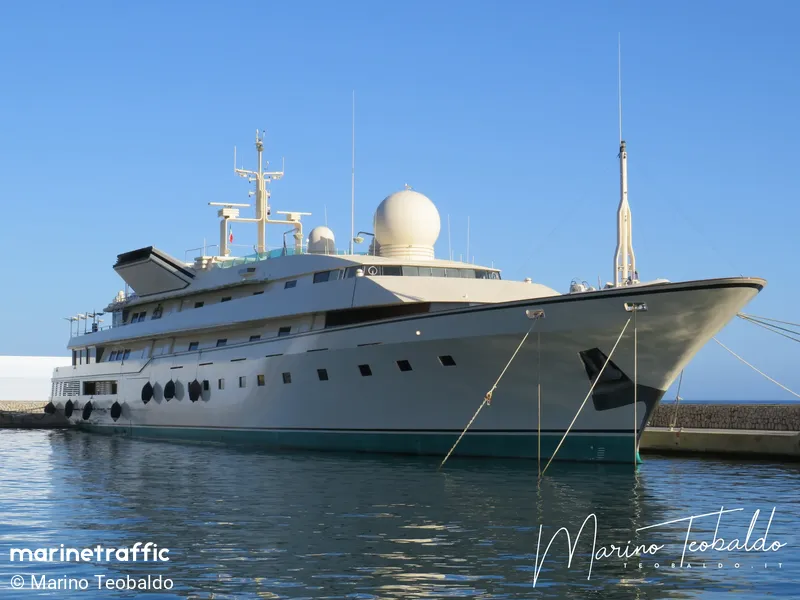
A vessel’s position is the boat’s, not the owner’s. Ownership is as reported, not certified.
Four decades separate these two Benetti motor yachts, yet they share a single builder and a common lineage of wealthy owners. Their physical divergence—the jump from a narrow, fast hull to a wide, voluminous one—tracks the changing economics of superyacht construction and the specific financial engines that fund them.
Kingdom 5KR and Luminosity were both constructed at the Benetti yard in Viareggio, but they occupy opposite ends of a structural evolution that redefined what a superyacht could carry. The 1980 vessel measures 86.01 metres in length with a beam of 13.23 metres and gross tonnage of 2,328. The 2022 vessel stretches to 105.0 metres, carries an 18.0-metre beam, and registers 5,844 gross tonnes. The length difference is modest, yet the tonnage more than doubles. That discrepancy reveals the core mechanism of modern megayacht design: engineers stopped increasing length to gain space and started widening beams instead.
The slipway constraint
In 1980, hydrodynamic efficiency dictated form. A narrower beam reduced wetted surface area, allowing the NOHAB Polar engines to push the hull toward a top speed of 20 knots and a cruising speed of 17.5 knots without excessive fuel burn. The 13.23-metre profile kept drag manageable for the propulsion technology of the era. Stability was achieved through displacement and careful weight distribution rather than sheer width. The result was a vessel optimised for movement, with a fuel capacity of 515,000 litres supporting extended transits across open water.
By 2022, the engineering calculus had shifted. Computer-controlled stabilisers and advanced ballast management removed the need for a narrow silhouette to maintain stability. Builders could expand the beam to 18.0 metres without compromising seaworthiness or speed potential. The extra width translated directly into interior volume, which became the primary commodity for new-build clients. The gross tonnage ratio illustrates the change clearly: Kingdom 5KR yields roughly 27 gross tonnes per metre of length, while Luminosity delivers over 55. The 105-metre hull achieves this volumetric density by spreading outward rather than stretching forward.
This dimensional shift imposes a physical cost on maintenance and dry-docking. An 18.0-metre beam excludes a vessel from many historic Mediterranean slips designed for 1980s-era hulls. Kingdom 5KR fits within standard mid-century maintenance facilities; Luminosity requires specialised heavy-lift infrastructure or expanded partner yards. The original slipway dimensions at Benetti and competing yards dictated the maximum beam available in 1980, effectively capping the size of vessels that could be serviced locally. Modern builds bypass that constraint by utilising larger basins, but they trade accessibility for interior space.
The interior layout and propulsion specifications for Luminosity have not been published. The available data confirms her Cayman Islands flag, her 2022 delivery year, and her registration under Andrey Guryev Jr. Without floor plans or engine schematics, the analysis must rely on the external dimensions and the tonnage figures that are publicly recorded. Those numbers alone establish that the 2022 build prioritises habitable volume over the hydrodynamic constraints that shaped its predecessor.
The provenance chain
Kingdom 5KR entered service as Nabila, built for Saudi billionaire Adnan Khashoggi in 1980. Khashoggi’s fortune derived from global arms contracting and construction, liquid enough to absorb a $100 million outlay during the peak of 1970s oil wealth. When his finances tightened, the yacht entered a secondary market that functioned as a barometer of late-twentieth-century liquidity cycles. It sold to the Sultan of Brunei, then transferred to Donald Trump for $29 million in 1988. Trump renamed it Trump Princess and secured special dredging permits to dock it in Atlantic City, a project completed in months with support from Roger Stone and the lobbying firm Black, Manafort, Stone and Kelly.
Prince Alwaleed bin Talal acquired the vessel in 1991 for $20 million, renaming it Kingdom 5KR after his investment company, his lucky number, and his children’s initials. Alwaleed is a grandson of Abdulaziz, the first king of Saudi Arabia, and his wealth stems from diversified equity holdings and sovereign-linked investments. The yacht’s trajectory mirrors a period when high-net-worth assets circulated freely among political figures, financiers, and entertainers. Ownership changed hands based on personal preference and liquidity availability, with each sale reflecting a distinct chapter in private asset trading.
Luminosity represents a different capital structure entirely. She was delivered new in 2022 to Andrey Guryev Jr, who took over PhosAgro, the phosphate-based fertiliser producer founded by his father in the 1990s following the collapse of the Soviet Union. The Guryev family controls nearly 50% of the company, positioning the yacht as a direct derivative of post-Soviet industrial privatization. Unlike Kingdom 5KR, which moved through multiple private sales, Luminosity emerged as a custom order, reflecting a modern preference among certain wealth classes for new builds rather than second-hand acquisitions.
Andrey Guryev Jr was added to the European Sanctions list on 9 March 2022 for providing a substantial source of revenue to the government of the Russian Federation. The UK government imposed parallel restrictions in the same year. These regulatory frameworks constrain the deployment of such assets regardless of their technical capabilities. Insurance availability, port state control checks, and routing permissions now dictate operational radius more than engine output or fuel capacity. The yacht remains registered under the Cayman Islands, but its movement patterns reflect a fragmented compliance landscape rather than navigational range.
Current tracking
Public AIS broadcasts place Kingdom 5KR at 43.52° N, 6.97° E in the Ligurian Sea. Her last broadcast timestamp aligns with routine coastal transit patterns. The vessel retains her original propulsion architecture and maintains a cruising profile consistent with her 1980 specifications. She moves through established superyacht corridors, operating within standard maritime insurance and port access frameworks.
Luminosity appears at 42.43° N, 18.69° E in the Adriatic Sea. Her routing strategy differs from the western Mediterranean pattern, likely influenced by the sanctions regime affecting her owner. The Adriatic offers alternative anchorage points, but the legal restrictions remain binding regardless of geographic location. Both yachts continue broadcasting via public AIS, but their movement patterns tell separate stories about accessibility and operational freedom. One navigates conventional commercial waters; the other operates within a constrained regulatory perimeter.
The comparison between these two Benetti hulls measures more than forty years of incremental growth. It tracks a deliberate engineering pivot from narrow, speed-optimised forms to wide, volume-driven platforms. It also records how the sources of funding shifted from arms-dealing liquidity to industrial privatization, and how contemporary sanctions reshape deployment strategies. The steel changed shape, the tonnage doubled, and the owners changed, but the underlying mechanics of superyacht construction remained tied to the same fundamental constraints: slipway dimensions, beam limits, and the financial engines that pay for the build.
Reporting and data: CelebYachts, republished by On the record.
Sources
The numbers on this page point here. Each one links to the record it came from.
- 1CelebYachtsCelebYachts: The beam and the ledger