
 CelebYachts reportYards & Design
Why Lionheart is narrow: the Benetti shed limit
Lionheart’s 14.4-metre width shows how Benetti’s Livorno sheds set her shape, not Sir Philip Green’s wish for space.
By On the record · Sep 7, 2026 · Data from CelebYachts1
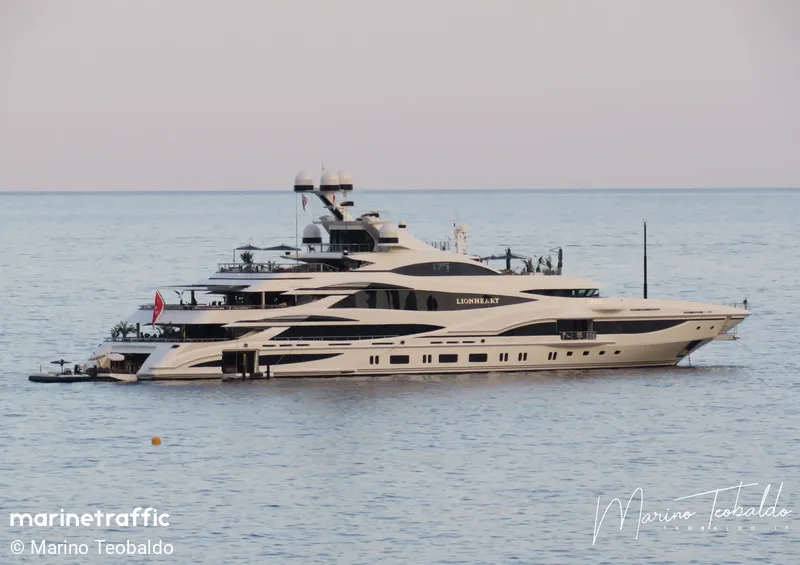
A vessel’s position is the boat’s, not the owner’s. Ownership is as reported, not certified.
The 90-metre motor yacht carries 2,997 tonnes of gross tonnage. This volume figure exposes the spatial compromises forced by shipyard infrastructure. The unpublished interior reflects a layout optimised for vertical separation. It proves that the vessel’s architecture answered to the dimensions of the shed, not the scale of the owner’s fortune.
Lionheart is a 90-metre motor yacht built by Benetti in 2016. Her owner is the Sir Philip Green family. She flies the Maltese flag and is registered in Valletta. Her gross tonnage stands at 2,997. This number measures her total internal space.
Her most striking dimension is her beam, or width. It measures 14.4 metres. This number comes from the building shed at Benetti’s Livorno yard. The shed sets a hard limit on hull width.
The floor plan follows this rule. It uses height instead of width. Machinery needs to be kept away from guests. The layout answers to the shed size first.
How did the Livorno shed set the beam?
Benetti has three main yards in Italy. They are in Viareggio, Fano, and Livorno. Lionheart was built at the Livorno site. This yard has a covered area of 30,000 square metres. Its production area covers 28,000 square metres.
Azimut-Benetti bought the Livorno site in 2003. The old yard was in trouble then. Benetti knocked down part of it. They made a commercial zone called Porta a Mare.
The harbour entrance holds six huge sheds. These structures hold large yachts. Workers removed the Morosini slip. They built a marina to berth the new vessels.
The shed width sets the max beam for any yacht inside. Lionheart’s 14.4-metre beam fits this limit. A wider hull would not fit through the doors. The architect had to work within this fixed space.
This rule shapes the whole vessel. Other Benetti yards have different sizes. The Viareggio yard expanded in 1997. It handles yachts up to 70 metres indoors. The Livorno yard handles larger vessels but has stricter width limits.
The result is a long but narrow hull. A 90-metre yacht can often be wider if built elsewhere. Lionheart’s shape comes from the Livorno infrastructure. The shed size drives her beam.
What does the volume budget allow?
Gross tonnage measures internal space, not weight. Lionheart carries 2,997 GT. This is a lot of space for a 90-metre hull. However, the shape of that space is defined by the beam. The narrow width means the inside is tall rather than wide.
The designer had a clear brief. They had to use the 14.4-metre space well. This usually leads to more decks or higher ceilings. Height becomes a priority. Rooms are stacked rather than spread out.
Machinery needs to be separated. Large yachts house big engines. These need to be far from guest areas. Noise and vibration must be controlled. The narrow beam makes this hard. Engineers place machinery carefully.
The floor plan is not public. Owners like Sir Philip Green keep plans private. We cannot see the materials or room layouts. This secrecy is common for yachts of this value.
Despite no photos, the rules show outside. The beam tells us the inside cannot have wide lounges on every deck. The layout must be efficient. Corridors and walls take up a fixed share of the space.
Who paid for Lionheart and why?
Sir Philip Green is a British businessman. He was born in 1952. He rose to fame as chairman of the Arcadia Group. This retail empire owned brands like Topshop, Topman, and Miss Selfridge.
Green bought Sears plc in 1999. He bought British Home Stores for £200 million in 2000. His biggest move was buying Arcadia in 2002 for £840 million. This deal made Arcadia private. It left the London Stock Exchange.
Arcadia ran over 2,500 shops in the UK at its peak. It also had spots in major department stores. The group made strong cash flow. This wealth funded Green’s assets, including his yacht and jet.
Lionheart cost an estimated $150 million to build. Industry reports give this figure. The exact price is not confirmed. It matches the cost of other 90-metre custom superyachts from Benetti.
Green’s net worth was £910 million in May 2023. This is less than earlier peaks. Arcadia went into administration in 2020 due to the pandemic. ASOS bought the Topshop brands in 2021. He still has the money to own such vessels.
Where is Lionheart now?
AIS data tracks Lionheart’s position in real time. In August 2026, she was active in the Mediterranean. She moved between Italian ports and Greek waters. Her moves were frequent but short-distance.
On August 17, she sailed from Castellammare di Stabia to Naples. The distance was 11.5 nautical miles. She then moved to Sorrento later that day. These trips suggest local cruising or provisioning.
In late August, she crossed to Sardinia. She travelled from Palau to Monaco on August 23. This leg covered 203.4 nautical miles. She maintained an average speed of 13.5 knots. This is a typical transit speed for a yacht of her class.
By September 1, she was back near Saint-Tropez. She moved to Monaco again. This final leg was 40.5 nautical miles. She covered it slowly, averaging 7.3 knots. This suggests anchoring or slow maneuvering in busy harbours.
Her last recorded position was in the Ionian Sea. The coordinates are 38.36° N, 20.75° E. She has remained stationary there since late August. This stillness may indicate a charter period or simply resting at anchor.
How does Lionheart compare to peers?
Lionheart sits in a crowded market segment. Many 90-metre yachts exist. However, few share her specific beam constraint. Most new builds aim for maximum beam to increase interior volume. Lionheart’s width is capped by the shipyard.
Yachts built in newer yards often exceed 15 metres in beam. This allows for wider sundecks and larger master suites. Lionheart’s 14.4-metre beam is modest for her length. It reflects the era of her construction and the yard’s limitations.
Benetti continues to build large yachts. Their newer models use the Viareggio or Fano yards for greater flexibility. Lionheart remains a record of Livorno’s capacity. She proves that even wealthy owners must adapt to shipyard realities.
The design compensates for the narrow beam. Tall ceilings and smart storage help. The focus on vertical space creates grandeur. Guests experience height rather than width. This approach works for the layout.
Reporting and data: CelebYachts, republished by On the record.
Sources
The numbers on this page point here. Each one links to the record it came from.
- 1