
 CelebYachts reportInvestigations
The charter rhythm of the Maltese Falcon
AIS tracking data from August 2026 reveals a commercial itinerary defined by rapid island-hopping and sustained auxiliary power, proving the vessel operates as a high-efficiency charter platform rather than a leisure cruiser.
By On the record · Sep 30, 2026 · Data from CelebYachts1
A vessel’s position is the boat’s, not the owner’s. Ownership is as reported, not certified.
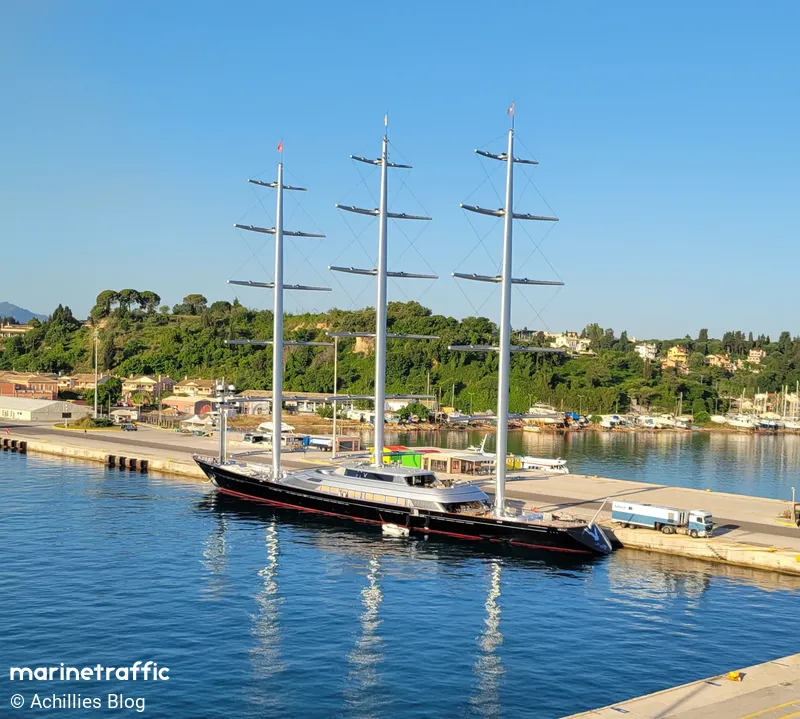
The Maltese Falcon’s position archive for August 2026 records eight distinct passages across the Cyclades, averaging over ten knots and covering nearly two hundred and thirty nautical miles. This pattern demonstrates that a speculative hull, launched in 1989 and completed sixteen years later, survives today by functioning as a mechanised transport asset rather than a traditional superyacht.
The Maltese Falcon’s tracking data for August 2026 does not show a leisure cruise. It records eight distinct passages across the Cyclades, covering roughly two hundred and thirty nautical miles in twelve days, with an average speed exceeding ten knots. A vessel of one thousand one hundred gross tonnes rarely maintains that pace under sail alone. The AIS broadcast traces a commercial rhythm: short hops between ports, rapid departures, and a complete absence of prolonged anchorage. This is the operational signature of a charter platform built on a speculative hull that survived decades of market indifference by prioritising mechanical efficiency over traditional cruising habits.
The speculative skeleton
The Maltese Falcon began life as an unfinished project. Perini Navi launched her bare hull in Tuzla, Istanbul, between 1989 and 1990, but the aftermath of the Gulf War left the yard without buyers. The steel sat idle until 2001, when Tom Perkins, a keen yachtsman and owner of two Perini ketches, acquired the incomplete vessel. Perkins commissioned Dutch naval architects Dykstra to adapt a nineteenth-century clipper profile into a modern three-mast square rig. The resulting system, known as the DynaRig, was engineered by Insensys Ltd, a British carbonfibre specialist led by Damon Roberts. The design replaced traditional standing rigging with three self-standing rotating masts, each measuring approximately fifty-seven metres above the bearing point.
Perkins oversaw the integration of these masts directly at the Tuzla premises. The masts feature symmetrical elliptical sections and rotate about deck and keel bearings, allowing unrestricted flow for all points of sail. Each mast supports six rigid yards with a built-in twelve per cent camber. Between them sit fifteen furling sails that store inside the mast structure and deploy along yard tracks in six minutes. To monitor structural integrity during operation, Insensys embedded a fibre optic strain system using fibre Bragg gratings during the wet layup of the carbonfibre spars. The load data transmits directly to bridge monitors. Ken Freivokh designed the interior layout, and Perini Navi completed the outfitting. The yacht entered service in 2006.
Original valuation figures remain contested. Perkins publicly estimated the final cost at between one hundred and fifty million dollars and three hundred million dollars in late 2007. By 2009, brokers listed the vessel for one hundred and fifteen million euros before dropping the price to seventy million euros following a change of flag. The current registered estimate places the asset at one hundred million dollars. The hull changed hands again when Pleon Ltd purchased it for charter operations, eventually transferring ownership to Luca Rovati. Perini Navi founded the yard in Viareggio in 1983, pioneering automation and furling systems in large sailing yachts. The ships it built became among the largest in their class. The yard operated independently until 2021, when financial pressures forced a bankruptcy sale. The Italian Sea Group acquired the assets for eighty million euros, absorbing the technical staff and intellectual property that originally shaped the Falcon’s design.
The mechanics of motion
The passage from Astypalaia to Patmos on 9 August covered forty-nine nautical miles in eleven hours, averaging eleven-point-seven knots with sixty-seven per cent coverage. The following day, the vessel moved twenty-nine nautical miles from Santorini to Naxos in three hours, maintaining an average speed of eight-point-eight knots despite a peak of eleven-point-six knots. On 11 August, a thirty-two-nautical-mile run from Amorgos to Antiparos took less than three hours, averaging ten-point-three knots at a maximum of twelve-point-eight knots. The sequence continued with a five-nautical-mile local movement around Antiparos on 15 August, followed by a thirty-four-nautical-mile crossing to Milos on 16 August that averaged eleven-point-two knots over thirteen hours.
The longest segment began on 17 August, departing Folegandros for Amorgos at sixty-two nautical miles, completed in fifteen hours with an average of eleven-point-six knots and sixty-one per cent coverage. The final legs returned to shorter hops: a thirty-seven-nautical-mile run from Naxos to Sifnos on 19 August, and a fifteen-nautical-mile transfer to Serifos on 20 August, both executed at high average speeds. Coverage percentages ranged from forty-one per cent to one hundred per cent, indicating consistent satellite tracking throughout the period. These velocities require sustained auxiliary power, confirming that the yacht functions primarily as a motor-sailer rather than a pure wind-driven craft.
This level of transit relies on the rig’s aerodynamic efficiency. The fifteen square sails are set between the yards in such a way that when deployed there are no gaps in the sail plan of each mast, enabling them to act as a single airfoil. The furling sails are stored in the mast and can be deployed along tracks on the yards in six minutes. The sails are trimmed by rotating the masts. As there is no rigging, the masts and yards can be rotated without restriction for all points of sail, making the vessel a capable upwind clipper. Because the rig can be tacked to allow flow in both directions, the mast rotates about deck and keel bearings and has symmetrical elliptical sections for better aerodynamics in both flows.
The control architecture enables this hybrid performance. Perkins personally authored portions of the vessel’s unique control software, which automates parameter detection including wind speed and direction. While an operator must still activate the controls, the system allows a single person to manage the rig and propulsion. The computer cross-references the fibre optic strain readings with real-time aerodynamic loads, adjusting sail deployment accordingly. This automation reduces crew requirements and accelerates departure times, a practical necessity for a commercial charter operation navigating busy island lanes.
The vessel has demonstrated this capability repeatedly. In December 2007, Perkins noted on BBC World Service that the computer could detect environmental parameters automatically. The system’s responsiveness also carries risks. On 4 November 2008, the Falcon collided with a forty-foot sloop in San Francisco Bay during the Leukemia Cup regatta, illustrating the challenges of manoeuvring a large, highly automated sailing vessel in confined waters.
The charter circuit
Ownership transitioned to Luca Rovati, an Italian businessman who directed investment activities through the family office Fidim following the 2014 sale of the pharmaceutical company Rottapharm. Rovati serves as the Sovereign Military Order of Malta’s Ambassador to Greece, a diplomatic posting that aligns with the vessel’s long-term Aegean base. The yacht flies the Maltese flag and is home-ported in Valletta, yet her operational geography remains fixed in the Greek archipelago.
The August track confirms a structured itinerary. Departures occurred almost daily, linking Astypalaia, Patmos, Santorini, Naxos, Amorgos, Antiparos, Paros, Milos, Folegandros, Sifnos, and Serifos. The routing follows established ferry corridors, minimising transit time between anchorages. The vessel logged one thousand eight hundred and ninety-nine engine hours prior to the 2009 broker listing, a metric that underscores the reliance on mechanical propulsion for scheduled movements. Today, those hours have accumulated further, but the underlying pattern remains unchanged: efficient point-to-point transit rather than extended exploration.
The Falcon has won multiple industry prizes, including the 2007 Boat International World SuperYacht Award for Sailing Yacht of the Year and victories at the Perini Navi Cup regattas in 2009, 2011, and 2018. These accolades recognise the technical achievement of the DynaRig system, but they do not dictate the vessel’s current utility. The hardware proves capable of high-speed passage; the commercial model dictates how often it runs those engines.

Reporting and data: CelebYachts, republished by On the record.
Sources
The numbers on this page point here. Each one links to the record it came from.
- 1