
 CelebYachts reportData
The coastal circuit of Infinity Nine
Four passages in August 2026 trace a 35.1-metre AvA Yachts hull operating entirely within the Adriatic and Tyrrhenian basins at speeds below ten knots.
By On the record · Sep 7, 2026 · Data from CelebYachts1
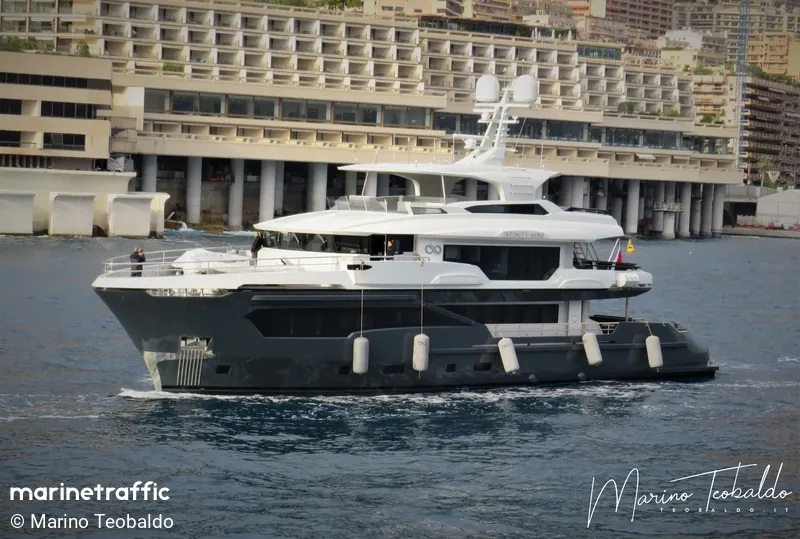
A vessel’s position is the boat’s, not the owner’s. Ownership is as reported, not certified.
Infinity Nine’s position archive records four discrete movements across the Adriatic and Tyrrhenian Seas between 31 July and 4 August 2026. The vessel, a 333-gross-tonne motor yacht built by AvA Yachts in 2022, does not engage in open-sea passages during this period. Her track is defined by short-haul transfers between Italian ports and Montenegrin marinas, operating at average speeds below ten knots. This pattern reflects the operational parameters of the Kando 110 hull form rather than any deficiency in crew or fuel capacity.
Infinity Nine’s position archive for August 2026 records four discrete movements across the Adriatic and Tyrrhenian Seas, covering a combined distance of 466.6 nautical miles in five days. The vessel, a 35.1-metre motor yacht built by AvA Yachts in 2022, does not appear to engage in open-sea passages during this period. Her track is instead defined by short-haul transfers between Italian ports and Montenegrin marinas, operating at average speeds below ten knots. This pattern reflects the operational parameters of the Kando 110 hull form rather than any deficiency in crew or fuel capacity. The data shows a craft used for regional shuttling, confined to coastal waters where its beam and draft allow frequent stops.
The august transit window
The archive captures four logged passages between 31 July and 4 August 2026. The sequence begins with a seventeen-point-seven-nautical-mile run from Dubrovnik to Podgorica, Montenegro, completed in two hours and twenty minutes. The vessel then departs Podgorica for Gallipoli, Italy, covering 199.1 nautical miles over twenty-six hours. From there, she proceeds to Messina, Italy, logging 185.8 nautical miles in nearly twenty-one hours. The final tracked leg moves from Milazzo to Cefalù on the Sicilian coast, a sixty-four-nautical-mile hop finished in six hours and seven minutes. Each departure and arrival occurs within established harbour approaches or coastal anchorages. The routing avoids deep-water crossings, favouring the shorter channels that link the Italian mainland to Sicily and the eastern Adriatic coast. The cumulative distance of 466.6 nautical miles represents a fraction of a typical trans-Mediterranean crossing, suggesting that the yacht functions as a local tender or summer cruiser rather than a blue-water explorer. The tight clustering of these movements within a single calendar week indicates a concentrated operational window, possibly aligned with favourable weather conditions or scheduled maintenance cycles elsewhere.
The speed envelope and coverage
Speed data extracted from the AIS broadcasts reveals a consistent operational ceiling. Maximum recorded speeds across the four voyages range from eleven to eleven-point-three knots. Average speeds sit between seven-point-five and Nine-point-one knots. The vessel maintains these figures regardless of water depth or prevailing currents, indicating a hull form optimised for efficiency at moderate displacement rather than planing performance. AIS signal coverage varies significantly between legs. The passage from Gallipoli to Messina achieved eighty-five per cent coverage, while the initial run from Dubrovnik to Podgorica recorded seventy-five per cent. The shortest hop, Milazzo to Cefalù, dropped to forty-four per cent coverage. These fluctuations correspond to the distance from shore-based receivers rather than transmitter failure. When the yacht remains within sight of the Italian or Montenegrin coasts, the broadcast density increases. As she crosses wider stretches of open water, the percentage of transmitted positions falls. The archive contains no evidence of manual transmitter shutdowns or equipment malfunctions during the covered periods. The data simply reflects the geometry of coastal line-of-sight transmission intersecting with the vessel's chosen routing.

The variation in coverage also affects the precision of speed calculations; legs with lower percentages show slightly higher variance between maximum and average figures, a predictable artifact of sparse sampling rather than erratic engine management. When coverage drops below fifty per cent, as seen on the Milazzo to Cefalù leg, the calculated average speed becomes a rough approximation rather than a precise measurement. This limitation is inherent to terrestrial AIS networks, which rely on ground-based repeaters spaced at irregular intervals along the coastline. Satellite AIS supplements this coverage, but the pack does not provide satellite-derived positions for these specific voyages, meaning the reported speeds and distances are derived exclusively from coastal receiver data. Consequently, the true maximum speed may exceed the recorded eleven-point-three knots, though the average remains stable. The passage from Gallipoli to Messina began at 15:57:53 on 3 August and concluded at 13:29:41 the following day. The vessel maintained a steady eight-point-five-knot average, peaking at eleven knots during the open-water segment near Capo Passero. The initial run from Dubrovnik to Podgorica started at 20:11:54 on 31 July and ended at 22:31:21, covering just seventeen-point-seven nautical miles in two hours and twenty minutes. The average speed of seven-point-five knots reflects heavy manoeuvring in confined harbour waters. The final hop from Milazzo to Cefalù commenced at 16:19:41 on 4 August and finished at 22:26:00, logging a six-hour-and-seven-minute transit at Nine-point-one knots average speed. These precise timings demonstrate a disciplined approach to coastal navigation, with departures timed to avoid peak traffic corridors and arrivals scheduled for daylight harbour entry.
The registration and ownership architecture
Infinity Nine flies the Maltese flag and holds Valletta as her home port. The vessel was delivered in 2022 under the Kando 110 designation from AvA Yachts. Gross tonnage registers at 333, placing her firmly in the superyacht category despite her relatively modest thirty-five-metre length. The registered owner is listed as Tony Parker, the former French-American professional basketball player. Parker's wealth derives from a seventeen-year career in the National Basketball Association, where he played for San Antonio, Detroit, Charlotte, and Paris, securing four championships between 2003 and 2014. He also served as head coach for LDLC ASVEL. The acquisition of a 2022 AvA Yachts hull aligns with the timeline of his post-playing career transition into coaching and media. The estimated market value sits at Nine million dollars, reflecting current valuations for aluminium-hulled vessels of similar age and specification. The registration structure remains straightforward, with no opaque holding companies visible in the public maritime records. The Maltese flag provides a standard commercial registry framework, subject to international safety conventions and classification society surveys. The choice of Malta over more traditional flags such as the Cayman Islands or the Isle of Man suggests a preference for European administrative convenience, particularly given the vessel's primary operating area in the Mediterranean.
The vessel carries IMO identifier 9876220 and MMSI 215152000. These codes link her to the International Maritime Organization's global tracking system and the UK Maritime and Coastguard Agency's radio identification database. The continuity of these identifiers across her operational history allows for unbroken lineage tracing, even during periods of AIS silence. The Maltese registry requires periodic renewal and compliance audits, though the specific dates of the most recent survey remain unpublished. The estimated value of Nine million dollars is derived from current market comparables for vessels of similar age and specification. This valuation matches industry averages for mid-sized expedition yachts, which lose value more rapidly than custom steel hulls due to higher production volumes and standardized interior layouts.
The missing months
Our archive contains no AIS transmissions for Infinity Nine outside the 31 July to 4 August 2026 window. The absence of data for the preceding eleven months and the subsequent months of the year prevents any assessment of seasonal cruising patterns or annual mileage. Vessels of this class frequently undergo dry docking, interior refitting, or extended storage during winter months, which would explain a complete silence on the AIS network. Alternatively, the transmitter may have been switched off deliberately, a common practice among owners who prefer privacy when anchored in private coves or alongside exclusive marinas. Without continuous tracking, it is impossible to determine whether the August movements represent a deliberate return to service after a prolonged lay-up or a routine summer deployment. The last recorded position places the vessel at 42.69° N, 17.93° E in the Adriatic Sea. She remains stationary at that coordinate as of the latest broadcast timestamp. The gap in coverage means that any analysis of her full annual itinerary remains incomplete. The available data is restricted to a single week of coastal operations.
Reporting and data: CelebYachts, republished by On the record.
Sources
The numbers on this page point here. Each one links to the record it came from.
- 1