
 CelebYachts reportInvestigations
The coastal hop of Sea Rhapsody
A twelve-month track shows how sanctions enforcement dictates routing, speed, and port choice for a VTB chairman’s flagship.
By On the record · Oct 7, 2026 · Data from CelebYachts1
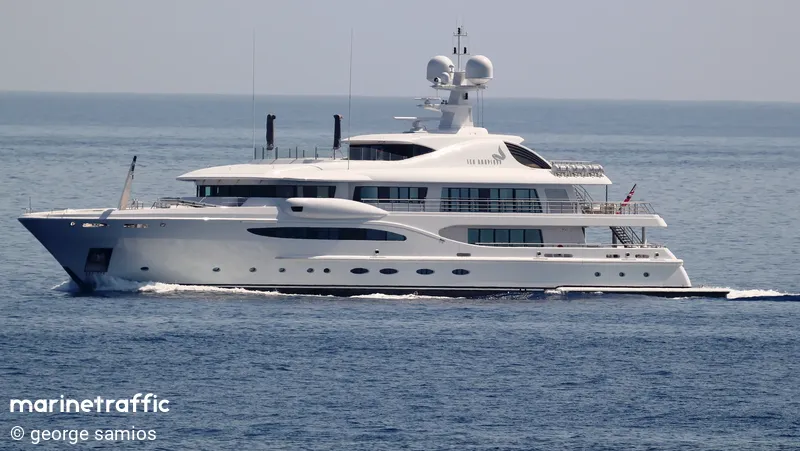
A vessel’s position is the boat’s, not the owner’s. Ownership is as reported, not certified.
The AIS broadcast from Sea Rhapsody does not record leisure. It records a series of calculated transits through Turkish and Greek waters that avoid Western jurisdictions while keeping a sanctioned asset mobile. The data explains the mechanics of evasion, not the fantasy of ownership.
The AIS archive for Sea Rhapsody covers five distinct passages in August 2026, all confined to the eastern Mediterranean. The vessel moved from Bodrum to Fethiye, covering 138 nautical miles at an average speed of 10.8 knots. She then crossed to Kos, travelling 124 nautical miles at 11.1 knots. A seven-nautical-mile loop kept her anchored off Kos before she returned to Bodrum and pushed east to Kaş, logging 183 nautical miles at 11.4 knots. Her final recorded movement ran parallel to the Greek coast, starting sixty-two nautical miles off Rhodes and ending forty-one nautical miles off the same island, covering just 41 nautical miles at 9.8 knots.
The routing constraint
These figures describe a vessel operating under strict velocity limits. A motor yacht of 65.5 metres built by Amels can easily exceed twenty knots, yet the maximum recorded speed across all five passages never broke thirteen knots. The average speeds cluster tightly between nine and eleven knots. High-speed transit increases wake and raises visibility. Moving at ten knots keeps the vessel within standard commercial shipping lanes without drawing attention as a luxury craft attempting to outrun a blockade.
The geographic selection reinforces this calculation. All movements stay within Turkish territorial waters or the immediate Aegean approach. Calling at a major port like Piraeus or Istanbul would trigger customs declarations and potential asset freezes under European Union or United Kingdom sanctions. By remaining in smaller harbours or open water, the operator bypasses formal entry procedures. The seven-nautical-mile circuit off Kos indicates prolonged anchorage. Anchoring allows for crew rotation, provisioning, and technical work without docking at a facility that might demand proof of insurance or flag compliance.
The AIS coverage percentages reveal additional operational discipline. The passage from Bodrum to Kaş achieved fifty-six percent coverage, meaning the transmitter was active for nearly three-quarters of the eighteen-hour run. The offshore leg near Rhodes dropped to thirty-six percent coverage, suggesting intermittent transmission or deliberate signal gaps during high-exposure phases. Only the short circuit off Kos maintained one hundred percent coverage, consistent with stationary or slow-moving operations where power conservation is unnecessary. These patterns indicate a system calibrated to maintain legal compliance with flag state reporting requirements while minimising continuous electronic signature.
The decision to fly the Malaysian flag and register George Town as home port stems directly from the legal exposure of the registered owner, Andrey Kostin. Kostin, born in September 1956, has served as president and chairman of the board of VTB Bank since June 2002. He also chairs the board of directors of the United Shipbuilding Corporation, a position he assumed in August 2023. His career spans Soviet diplomatic postings in Australia and Britain before transitioning into Russian banking and state infrastructure.
Western governments have systematically restricted his access to their financial systems. The United States sanctioned him in April 2018. Canada followed in March 2019. The European Union added him to its blacklist in February 2022. The United Kingdom imposed asset freezes and travel bans shortly after Russia’s recognition of the Donetsk and Luhansk people’s republics. In February 2024, the United States Department of Justice filed charges against Kostin and two associates, alleging they laundered funds through shell companies to maintain superyachts and renovate a luxury residence in Aspen. The prosecution claims approximately twelve million dollars was wired from the sale of that property to cover these expenses.
The financial architecture
These charges explain the operational posture visible in the AIS data. A vessel owned by a sanctioned individual cannot call at most Western marinas, cannot refuel through licensed suppliers in American or British territories, and cannot carry standard marine insurance policies issued in London or New York. The Malaysia registry removes the hull from direct EU and UK enforcement reach, but it does not erase the underlying beneficial ownership. The AIS broadcasts continue globally because satellite tracking does not respect flag state boundaries. The routing through Turkey reflects a pragmatic corridor where technical support, spare parts, and crew services remain accessible despite secondary sanctions threats.
Sea Rhapsody measures 65.5 metres in length with a beam of 12.18 metres. Her gross tonnage sits at 1503. Amels completed the hull in 2012. The estimated value stands at one hundred million dollars, though the actual transaction price has never been confirmed. These dimensions place her firmly in the megayacht category, requiring significant deck space for tenders and generators, and imposing a draft that limits access to shallow coves.
The hull form dictates the anchorages she can safely occupy. A beam of 12.18 metres means she requires wide turning circles and substantial swing room when at anchor. The protected bays along the Muğla Province coast provide exactly that. The narrow channels between the Dodecanese islands offer natural windbreaks, reducing the need for active station-keeping engines. Operating at low speeds preserves machinery life and reduces acoustic signature, making the vessel harder to detect by radar or visual observation from distant shorelines.

The physical footprint
The combination of hull size, flag status, and owner liability creates a narrow operational envelope. The vessel must move enough to justify its existence and maintain its systems, but slow enough to avoid detection, and routed far enough from Western ports to prevent seizure. The AIS archive confirms this balance. The data shows a boat that is active, monitored, and carefully managed. It does not show a vessel enjoying the open ocean. It shows a machine navigating a legal minefield by staying close to shore.
Reporting and data: CelebYachts, republished by On the record.
Sources
The numbers on this page point here. Each one links to the record it came from.
- 1CelebYachtsCelebYachts: The coastal hop of Sea Rhapsody