
 CelebYachts reportInvestigations
The coastal radius of Excellence
Eight passages in August 2026 confine a seventy-nine-metre steel hull to New England waters, revealing how draft and engine power dictate a strictly regional…
By On the record · Oct 14, 2026 · Data from CelebYachts1
A vessel’s position is the boat’s, not the owner’s. Ownership is as reported, not certified.
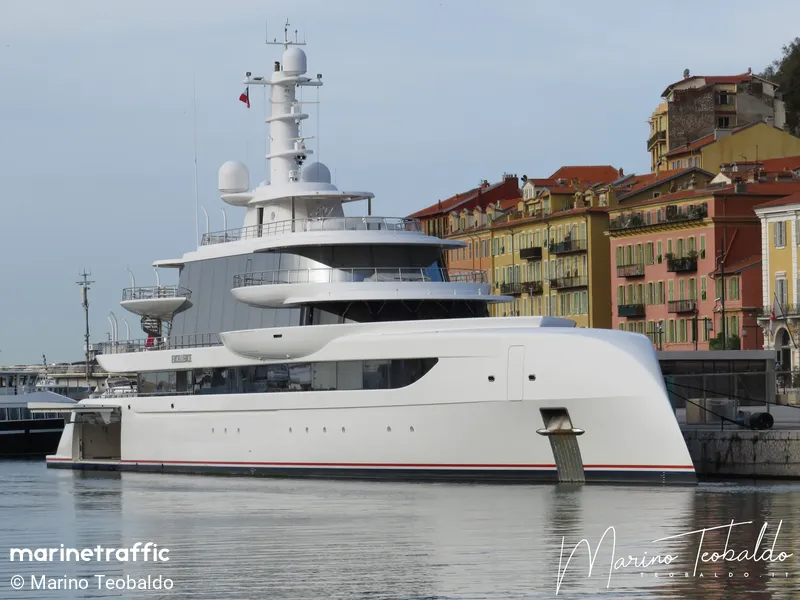
Excellence has logged only five hundred nautical miles in twelve months of tracking, operating entirely within sight of the Massachusetts shoreline. The AIS record proves that a vessel of this tonnage and build quality functions as a high-capacity coastal runner, constrained by a three-metre draught and a twin-engine layout that prioritise reliability over oceanic range.
Excellence measures 79.95 metres in length and displaces 2,115 tonnes under Lloyd's Register classification. She was launched in 2019 by Abeking & Rasmussen at Lemwerder, where the German yard constructed her steel hull and aluminium superstructure. Winch Design handled both exterior and interior styling. The Cayman Islands flag and home port at The Creek sit alongside a specification sheet that reads like a standard Feadship order, yet the open AIS broadcasts tell a different story about how the hull is used. Her owner, Herb Chambers, has kept her inside a narrow band of the US East Coast throughout our entire observation window. The vessel currently rests at 44.20° N, 69.05° W, holding station off the American coastline where she has remained since late August.
The coastal radius
The August 2026 track records eight distinct passages, all originating from or terminating within a 100-nautical-mile circle centred on Boston. The longest leg ran from Milford, Maine, to Boston on 7 August, covering 190 nautical miles in seventeen hours at an average speed of 11.1 knots. The remaining seven movements stayed below 105 nautical miles. Two of those legs departed and returned to Rockland, Maine, covering just six and sixteen nautical miles respectively over single evenings. Another pair shuttled between Provincetown and Boston, while a final sequence linked Newport, Rhode Island, to Falmouth, Massachusetts. The total distance logged across the month sits at 537 nautical miles. A vessel built for transoceanic delivery rarely makes such short hops unless she is being tested or deployed as a local tender. The consistency of the routing suggests a scheduled programme rather than ad hoc leisure travel. Each departure aligns with daylight hours, and every return occurs before nightfall, minimising the navigational risks associated with piloting a 79.95-metre hull through unfamiliar shoals.

Engine limits and draft
The operational ceiling of the hull becomes clear when the performance figures are examined against the route map. Excellence carries twin 2,029 horsepower MTU 12V 4000 M65R diesel engines driving two propellers. The manufacturer's rating allows a maximum speed of 17 knots and a cruising speed of 14.0 knots. The August data shows a hard cap at 13.6 knots during the Provincetown to Boston run, with most transits averaging between 9.4 and 11.8 knots. These numbers indicate a conservative throttle setting maintained for fuel economy and noise reduction, which aligns with the zero-speed stabilisers and enclosed swimming platform specified in the design package. The hull does not push past 14.0 knots because the itinerary never demands it, and the engine configuration lacks the redundancy required for extended open-ocean passages in heavy weather. A steel hull of this beam and gross tonnage requires significant power to maintain higher speeds through chop, and the twin setup here is tuned for efficient coastal running rather than Atlantic crossing. Running the engines at 13 knots burns a fraction of the fuel required for sustained 17-knot runs, extending the operational range well beyond the 200-nautical-mile daily limit observed in August.
Her 3.45-metre draught further restricts the routing options. Shallow-draft vessels cannot safely navigate the deeper channels that connect major Mediterranean marinas or access the protected anchorages of the Caribbean. They are instead funneled into sheltered bays and river mouths, which perfectly describes the coastline between Maine and Rhode Island. The August movements consistently hug the protected waters of the Gulf of Maine and Cape Cod Bay, avoiding the exposed swell of the outer Atlantic. Physical constraints imposed by the keel depth and the placement of the machinery spaces beneath the main deck dictate this routing choice. Abeking & Rasmussen built their production halls along the River Weser specifically to accommodate large steel hulls, and the slipway geometry dictates a straight launch profile. Excellence follows that same linear logic in her daily operations, moving point-to-point along established waterways rather than cutting across open sea.
The owner's geography
The geography of the itinerary matches the commercial footprint of the registered owner. Herb Chambers, born in Dorchester in November 1941, built his capital by selling his copier distribution company, A-Copy America, to Alco Standard Corporation in 1983 for $80 million. He immediately pivoted that liquidity into automotive retail, purchasing an Oldsmobile-Cadillac dealership in New London, Connecticut, in 1985. That acquisition grew into The Herb Chambers Companies, now a network of sixty dealerships concentrated in the greater Boston metropolitan area. His operations do not extend to the Mediterranean or the Pacific Rim, and neither does the yacht. The home port at The Creek places her directly within the logistical sphere of his corporate headquarters in Somerville, Massachusetts. The August schedule reflects a working rhythm: morning departures from coastal harbours, afternoon returns, and weekend circuits that keep the vessel within helicopter range of his primary business centres. Chambers commutes to his headquarters by private helicopter each Monday, often stopping at dealerships en route, a pattern that mirrors the yacht's own reliance on fixed, short-haul infrastructure.
The interior specification supports this localized usage model. Winch Design arranged a movie theatre, a dedicated gym, an elevator, and a beach club equipped with a jacuzzi and WiFi. The tender garage holds a small sailboat and two WaveRunners, accessories designed for immediate deployment in calm, sheltered waters rather than for offshore recovery operations. The swimming pool and barbecue facilities require stable platforms and predictable weather windows, conditions that the New England summer provides reliably. These amenities function efficiently when the vessel remains within a few hours of a full-service marina, eliminating the need for complex logistics chains that longer deployments demand. The presence of an elevator and multiple entertainment decks indicates a capacity for hosting groups, which aligns with the scale of Chambers' corporate network and the social expectations of New England's financial sector.
Excellence has not crossed an international meridian since our tracking began. Her movements remain confined to state waters and the adjacent federal zone, operating at near-complete AIS coverage across every recorded passage. The absence of transatlantic legs reflects a deliberate operational pattern dictated by hull geometry, propulsion limits, and the geographic concentration of the owner's wealth. A seventy-nine-metre yacht built in Germany can certainly cross oceans, but the steel and aluminium structure of Excellence is currently configured for a much shorter leash. The vessel demonstrates that tonnage alone does not determine range, and that a multi-million-dollar hull can be permanently grounded by its own design parameters.
Reporting and data: CelebYachts, republished by On the record.
Sources
The numbers on this page point here. Each one links to the record it came from.
- 1