
 CelebYachts reportYards & Design
The commercial geometry of Olivia O
The unpublished interior reveals a Support vessel built to commercial specifications rather than a leisure platform
By On the record · Oct 19, 2026 · Data from CelebYachts1
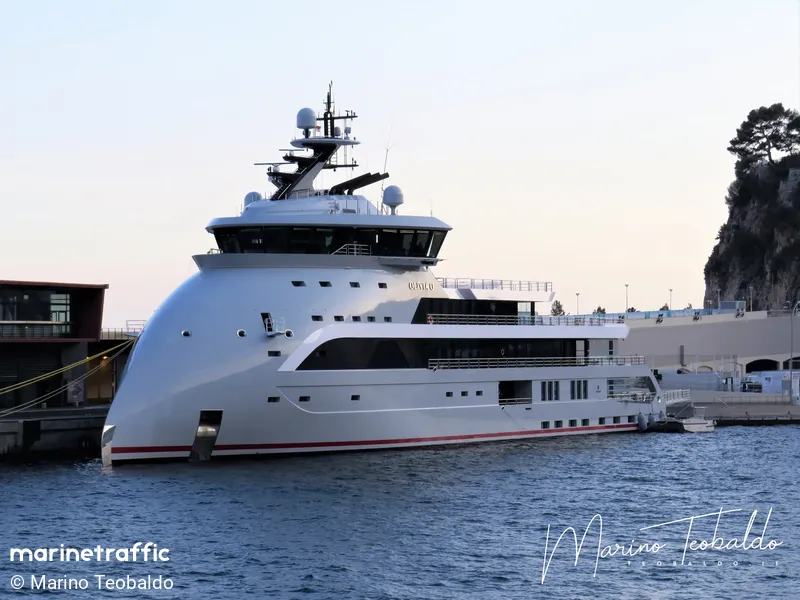
A vessel’s position is the boat’s, not the owner’s. Ownership is as reported, not certified.
The floor plans have never been released, but the steel tells a different story. Olivia O was configured as a Support and explorer asset under Eyal Ofer’s corporate fleet, where volume allocation follows machinery requirements and classification rules rather than salon aesthetics.
The interior of Olivia O has not been published. Where the record is silent on cabinetry, finishes, or commissioned art, the constraints of the hull itself dictate the arrangement. An eighty-eight-point-five-metre length paired with four thousand nine hundred and eighty-nine gross tonnes produces a volume ratio that leaves little room for open-plan leisure spaces. The vessel was classified as a Support and explorer asset, a designation that shifts the priority from guest accommodation to machinery redundancy, crew quarters, and aviation handling. The geometry of the steel reveals a commercial mandate.
The commercial hull form
Gross tonnage measures the total enclosed volume of a vessel, not its displacement, and the relationship between the two figures explains how the interior was partitioned. A ratio of roughly fifty-six point three gross tonnes per metre of length places Olivia O well above the threshold for conventional superyacht layouts. Standard luxury platforms typically operate between forty and fifty gross tonnes per metre, leaving maximum square footage for saloons, decks, and guest cabins. Olivia O exceeds that ceiling because the extra volume was consumed by structural reinforcement, double-bottom tanks, and dedicated machinery spaces required for offshore Support operations.
The beam of sixteen metres further confirms the utilitarian intent. A length-to-beam ratio of five point five to one yields a hull that is narrow relative to its tonnage. Wide-beam designs prioritise interior spread and stability for large tender garages or helicopter pads placed far from the centreline. Olivia O carries a tighter cross-section, which concentrates internal volume along the longitudinal axis. This configuration is standard for vessels that must navigate constrained waterways or dock alongside smaller commercial infrastructure, and it forces the naval architect to stack functional spaces vertically rather than spreading them horizontally.
Classification drives the remaining internal layout. The register lists Olivia O under the category Support and explorer vessels, a classification that subjects the hull to stricter regulatory frameworks than those applied to recreational craft. Survival at sea conventions demand additional watertight subdivision, reinforced escape routes, and independent fire-fighting systems. Each requirement removes usable deck height and reduces the net area available for passenger amenities. The result is a compartmentalised interior where bulkheads, access corridors, and equipment rooms occupy a larger share of the plan than in a comparable leisure yacht.
The yard split and the Maltese registry
Construction history clarifies why the vessel arrived in its current configuration. The register attributes the build to Ulstein Verft, with the hull fabricated by Brodosplit and the final outfitting completed at Palumbo Malta in 2020. This tripartite supply chain indicates a deliberate separation of design, structural fabrication, and interior fit-out. Ulstein supplied the naval architecture and overall project management, while Brodosplit handled the steel cutting and block assembly. Palumbo Malta then took the bare hull for mechanical installation, electrical routing, and exterior finishing.
Outfitting in Malta in 2020 suggests a prolonged delivery schedule or a mid-build reclassification. Moving a hull of this size between yards requires careful dry-docking coordination and extensive surveying to maintain class notation. The delay also aligns with the shift toward commercial Support standards, which often require additional certification steps before a vessel can operate outside protected waters. The Maltese yard would have installed the propulsion trains, generator sets, and auxiliary systems that define the vessel’s operational envelope.
The choice of Malta as the fitting location also determined the registry. Olivia O flies the Maltese flag and uses Valletta as her home port. Malta maintains a dual-purpose register that accommodates both commercial merchant ships and private yachts, allowing operators to switch between regimes depending on the mission profile. A Maltese registration provides access to international commercial contracts, simplifies crew employment across multiple jurisdictions, and satisfies the insurance requirements for offshore Support work. The flag state does not restrict the vessel from leisure use, but it signals that the primary commercial function takes precedence in the legal framework.
The operator’s footprint
Ownership structure reinforces the commercial orientation. The register names Eyal Ofer as the owner, an Israeli billionaire whose wealth originates from shipping, real estate, energy, and technology. He serves as chairman of Ofer Global, Zodiac Group, and Global Holdings, entities that manage diversified industrial assets across Europe, North America, and Asia. His family business began under his father Sammy Ofer, a Romanian-born shipping magnate who established the core maritime portfolio that the group still operates today.
Ofer’s corporate background explains the absence of traditional superyacht features. Commercial shipowners prioritise durability, fuel efficiency, and maintenance accessibility over decorative finishes or expansive social spaces. The capital that funded Olivia O came from long-term industrial investments rather than short-term asset speculation, which favours vessels that can perform repetitive offshore tasks without compromising reliability. The interior layout reflects this discipline, with storage, workshop areas, and technical control rooms occupying the space that a leisure-focused owner might have allocated to entertainment decks or spa facilities.
Deployment and operational reality
AIS broadcasts place Olivia O in the Tyrrhenian Sea at thirty-eight point zero nine degrees north and fifteen point five six degrees east. The coordinates sit within a busy commercial corridor that links Italian ports with Sicilian straits and North African approaches. Vessels operating in this zone typically service offshore wind farms, cable-laying projects, or scientific research expeditions. The lack of recent voyage data in the public record suggests the boat may be engaged in contracted work rather than open-market chartering.
The combination of her classification, builder split, and ownership profile creates a coherent picture. Olivia O was engineered as a working platform first and a luxury residence second. The unpublished interior exists within a shell that prioritises structural integrity, machinery access, and regulatory compliance. Every cubic metre of gross tonnage was allocated to meet the demands of Support operations, leaving a functional layout that serves the commercial objectives of its owner rather than the aesthetic preferences of a leisure market.
Reporting and data: CelebYachts, republished by On the record.
Sources
The numbers on this page point here. Each one links to the record it came from.
- 1