
 CelebYachts reportProfiles
How Feadship builds yachts across four yards
Feadship splits construction across two families and four sites. This network shares one design office to bypass the limits of any single slipway.
By On the record · Jul 25, 2026 · Data from CelebYachts1
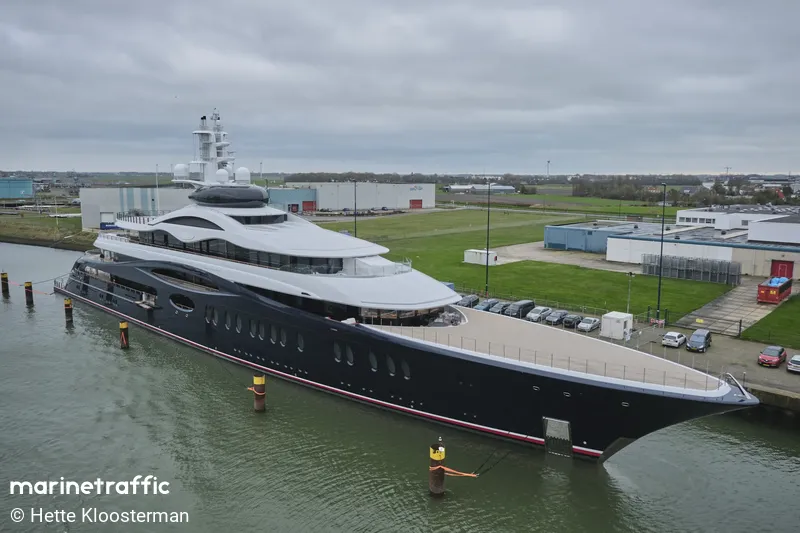
A vessel’s position is the boat’s, not the owner’s. Ownership is as reported, not certified.
Feadship has built twenty-seven hulls by using a distributed network. The yard shares De Voogt Naval Architects with Koninklijke De Vries Scheepsbouw and Royal Van Lent. This structure allows it to build LAUNCHPAD, which sits in Makkum’s 170-metre shed.
Feadship is a cooperative venture between two Dutch shipyards. These are Royal Van Lent Shipyard and Koninklijke De Vries Scheepsbouw. The group operates four separate locations across the Netherlands. They share one central engineering centre.
This model solves a physical problem. No single slipway can hold every yacht an owner might want. By splitting work across multiple sites, Feadship avoids this limit. The fleet reaches 118.9 metres because the Makkum shed is that long. The business survives because the design office coordinates steelwork across borders.
The yard was founded in 1949. Its original name was the First Export Association of Dutch Shipbuilders. The goal was simple. The Dutch government offered export incentives after World War II. European markets had little money for pleasure yachts. The founders wanted to sell to American clients instead.
Why did Feadship start as an export club?
The idea came from naval architect Henri de Voogt. He formed the association in 1949. Several small shipyards joined at first. One was Scheepswerf De Vlijt in Aalsmeer. Another was Jacht & Scheepswerf Van Lent on Kaag. H.W. de Voogt joined the naval architects team in 1950.
Other yards left over time. Scheepswerf E.G. van de Stadt left Zaandam in 1953. Nicolaas Witsen & Vis left Alkmaar in 1957. Het Fort left Nieuwendam in 1958. W.P.M. Akerboom left Lisse in 1968. Mergers reduced the agreement to just three yards by 1966.
The group showed its first steel yacht at the 1951 New York Boat Show. Steel was new technology for North American yachts then. Orders flowed for both steel and aluminum. By the mid-1950s, Feadship stopped building wood. The shift changed the industry standard for custom vessels.
American buyers drove early growth. Henry Ford and Malcolm Forbes owned Feadship yachts. The company launched its US entity in 1977. Don Kenniston became the first general manager. He held the role until 2008. Ted McCumber manages the Americas office today.
Which yards make up the current network?
The modern group has two main owners. Koninklijke De Vries Scheepsbouw owns sites in Aalsmeer and Makkum. Royal Van Lent owns sites in Amsterdam and Kaag. Both families run their operations as family businesses. They share the design and engineering center, De Voogt Naval Architects.
Hoofddorp hosts the headquarters. This is where De Voogt Naval Architects works. The design team plans every hull here. The actual construction happens at the other four locations. This separation keeps engineering consistent while allowing local fabrication.
Aalsmeer is De Vries headquarters. The De Vries Group focuses only on custom superyachts. It received the 'Koninklijk' (Royal) designation in 2006. This marked its centenary. The yard has deep roots in the region.
Makkum opened in 2005. It uses a location active since the early twentieth century. The site has access to deep water. This allows construction of yachts over 120 metres. A 170-metre construction shed sits there. It includes a massive dry dock for large projects.
Kaag is Royal Van Lent headquarters. Roots date back to 1849. Motor and sailing yachts started eighty years ago. They were built out of wood initially. The yard expanded into steel and aluminium rapidly. It now builds only motor yachts. Two launches happen per year on average.
Amsterdam added a new dock in 2019. It is in the Westpoort area. The dock holds superyachts up to 160 meters. It also handles refits for existing Feadship yachts. Management runs from Kaag. The existing team oversees daily operations.
Royal Van Lent got its charter in 2001. De Vries Scheepsbouw got hers in 2006. Each celebrated its hundredth anniversary. LVMH acquired Royal Van Lent in 2008. The ownership change did not alter the cooperative structure.
What does the current order book look like?
The register lists twenty-seven hulls. Their combined length is 2,119.7 metres. LAUNCHPAD is the longest at 118.9 metres. She completed in 2024. MOONRISE measures 102.0 metres and finishes in 2025. PI measures 100.0 metres for the same year.
MOONRISE also has a 2020 version. That hull is 99.95 metres long. Madame Gu is 99.0 metres and finished in 2013. VIVA measures 94.0 metres and completed in 2021. LADY S is 93.0 metres from 2019.
Royal Romance is also 93.0 metres. She launched in 2015. Drizzle is 90.5 metres and finished in 2024. ZEN measures 88.38 metres and completed in 2021. MUSASHI is 87.78 metres from 2011.
Hampshire II is 78.5 metres long. VENUS is 78.2 metres and launched in 2012. Tango measures 77.7 metres and finished in 2011. PI also has a 2019 version at 77.25 metres. BOARDWALK V is 76.5 metres from 2021.
LONIAN measures 74.0 metres and launched in 2018. PODIUM is 72.45 metres and finished in 2020. VANISH is 71.5 metres and completed in 2021. SHERPA is 71.2 metres and launched in 2018. The list shows steady output.
How does the shed size limit growth?
LAUNCHPAD sits within the Makkum shed envelope. The shed is 170 metres long. This allows hulls near 120 metres. Larger yachts need bigger sheds. No other Feadship site has this capacity. Amsterdam docks go to 160 metres.
The next constraint is physical space. Kaag handles up to 100 metres. Aalsmeer has similar limits. Makkum handles the largest. Design stays central. Construction moves to the right shed. This keeps quality high.
Feadship joined NEMO in September 2025. This is the Nuclear Energy Maritime Organization. The move signals future interest in nuclear power. Current hulls use conventional engines. The regulatory path for nuclear yachts remains unclear.
The cooperative model scales well. It spreads risk across sites. It keeps design unified. Owners get consistent interiors. Builders get specialized facilities. The system worked for seventy-five years. It continues to produce record-breaking lengths.
Reporting and data: CelebYachts, republished by On the record.
Sources
The numbers on this page point here. Each one links to the record it came from.
- 1