
 CelebYachts reportInvestigations
The corporate architecture behind Clio
A 2004 Lürssen hull registered in the Cook Islands reveals how sanctioned Russian capital navigates maritime law through flag selection and yard pedigree…
By On the record · Sep 22, 2026 · Data from CelebYachts1
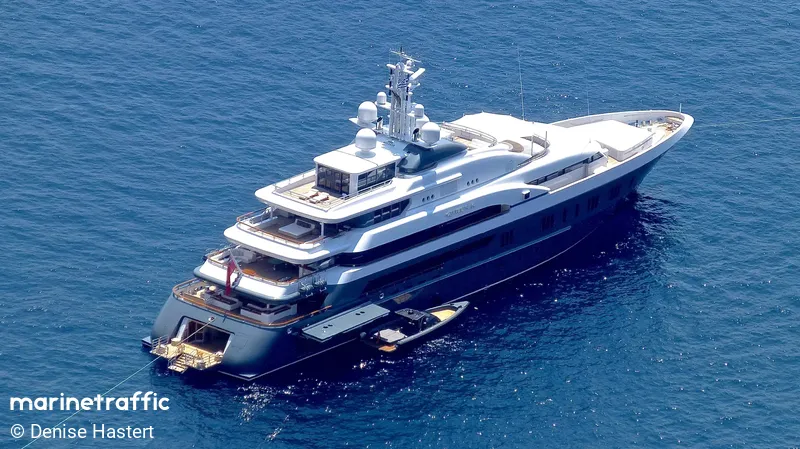
A vessel’s position is the boat’s, not the owner’s. Ownership is as reported, not certified.
Clio measures 72.6 metres and flies the Cook Islands flag from George Town. Her registration conceals a transaction chain that began with the Sayanogorsk aluminium smelter, while her builder’s naval division illustrates the industrial capacity that funds modern superyachts.
Clio is recorded on the Cook Islands registry, a jurisdiction that permits foreign beneficial owners to remain opaque. Her home port is George Town. AIS data places her at 40.87° N, 29.24° E in the Marmara Sea. The vessel is reported as owned by Oleg Deripaska. The sale price has never been confirmed; the estimated value sits at $65 million. The interior layout remains unpublished. The holding structure that purchased the hull is not disclosed.
What matters is the flag. The Cook Islands registry allows vessels to operate under a commercial framework that separates legal title from operational control. This arrangement is standard for assets moving through jurisdictions with restrictive trade policies. Deripaska holds citizenship in Russia and Cyprus. The Cypriot passport was obtained in 2017 through an investment programme. The Cook Islands flag does not erase the regulatory environment that governs his other holdings. In 2022, both the United States and the United Kingdom imposed asset freezes and travel bans on him following the invasion of Ukraine. The restrictions apply to his personal assets and to companies he controls. A vessel registered in the Cook Islands does not bypass those directives. The flag merely dictates where the paperwork is filed.
The yard, not the drawing
Lürssen built Clio in 2004. The yard operates from Bremen-Vegesack and Lemwerder. Its naval division, Naval Vessels Lürssen, constructs fast attack craft and patrol vessels for export. In September 2025, Rheinmetall acquired that military division. The same facility that designs corvettes and minesweepers also produces custom superyachts. Clio measures 72.6 metres in length with a beam of 13.91 metres. She displaces 2,194 gross tonnes. A hull of that volume requires a specific structural grid. The deck height and machinery placement are dictated by classification society rules for passenger vessels, not by aesthetic preference. The builder’s experience with high-speed displacement hulls carries over into the yacht sector. The transition from military fast craft to leisure vessels relies on shared metallurgy and propulsion integration. Lürssen delivered Azzam, the second largest private yacht at 180 metres, and Dilbar, the highest volume superyacht in 2016. Clio sits between those extremes in scale but shares the same engineering lineage. The yard’s capacity determines which contracts it accepts. Dry dock availability limits the number of large hulls under construction at any one time. Money does not guarantee a slipway.
The shipyard’s history stretches back to 1875, when Friedrich Lürssen established a boatbuilding workshop in Aumund, a suburb of Bremen. The focus initially covered work boats for fishing and ferry operations. Hull number one measured five metres. The yard opened the sport boat market in the 1880s and constructed the world’s first motorboat in 1886. That early experimentation with combustion engines established a technical baseline that persists today. The yard expanded its footprint to Berne and Bremen-Fähr-Lobbendorf. It acquired Blohm+Voss in 2016, integrating a Hamburg-based competitor into its portfolio. The integration proved uneven. In June 2025, Lürssen sold its Australian operation to Civmec. The department responsible for new building projects was dissolved, and Blohm+Voss reduced its workforce by more than 100 staff. The yard stopped renewing cruise ships and tankers, retaining only defence contracts and yacht construction. The consolidation reflects a broader shift in German shipbuilding toward high-margin custom projects and government procurement. Clio predates those adjustments. She represents an earlier phase of the yard’s expansion, when contract volume relied on a steady stream of private commissions alongside naval orders.
The capital, not the captain
The name Clio appears on the register. The origin of the name is not documented in public records. It does not correspond to a known holding company or family member in the available sources. Where a name cannot be explained, the choice of letters still performs a function on the registry. It must be unique to the flag she flies. It must survive being called over VHF radio. It will be painted on the transom. The register shows her category as Russian/CIS oligarch megayachts. The classification groups her with other vessels purchased during the commodity boom of the early twenty-first century. Deripaska accumulated his initial capital through metals trading after the collapse of the Soviet Union. He used those funds to acquire stakes in the Sayanogorsk aluminium smelter from a consortium that privatized it. The smelter became the foundation of Rusal, which merged with SUAL Group and Glencore International AG in 2007 to form UC Rusal. Deripaska served as chairman until he stepped down in 2018. The capital that bought Clio came from that consolidation. The vessel entered service in 2004, before the merger and before the Hong Kong listing. The timing places her purchase squarely within the period when Russian industrial assets were being consolidated under single management. The name itself leaves the register neutral. It does not signal affiliation. It does not advertise wealth. It simply occupies a slot in the database.
Deripaska’s trading company, VTK, operated through Estonia, exploiting the disarray in the Russian export licensing system. He bought metal at low domestic prices and sold it abroad at international market rates. The arbitrage profits funded the acquisition of the Sayanogorsk smelter in Southern Siberia. He became director general of the plant in 1994 at age twenty-six. In 1997, he founded Sibirsky Aluminium Group, which merged with Roman Abramovich’s Millhouse Capital in 2000 to create RUSAL. By 2004, the consolidation of RUSAL’s ownership was complete, with Deripaska’s related companies acquiring the remaining equity managed by Millhouse Capital. The vessel launched that same year. The alignment is structural rather than coincidental. Industrial consolidation generates liquidity that flows into fixed assets. Yachts appear as the final stage of that cycle. The Cook Islands registration follows the capital trail. The flag choice matches the jurisdictional strategy used for other holdings. Deripaska established Kuban Agroholding in 2011, integrating dairy farms, grain elevators, and horse breeding operations. The land bank ranks among the largest in Russia. The agricultural expansion occurred after Clio entered service, confirming that the vessel belongs to an earlier accumulation phase. The sanctions imposed in 2022 targeted his personal assets and his companies. The freeze covers entities he controls. A vessel registered offshore does not remove the underlying exposure. The register notes her category. The category describes the source of the steel.
Lürssen’s military division operated independently of the yacht business until the recent restructuring. Naval Vessels Lürssen built fast attack craft, minehunters, and patrol vessels for foreign navies. The division supplied the Bulgarian Navy with multi-purpose patrol ships in 2021 and secured a contract for twelve Arafura-class offshore patrol vessels for Australia. The Australian project split construction between Adelaide and Western Australia. The division also contributed to German Navy corvettes and frigates. The revenue from government contracts subsidises the custom yacht programme. The financial model allows the yard to maintain dry dock capacity for vessels like Clio even when private commission volumes fluctuate. The separation between defence production and luxury construction blurred in 2018, when a fire broke out at the floating dock in Fähr-Lobbendorf. The blaze consumed the under-construction structure of Sassi. Emergency services deployed approximately 900 personnel. The damage exceeded €610 million. The incident demonstrated the vulnerability of concentrated shipyard infrastructure. Recovery required insurance payouts and schedule adjustments. The yard continued delivering new builds. Clio survived the earlier construction cycles without such disruption. Her specifications reflect the standards of 2004, before the yard scaled up to accommodate hulls exceeding 150 metres. The engineering constraints that governed her design remain visible in the proportions. The beam supports the gross tonnage. The length accommodates the machinery spaces. The register captures the result.
The track, not the voyage
AIS broadcasts place Clio in the Marmara Sea. The coordinates 40.87° N, 29.24° E sit near the Turkish straits. The last transmission recorded the vessel stationary or moving slowly in coastal waters. No voyage charts exist for her movements. The absence of tracked passages does not indicate inactivity. It indicates restricted broadcasting or selective logging. Vessels operating under sanction regimes often alter their AIS behaviour to reduce visibility. The Cook Islands registry does not mandate continuous tracking. The flag state accepts periodic updates. The gap in the broadcast record aligns with the regulatory pressure applied to the owner. Asset freezes limit access to ports that require full documentation. The Marmara Sea offers anchorage outside immediate enforcement zones. The vessel remains within range of European shipping lanes without entering jurisdictions that would enforce the 2022 restrictions. The position confirms the utility of the flag choice. The registry provides a legal shell. The AIS data shows the practical application. The hull stays close to home. The name on the transom does not change. The register entry remains static. The database records what the satellite sees. The rest is handled by lawyers and brokers.
Reporting and data: CelebYachts, republished by On the record.
Sources
The numbers on this page point here. Each one links to the record it came from.
- 1