
 CelebYachts reportInvestigations
The corporate architecture behind Cloudbreak
AIS tracks show sustained movement along the Turkish coast, funded by a property and electronics group that outlasted the bank sale that created the owner’s wealth.
By On the record · Oct 12, 2026 · Data from CelebYachts1
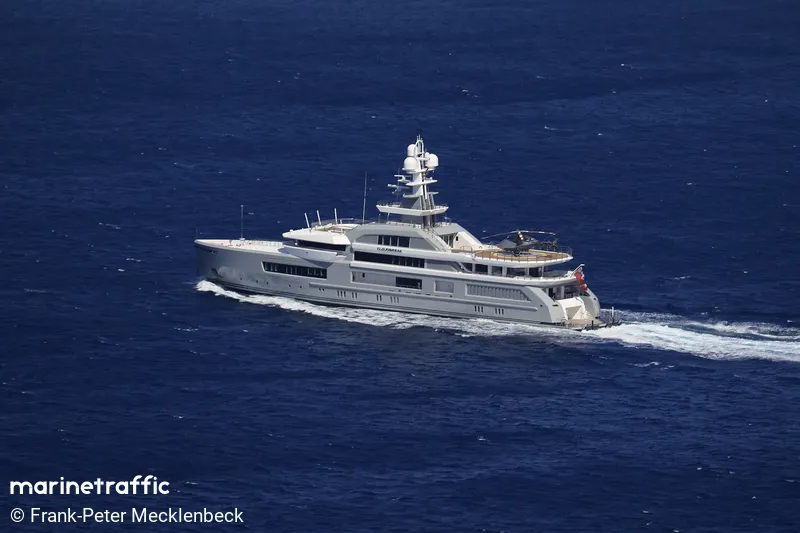
A vessel’s position is the boat’s, not the owner’s. Ownership is as reported, not certified.
Public records do not detail the specific regulatory instrument affecting Aleksandr Svetakov, but the AIS broadcast from Cloudbreak reveals a vessel maintained by a functioning commercial enterprise rather than a frozen asset. The engineering and financial mechanics of keeping a 2,308-tonne explorer hull active are visible in the steel and the ledger.
Cloudbreak measures 72.25 metres in length with a beam of 12.0 metres and carries 2,308 tonnes gross tonnage. She was launched in 2016 by Abeking & Rasmussen at their Lemwerder shipyard on the River Weser. The Cayman Islands registry lists George Town as her home port. The hull type is recorded as a motor vessel within the Support and explorer category. These figures place her in a specific class of offshore-capable yachts where volume dictates machinery layout and fuel capacity more than luxury fittings. A&R concentrated on superyachts after abandoning varnished wooden construction in 1981, and Cloudbreak reflects that shift toward aluminium and steel fabrication designed for extended range.
The register and the yard
Abeking & Rasmussen was founded in 1907 by Georg Abeking and Henry Rasmussen. The facility sits on the left bank of the River Weser in Lower Saxony and currently comprises five production halls with associated workshops and offices, an inner harbour and a syncrolift. The yard has developed small-waterplane-area twin hull (SWATH) ships alongside private vessels, indicating a design philosophy that prioritises stability and seakeeping over pure speed. Cloudbreak’s classification as a Support and explorer craft aligns with this heritage. Explorer hulls require reinforced structural framing to withstand heavy seas, additional ballast capacity to maintain trim under variable loading, and deck space large enough to store tenders and generators without compromising interior volume. The 12.0-metre beam provides a stable platform for these systems while limiting the width of marinas she can enter. Her draft necessitates deep-water berths or mooring buoys, which explains her preference for sheltered anchorages along the Turkish coastline.
A vessel of this age and tonnage demands continuous maintenance. Anti-fouling applications, propeller polishing, generator servicing and hull inspections scale directly with gross tonnage and hours run. The supplied sources do not include the primary OFAC or EU listing that restricts Aleksandr Svetakov, nor do they state the date or legal instrument of any such designation. What remains verifiable is the continuity of the corporate structure that generated the capital for the yacht. Svetakov founded Absolute Trade House while studying engineering at the Moscow Institute of Electronic Machine Building. The wholesale electronics business grew into Absolute Bank, which he sold in 2007 for almost $1 billion. He shifted to property development after the bank sale, establishing Absolut Group, which holds commercial real estate projects across Europe and Russia. Svetakov resides in Larnaca, Cyprus. The ongoing property portfolio provides a steady revenue stream that covers dry-docking, crew wages and fuel without requiring liquidation of assets. The vessel’s maintenance is therefore a line item in a living company’s accounts rather than a standalone trust expenditure.
The AIS record
The broadcast data from Cloudbreak shows a pattern of short coastal hops rather than open-ocean transits. In mid-August 2026 she moved between Fethiye, Datça, Kaş, Kemer, Antalya and Bodrum. Passage 1766 covered 66 nautical miles from Fethiye to Datça at an average speed of 9.3 knots. Passage 1652 ran 67 nautical miles from Kaş to Fethiye at the same average speed. Passage 1528 connected Kemer to Kaş over 55 nautical miles at 10.5 knots average. Passage 1295 took her from Fethiye to Antalya, a distance of 106 nautical miles at 12.4 knots average. Passage 1162 logged 134 nautical miles from Bodrum to Fethiye at 11.8 knots average. Passage 680 measured 131 nautical miles from Fethiye to Didim at 12.2 knots average. Passage 241 crossed from 38 nautical miles off Kos to 38 nautical miles off Rhodes, covering 97 nautical miles at 12.7 knots average. The maximum speeds recorded across these legs ranged from 13.5 to 15.1 knots.
All eight passages show coverage between 89 per cent and 100 per cent, indicating reliable satellite tracking typical of standard maritime SATCOM installations. The departure and arrival times cluster heavily around evening and night hours. Passage 1766 began at 20:36 and ended at 03:17 the following day. Passage 1652 started at 20:13 and finished at 03:35. Passage 1528 departed at 19:03 and arrived at 23:48. Passage 1295 left at 20:46 and reached destination at 04:58. Passage 1162 sailed from 18:43 to 05:43. Passage 680 ran from 17:30 to 04:19. Passage 241 departed at 19:55 and completed the leg at 04:26. Only passage 742 occurred during daylight, moving 6 nautical miles from 09:36 to 10:22. The consistent use of night sailing suggests a deliberate operational tempo, likely chosen to reduce visual exposure or avoid daytime traffic density in the Aegean corridor. The average speeds hover between 9.3 and 12.7 knots, numbers consistent with a diesel-electric or conventional propulsion system running at moderate cruising efficiency rather than high-speed transit.
Operational constraints
Fuel consumption at 10 knots for a vessel of 2,308 tonnes typically exceeds several hundred litres per hour, meaning each coastal hop adds thousands of dollars to operating expenses. These costs are absorbed by the corporate entity that owns the hull. The Cayman Islands flag offers a neutral registry that does not automatically enforce European port bans, though local authorities retain discretion over entry. Her last recorded position sits at 36.75° N, 28.93° E in the East Mediterranean. The routes stay within protected bays and sheltered anchorages, avoiding deep-sea exposure. Crew quarters must accommodate staff for extended autonomous operations, which raises daily consumable costs including fresh water production, waste management and provisions. The vessel’s category as a Support craft implies additional storage for diving equipment, survey gear or tender launches, features that further constrain interior layout and increase weight distribution challenges. Maintaining a 2016 hull in salt water requires strict adherence to coating schedules and cathodic protection monitoring. The combination of corporate backing, neutral registration and calculated routing allows Cloudbreak to remain operational despite the regulatory environment surrounding its owner.
Reporting and data: CelebYachts, republished by On the record.
Sources
The numbers on this page point here. Each one links to the record it came from.
- 1