
 CelebYachts reportInvestigations
How Marala survived the war and kept her 1931 engines
Marala’s ownership history is a straight line of public records. She was built for a car maker who died before launch. The Royal Navy then used her as a warship.
By On the record · Oct 12, 2026 · Data from CelebYachts1
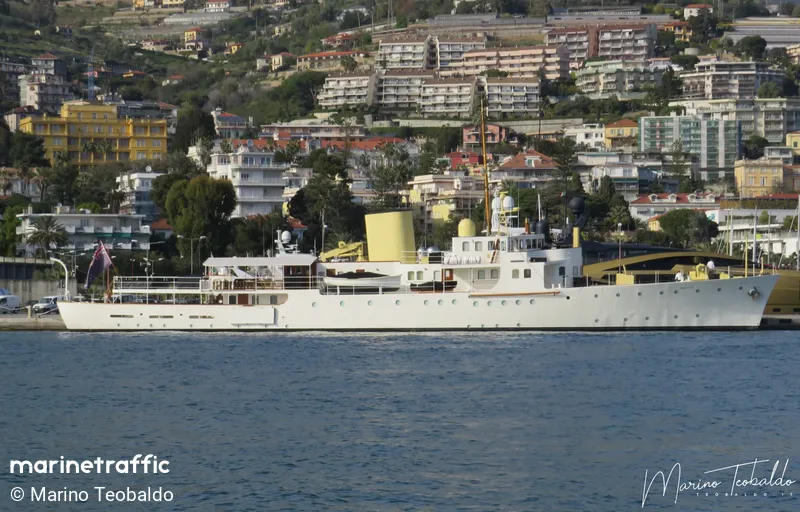
A vessel’s position is the boat’s, not the owner’s. Ownership is as reported, not certified.
Built in 1931 for an automobile manufacturer who died before launch, commissioned as a warship, and sold through four private owners over ninety years, Marala proves that Historic yachts rarely require offshore trusts to obscure their provenance. Her paper trail is public record, constrained only by the mechanical reality of retaining her original propulsion.
The yacht Marala does not hide behind a holding company. Her ownership history is a straight line of title transfers. These documents trace the movement of Atlantic wealth across a century.
She was built in 1931 by Camper & Nicholsons at Gosport. The yard assigned her hull number 388. She was originally building for Montague Napier. He was a British automobile pioneer. He died in January 1931. He never saw her named.
The Royal Navy took her during the Second World War. They renamed her HMS Evadne. She served in the Irish Sea, Bermuda, and Gibraltar. She damaged a German U-boat in the Strait of Gibraltar. She returned to civil life after the war ended.
Who bought Marala after she left the navy?
Richard Fairey bought the yacht in December 1931. He paid £50,000 for it. He owned Fairey Aviation. He renamed the vessel Evadne. The sale happened just months after Napier’s death. The transfer was recorded in Southampton with official number 161735.
Fairey lent Evadne to Amelia Earhart in 1932. Weather forced Earhart to end her solo flight in Ireland. She could not reach Paris. Evadne helped her meet fans at Cherbourg. This loan shows how quickly the yacht moved between famous figures.
The Admiralty hired Evadne in September 1939. They refitted her in England as an anti-submarine vessel. The Royal Navy commissioned her as HMS Evadne. She carried the pennant FY 009. The government needed every available ship for the war effort.
Evadne started in Liverpool. She patrolled the Irish Sea. In 1940 she was fitted out at Grayson Rollo shipyard. She worked on examination service duties at Holyhead. She also escorted convoys from Milford Haven and Liverpool bases.
In July 1942 Evadne joined the Highlander escort group. She escorted a convoy across the Atlantic. She then broke away to Bermuda. She worked on anti-submarine duties at the Royal Naval Dockyard there.
Evadne stayed in Bermuda until March 1944. She was reallocated to the Commander-in-Chief Mediterranean. She arrived in Gibraltar on 12 March 1944. She remained based there until hostilities ended.
On 19 February 1945 Evadne damaged a German U-boat. She used depth charges in the Strait of Gibraltar. The position was 35°54′N 05°43′W. The U-boat was U-300. It sank on 22 February west of Cadiz. Minesweepers HMS Recruit and HMS Pincher finished it. Nine of the fifty crew were lost.
Evadne arrived back in Portsmouth on 6 September 1945. She was paid off the following month. The war was over. The Royal Navy no longer needed her services. She returned to civilian hands.
By September 1950 Evadne had been sold to Zapla Ltd. This was a private British company. They renamed her Zapala. The new owner was R. J. Reynolds Jr. He was an American businessman. He owned the tobacco company that shares his name.
Reynolds planned a world cruise. He owned Sapelo Island in Georgia. Spanish colonists called it Zapala. The name fit his plans. He used the yacht for leisure travel in the early 1950s.
Arturo López Willshaw bought the yacht in 1952. He renamed her Gaviota IV. He had Georges Geffroy redecorate the interior lavishly. Arturo entertained many famous guests. Salvador Dali visited aboard. Sotheby’s later sold many of the Geffroy items.
André François-Poncet died in 1962. Robert Zellinger de Balkany bought the yacht next. He was a French retail property magnate. He renamed her Marala. The name combined his first two daughters. They were Alexandra and Maria.
Zellinger de Balkany owned Marala until his death in 2015. Frank Sinatra hired her for June 1970. He hosted Grace Kelly on board. Princess Alexandra of Kent also visited. The yacht became a fixture of high society.
The film The Cat's Meow used Marala in 2001. The movie represented William Randolph Hearst's yacht Oneida. The setting matched the era perfectly. The public saw her again on screen.
Why does Marala still have her 1931 engines?
Marala operates today in the Mediterranean. She flies the flag of the Cayman Islands. Her home port is George Town. She still uses her original engines. These machines powered her through the war.
Retaining these engines is a mechanical constraint. Modern replacements would be expensive. They would also change her character. Owners choose to keep the historical machinery intact.
Her AIS data shows her moving slowly. She travels at about seven knots. This speed matches her engine capabilities. She cannot go faster without risking damage.
A tracked passage from Samos to Samos covers 7.2 nautical miles. This trip happened on 4 August 2026. The average speed was 7.7 knots. This demonstrates the operational envelope of her preserved machinery.

Other recent voyages show similar speeds. A trip from Cannes to Saint-Tropez covered 22.0 nautical miles. The average speed was 7.0 knots. Another leg from Monaco to Cannes averaged 10.0 knots.
A journey from La Maddalena to Bonifacio covered 17.3 nautical miles. Coverage was only 26 percent. The average speed was 7.4 knots. These figures confirm the limits of her current propulsion system.
Marala’s history is clear because her owners are known. Each purchase was recorded. Each name change was public. There are no hidden trusts. There are no shell companies blocking the view.
The chain of title starts with Camper & Nicholsons. It moves through Richard Fairey. It passes to R. J. Reynolds Jr. It continues to Arturo López Willshaw. It ends with Robert Zellinger de Balkany.
This transparency is rare for yachts of this size. Most large vessels use complex structures. Marala does not. Her story is written in public records. Anyone can read them.
The constraints are physical, not legal. Her engines limit her speed. Her age limits her range. But her ownership remains open. The public knows who steered her.
Reporting and data: CelebYachts, republished by On the record.
Sources
The numbers on this page point here. Each one links to the record it came from.
- 1