
 CelebYachts reportInvestigations
How Christina O's owner vanished from public view
The yacht’s path from a Greek tycoon to a state asset ended in a limited partnership. That structure erased the beneficial owner from every public record.
By On the record · Oct 16, 2026 · Data from CelebYachts1
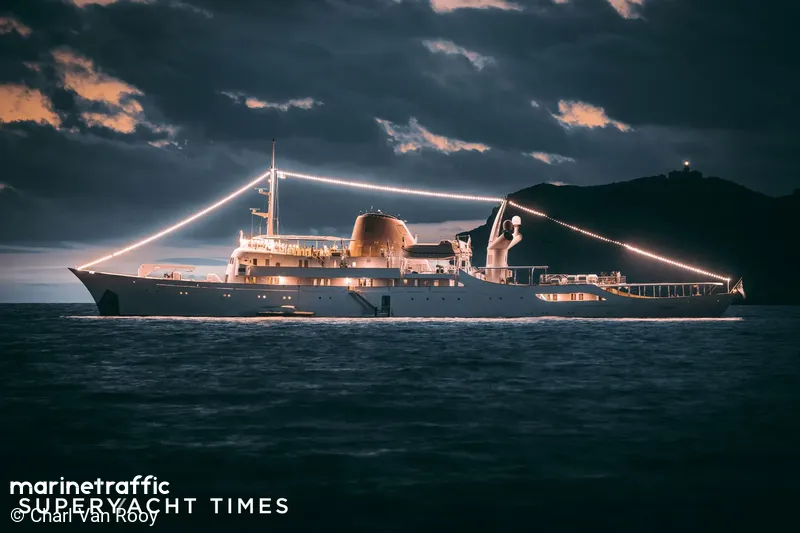
A vessel’s position is the boat’s, not the owner’s. Ownership is as reported, not certified.
Christina O was built for Aristotle Onassis, but his estate could not keep her. The Greek government let her decay before selling her to a limited partnership in 2000. That deal removed the name of the person who really owned her.
Christina O is a 99.15-metre motor yacht flying the Maltese flag. She sits at anchor in the Ligurian Sea near Nice. Her position shows she is active today. But her ownership history is far less clear.
The register lists Aristotle Onassis as the owner. He bought the hull in 1943 as naval surplus. He spent US$4 million to turn it into a luxury yacht. This was the first postwar superyacht. He named her after his daughter Christina.
Onassis died in 1975. His daughter and his widow both declined the inheritance. The Greek government took the vessel. They renamed it Argo. They allowed it to rot in a dock. It sat there for over twenty years.
Who owned Christina O when it was new?
Aristotle Onassis was a Greek shipping magnate. He built the world’s largest private fleet. He married Jacqueline Kennedy in 1968. He used Christina O to host global elites. Guests included John F. Kennedy and Grace Kelly.
The yacht carried unique features. A swimming pool had a mosaic floor. It rose to become a dance floor. Bar stools were upholstered in whale foreskins. These details showed immense wealth. They also marked the vessel as distinct.
Onassis willed the yacht to his daughter. The will named Jacqueline Kennedy Onassis next. If neither wanted it, the Greek state would take it. The condition was strict maintenance. It must serve as a presidential yacht.
Both women refused the gift. They did not want the burden. The Greek government accepted the terms. They changed the name to Argo. They failed to maintain the vessel. The ship decayed while tied to the quay.
The state put Argo up for sale in the early 1990s. The price was US$16 million. No buyer appeared. The vessel remained unsold. It sat in poor condition for years. The market for such a large Historic yacht was thin.
An American named Alexander Blastos tried to buy it in 1996. He offered a deposit. His check bounced. He was later convicted of wire fraud. The deal collapsed completely. The yacht stayed with the state.
John Paul Papanicolaou bought the ship in 1998. He was a Greek shipping magnate. He knew the Onassis family. He restored the original name Christina O. He honoured his friend Christina Onassis, who had died in 1988.
Papanicolaou started a major refit. It lasted from January 1999 to April 2001. The cost was US$50 million. Naval architect Costas Carabelas led the project. Decon managed the construction work.
The Viktor Lenac Shipyard in Croatia did the heavy lifting. Interior architect Apostolos Molindris updated the cabins. The refit preserved the old luxuries. It kept the mosaic dance floor. It maintained the whale leather seats.
Papanicolaou held the vessel personally for a short time. He then transferred it to a corporate structure. This move changed everything about the public record. The name on the papers disappeared.
How did the owner disappear from public view?
The Christina O Limited Partnership bought the yacht in 2000. The price was €65 million. This entity replaced Papanicolaou as the legal owner. The partnership structure is opaque by design.
Limited partnerships hide their shareholders. The names of the partners are not public. They do not appear in ship registers. They do not appear in press reports. The beneficial owner became invisible.
The register now lists Aristotle Onassis as the current owner. This is a historical placeholder. It does not list the people behind the scenes. We cannot say who owns the shares. We cannot say who controls the vessel. The paper trail ends at the partnership.
This opacity is common for large yachts. Owners use companies to shield their identity. The Christina O case is a clear example. The shift happened exactly in 2000. Before that, the owner was known.
Papanicolaou remains linked to the vessel’s recent past. He bought it from the state. He paid for the refit. He sold it to the partnership. But he is not listed as the current owner.
The partnership has operated the yacht since 2000. It has hosted film shoots. It appeared in Triangle of Sadness in 2022. It was used for Maria in 2024. The operational record is public.
The AIS data shows regular movement. She sails between Italy and France. She visits Capri, Sorrento, and Monaco. Her speed is consistent with leisure cruising. Her location is tracked daily.
The hull itself tells a different story. It was built in 1943. Canadian Vickers launched it as HMCS Stormont. It served in the Battle of the Atlantic. It escorted convoys to Normandy.
Onassis converted the frigate in Kiel. Howaldtswerke did the work in 1954. The conversion took ten years. The result was a unique hybrid. It had naval strength and luxury interiors.
The gross tonnage is 1,802. The beam is 11.12 metres. The length is 99.15 metres. These figures place it in the superyacht class. It is smaller than modern giants. It is larger than most classics.
The value is not publicly stated. Estimates vary widely. The refit cost US$50 million. The purchase price was €65 million. Current market value is unknown. The partnership does not disclose financials.
The IMO number is 8963818. The MMSI is 248383000. These identifiers link to the partnership. They do not link to individuals. They confirm the vessel’s legal status. They do not reveal its true owners.
Jacqueline Kennedy Onassis decorated the cabins. She chose a pastel scheme. She influenced the interior aesthetic. Her touch remains visible today. It adds historical weight to the vessel.
Maria Callas was a frequent guest. Onassis entertained her aboard. She was his mistress for many years. She sang on the decks. Her presence added cultural prestige to the yacht.
The Greek government’s neglect damaged the hull. Salt water entered the systems. Wood rotted in the cabins. The 1998 purchase saved it from scrap. Papanicolaou saw its potential.
The partnership structure protects privacy. It is a standard tool for the wealthy. It separates the asset from the person. It makes tracing ownership difficult. It requires deep legal research to penetrate.
We have no proof of who holds the shares. We rely on reported facts. Papanicolaou sold to the partnership. The partnership has held it since. The chain is clear up to 2000. It stops there.
The yacht continues to sail. It moves through the Mediterranean. It hosts events and films. It remains a symbol of Onassis’s era. But the man behind it is gone. The woman who refused it is gone. Only the company remains.
Reporting and data: CelebYachts, republished by On the record.
Sources
The numbers on this page point here. Each one links to the record it came from.
- 1