
 CelebYachts reportProfiles
The corporate architecture of Haida 1929
Her title has passed through fourteen legal configurations since 1927. The sequence reveals how state requisition and commercial charter replace personal…
By On the record · Aug 17, 2026 · Data from CelebYachts1
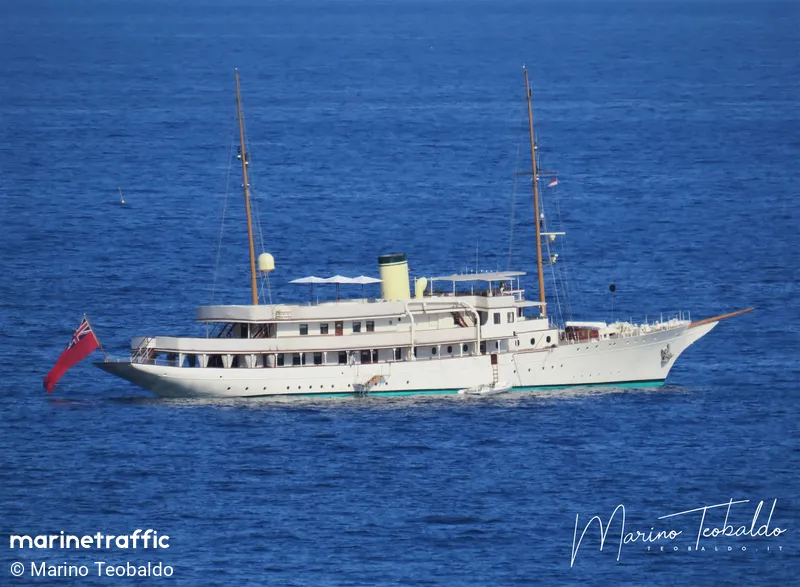
A vessel’s position is the boat’s, not the owner’s. Ownership is as reported, not certified.
Haida 1929 demonstrates how large vessels transition from private assets to regulated commercial instruments. Her ownership history tracks institutional absorption rather than individual taste. The register captures the flag, the builder, and the last known position. It does not capture the trust deed, the shell company, or the bank account that funds her upkeep.
Max C. Fleischmann commissioned the vessel in 1927. He was the younger son of Charles Fleischmann, founder of the Cincinnati yeast company. When his brother Julius died in 1925, Max assumed management control but declined to relocate from California. He stepped down from active management in 1929 to fund the build. The design came from Cox & Stevens. The hull was constructed at Friedrich Krupp Germaniawerft in Kiel. The yard delivered the 66.41-metre motor yacht via New York and the Panama Canal to Santa Barbara. Fleischmann had donated over half the cost of the breakwater at the Santa Barbara Yacht Club, securing her berth there. She carried original Krupp diesel engines producing 1,500 horsepower. The owner specified a black hull finish. This configuration lasted until October 1940.
The industrial origin and naval absorption
Friedrich Krupp Germaniawerft possessed the slipways and dry docks necessary to construct vessels of this scale during the interwar period. The yard had previously built battleships for the Kaiserliche Marine and U-boats for both world wars. Its transition to luxury motor yachts relied on the same steel fabrication techniques and precision machining. The delivery route via New York and the Panama Canal tested the hull's seaworthiness before she reached the Pacific coast. The Santa Barbara berth provided sheltered anchorage that reduced wear on the original propellers and rudders.
The United States Navy acquired the yacht from Mrs. Max C. Fleischmann of Glenbrook, Nevada, on 25 October 1940. The acquisition triggered a structural reset. The vessel was transferred to Long Beach for conversion by the Craig Shipbuilding Company. She was renamed USS Argus (PY-14) on 14 November 1940 and commissioned on 13 February 1941. The navy repurposed her hull for coastal patrol in the 12th Naval District. This period removed the yacht from private registry entirely. She operated under military command until September 1941, when she was transferred to the United States Coast and Geodetic Survey and renamed Pioneer.
Coastal patrol duties in the 12th Naval District required frequent turns and shallow-water maneuvering. The 3.5-metre draft allowed operations near the San Francisco Bay entrance but limited open-ocean endurance. The conversion by Craig Shipbuilding Company added radar arrays and communication masts that raised the centre of gravity. The subsequent transfer to the Coast and Geodetic Survey stripped most military fittings to accommodate hydrographic equipment. The dual service pattern ensured the hull experienced minimal corrosion compared to purely civilian vessels, as naval maintenance schedules enforced stricter inspection regimes.
Executive Order 9072 returned her to the Navy on 16 March 1942. General Engineering & Drydock Company reconversioned her at San Francisco. She resumed patrol duties, rescued sixty survivors from the torpedoed Liberty ship John A. Johnson on 30 October 1944, and established a meteorological station on Clipperton Island in December 1944. The rescue operation required the vessel to loiter in heavy seas while recovering survivors from machine-gunned rafts. The Clipperton mission involved landing personnel and equipment 670 nautical miles southwest of Acapulco. Decommissioning occurred on 15 April 1946. Her name was struck from the Naval Vessel Register on 21 May 1946. The Maritime Commission took custody on 30 October 1946 for disposal. The state had absorbed a private asset and returned it to the market as surplus property. The original 693 gross register tons were recalculated upon her return to civilian status, reflecting wartime modifications and stripped armament.
Commercial intermediaries and the charter engine
The post-war disposal process placed the vessel back into civilian commerce. An Egyptian cotton magnate, Maurice Ada, purchased her in late 1946. He renamed her Sarina and repainted the hull white. The registration shifted to the Alexandria Yacht Club. Ownership remained tied to diplomatic proximity until 1952, when King Farouk was deposed and exiled. The yacht relocated to Cannes, France. The next transaction occurred in the late 1960s when Larry Green, an American motor trade businessman, acquired her. She passed to Loel Guinness, a former British Member of Parliament, in 1969. His membership in the Royal Yacht Squadron permitted the vessel to fly the White Ensign during his tenure. Guinness maintained a systematic winter restoration schedule while operating her in the Mediterranean during summer months.
He sold the yacht in 1979 to Robert Stigwood, an Australian music entrepreneur and film producer. Stigwood installed satellite communications, concealing the receiver dome inside a fabricated false funnel. The modification altered the vessel’s silhouette and required structural reinforcement to support the additional weight aloft. After two years of cruising, he sold the vessel without the dummy funnel to Stanley J. Seeger, a British-resident American art collector. Seeger renamed her Rosenkavalier. The ownership cycle accelerated in 1988 when three Japanese brothers—Hiroshi, Takashi, and Yasushi Isaka—purchased the yacht through their Yokohama property development company. They commissioned a major refit in Thailand during 1991 and sold the hull the following year to Andreas Liveras, a Greek-Cypriot operator already established in the yacht charter business.
Charter operations require specific corporate structures to manage liability and crew licensing. Liveras held the vessel until 1999, when a Swiss-based businessman acquired her and renamed her Haida G. This buyer initiated a restoration across France and Turkey, including a complete overhaul of the original Krupp diesel engines. The mechanical renewal aligned with a shift toward long-term commercial leasing rather than short-term chartering. The charter model necessitated a transparent maintenance log and predictable turnaround times between seasons. The 1991 Thai refit addressed hull plating fatigue accumulated from decades of Mediterranean salt exposure. The Swiss buyer's French and Turkish restoration prioritised interior habitability over performance upgrades. The removal of the false funnel restored the original deck profile and improved wind resistance. These incremental modifications kept the vessel within class requirements without altering the fundamental Cox & Stevens geometry.
The modern holding structure and opacity
The current ownership configuration emerged from a 2011 sale that renamed the vessel Dona Amelia. The transaction preceded an extensive refit at Pendennis Shipyard in Falmouth, Cornwall, completed in 2017. The yard recalculated her displacement and internal volume, updating her gross tonnage to 720 GT and net tonnage to 216 NT. Following the refit, the new registered owner renamed her Haida 1929. The register lists Max C. Fleischmann as the associated owner, but this reflects historical attribution rather than current title. The actual holding company remains unrecorded in public maritime databases.
Cayman Islands registration requires annual tonnage declarations and proof of insurance but does not mandate public disclosure of the ultimate beneficiary. The home port designation in George Town serves primarily as an administrative anchor for flag state oversight. The IMO number links the vessel to international safety conventions, while the MMSI identifies her radio traffic. AIS broadcasting in the South Pacific suggests active navigation rather than permanent mooring. The absence of voyage charts indicates either deliberate signal suppression or reliance on coastal routing that avoids open-ocean tracking zones. Classification societies verify structural integrity through periodic dry-docking, which aligns with the 2017 Pendennis schedule. The corporate veil protecting the current owner remains intact behind the registry interface.
The vessel sails under the Cayman Islands flag with George Town as her home port. Her IMO identifier is 8981652 and her MMSI is 319080000. AIS broadcasts place her in the South Pacific at coordinates 16.47° S, 151.74° W. The lack of a verified beneficial owner in the register is standard for vessels of this age and tonnage. Modern yachts above fifty metres are typically held by offshore trusts or limited liability companies domiciled in jurisdictions with restrictive disclosure laws. The Cayman Islands registry accepts these structures without requiring public verification of the underlying shareholders. The vessel’s operational profile matches this arrangement.
The 2017 Pendennis refit preserved the original propulsion layout while bringing the electrical and navigation systems into compliance with contemporary SOLAS standards. The hull retains the Cox & Stevens lines and the Germaniawerft steel framing from 1929. Her survival depends on the financial capacity of a corporate entity to maintain classification society surveys and pay annual tonnage taxes. Personal attachment plays no role in her maintenance schedule. The register captures the flag, the builder, and the last known position. It does not capture the trust deed, the shell company, or the bank account that funds her upkeep. That information exists outside the public domain.
Reporting and data: CelebYachts, republished by On the record.
Sources
The numbers on this page point here. Each one links to the record it came from.
- 1