
 CelebYachts reportInvestigations
Why Olympia has been stuck in Russia since 2021
A Feadship yacht linked to Putin sits idle. Sanctions froze her assets, not her engines.
By On the record · Oct 22, 2026 · Data from CelebYachts1
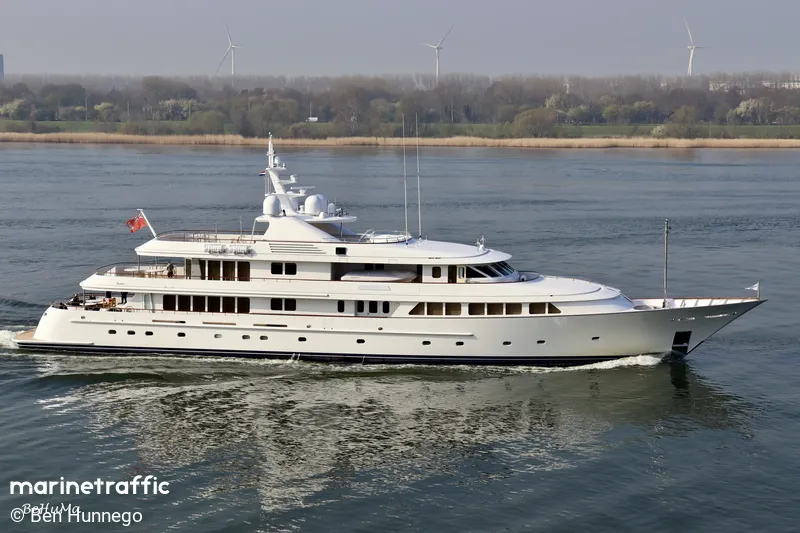
A vessel’s position is the boat’s, not the owner’s. Ownership is as reported, not certified.
Olympia is a 57-metre Feadship motor yacht registered in the Cayman Islands. She has not moved since May 2021. The United States Treasury sanctioned her in June 2022. Her stillness is caused by financial regulations, not mechanical failure.
The AIS signal from Olympia stopped on May 2, 2021. She was then at the port of St. Petersburg in Russia. That was her last known position. The tracking data shows she has not moved since that day.
Her flag is the Cayman Islands. Her home port is George Town. The vessel is a steel-hulled motor superyacht built by Feadship. Construction began in 1999 and ended in 2002. She measures 57 metres long with a beam of 10.2 metres.
Reports link Olympia to the Russian President. Some accounts say it was a gift from Abramovich. The register lists the owner as an Alleged Putin gift from Abramovich. This ownership claim remains unconfirmed by public records.
Who owns Olympia, and how?
The original owners were listed as SCF Management Services or Ironstone Marine Investments. These are shell or holding companies based in Cyprus. They appear in early registration documents for the vessel.
The current legal owner is not publicly disclosed. Open records do not show who holds the title today. The vessel is considered property of entities within the Russian Government. This classification drives the sanctions against her.
Ownership of large yachts is rarely direct. A person does not usually hold the title themselves. They use a company in a jurisdiction with strict privacy laws. That company might be owned by another trust or entity further up the chain.
This structure makes tracing the true beneficial owner difficult. It also makes enforcing restrictions harder. When a government sanctions an asset, it targets the registered holder. But if that holder is a complex web of shells, the freeze can stall.
In Olympia's case, the US Treasury Department acted directly. They sanctioned the yacht itself. This blocks any US person or entity from dealing with her assets. It effectively freezes her ability to operate commercially or move freely in international waters.
How did Feadship build this hull?
Feadship is a cooperative venture between two Dutch shipyards. These are Royal Van Lent Shipyard and Koninklijke De Vries Scheepsbouw. The brand was founded in 1949 as an export association. Its goal was to sell custom yachts to American clients.
Both yards share a design and engineering center. This is De Voogt Naval Architects, located in Hoofddorp. Exterior design for Olympia came from De Voogt. Interior design was handled by Mark Hampton and John Gallagher.
Construction started in 1999 at the Aalsmeer yard. The hull is made of steel. The superstructure uses aluminum. This combination offers strength without excessive weight. It is a standard practice for high-end Feadship builds.
The vessel was delivered in 2002. She had a refit in 2008. The yard has four locations across the Netherlands. Two are owned by De Vries. Two are owned by Royal Van Lent. Both received royal charters in the early 2000s.
Feadship is one of the leading builders of custom superyachts. They have built vessels like Aquarius and Savannah. The brand focuses on quality over quantity. They typically launch only two or three new yachts per year.
What are her technical limits?
Olympia has a gross tonnage of 776. This measures her internal volume. She has three decks. There are five cabins for ten guests. Crew quarters accommodate sixteen staff members. The sundeck includes a spa pool.
Her propulsion system uses twin Caterpillar diesel engines. Each engine produces 1,500 horsepower. They drive twin propellers. This setup allows a maximum speed of 15 knots. Her cruising speed is 13 knots.
The fuel tanks hold 100,000 liters of diesel. This gives her a range of 4,700 nautical miles. She can travel significant distances without refueling. The electrical needs are met by two Caterpillar generators.
These generators are linked to a Halyard exhaust-cleaning system. This reduces emissions from the exhaust gas. It helps the yacht meet environmental standards. The draft is 2.95 metres. This allows access to many ports.
The owner's quarters include a private study. This suggests a focus on comfort and work space. The layout is designed for long stays. The vessel is built for endurance, not just speed.
When did she become trapped?
In April 2021, Olympia moved from Rotterdam to Russia. This happened shortly after the Russian invasion of Ukraine. She relocated to the port of St. Petersburg. The AIS signal ceased there on May 2, 2021.
The reason for the silence is regulatory. The United States Treasury Department sanctioned her in June 2022. The sanction list includes Kosatka, Shellest, and Nega alongside Olympia. These are all linked to Russian interests.
Sanctions prevent the transfer of funds or services. They block insurance and port entry in many jurisdictions. A sanctioned yacht cannot legally dock in most European ports. It cannot refuel or receive maintenance through official channels.
This leaves the vessel stranded. It cannot sail to a dry dock for repairs. It cannot move to a new owner. The physical machine is fine. The legal status is broken. The US Treasury froze her assets.
The last known location is Inland Russia. The coordinates are 61.52° N, 30.66° E. She is likely moored in St. Petersburg or a nearby facility. No recent AIS data confirms her exact spot.
Why does this matter now?
Olympia represents a category of sanctioned assets. She is not unique in size or age. Many oligarch yachts face similar fates. But her specific history highlights the difficulty of enforcement.
The link to the Russian President makes her high profile. Whether she was a gift from Abramovich or state property, the result is the same. She is frozen. She cannot be sold or moved.
The value of the yacht is estimated at $50 million. This is a fraction of the cost of larger megayachts. But for a vessel of this class, it is significant. The loss of utility is total.
The case shows how sanctions target mobility. A yacht is a mobile asset. It can hide its location. It can change flags. But once identified and sanctioned, it becomes a liability. It cannot leave port.
Olympia sits in Russia because she cannot go anywhere else. The world has closed its ports to her. The technology works. The law does not allow it. She is a prisoner of finance.
Reporting and data: CelebYachts, republished by On the record.
Sources
The numbers on this page point here. Each one links to the record it came from.
- 1