
 CelebYachts reportInvestigations
The corporate architecture of Sailing Yacht A
How a Bermudian holding company and a sequence of flag transfers failed to protect a twelve-thousand-ton hull from European sanctions.
By On the record · Oct 22, 2026 · Data from CelebYachts1
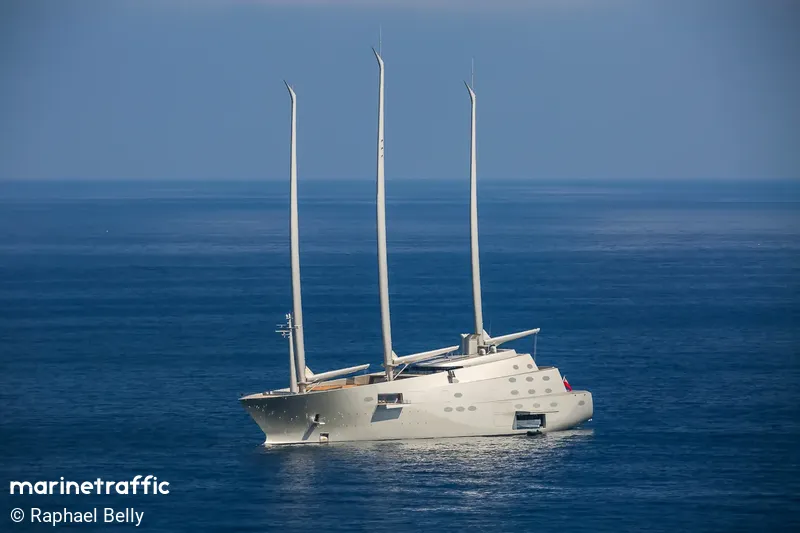
A vessel’s position is the boat’s, not the owner’s. Ownership is as reported, not certified.
The ownership structure of Sailing Yacht A demonstrates how a sanctioned oligarch uses corporate layering and flag-hopping not to hide his identity, but to manage regulatory risk while leaving the vessel immobilised. The hull’s journey from Kiel to Trieste mirrors the collapse of the legal architecture that held it.
The vessel is titled to Valla Yachts Ltd., a limited company incorporated in Bermuda. That jurisdiction was selected for its corporate disclosure rules, which permit the true beneficiary to remain outside public registries. The yacht was initially registered in Hamilton under the Bermudan flag. In December 2021, the registration transferred to Douglas on the Isle of Man. The administrative shift preceded the European Union’s sanction regime by three months, indicating either routine fleet consolidation or a pre-emptive adjustment to shifting political conditions. When the EU listed Andrey Melnichenko on 9 March 2022, the legal framework required immediate adaptation. Twelve days later, the Italian Guardia di Finanza seized the yacht in the port of Trieste. By June 2022, the vessel had been re-registered in Freetown under the Sierra Leone flag, a change executed while the hull remained physically detained in Italy. The ultimate beneficial owner is reported through Valla Yachts Ltd.; the precise chain of trusts or foundations that sit above that company has not been published. The relocation to a Sierra Leone flag did not lift the detention. It merely altered the administrative paperwork attached to a hull that could no longer leave the Gulf of Trieste.
The holding company and the flag
Melnichenko’s capacity to commission a twelve-thousand-ton sailing yacht derived entirely from two industrial enterprises: EuroChem Group, a fertilizer producer, and SUEK, a coal miner. He founded both companies in the early 2000s by acquiring derelict assets and consolidating them into functional export businesses. He served as non-executive director and effective beneficiary until 9 March 2022. On that date, he stepped down from both roles and withdrew as a beneficiary, a procedural step taken immediately upon being placed on the EU sanctions list. The European Court of Justice repelled his petition against the listing on 17 December 2023, confirming the restrictions. The sanctions froze his western assets, blocked his travel to the European Union and the United States, and rendered any commercial operation of his superyachts legally impossible. The corporate veil of Valla Yachts Ltd. provided no immunity against the EU’s asset freezes. A holding company registered in Bermuda cannot override a Brussels regulation that targets the underlying individual. The result was a static asset in a dynamic legal environment.
The acquisition of EuroChem and SUEK required capital that Melnichenko generated through aggressive consolidation rather than state privatization. Between 2000 and 2004, he purchased more than fifty independently run businesses, including joint-stock companies, plants, and mines. These industries were derelict and risky, deliberately chosen to avoid the political influence that dominated other sectors at the time. No more than five percent of the assets were acquired from the state. The process of post-Soviet era privatizations had concluded five years earlier, leaving a vacuum that Melnichenko filled through private acquisition. His companies invested more than twenty-three billion dollars into the Russian economy and industrial sector over fifteen years. The sheer scale of that capital generation explains the budget available for a project that would eventually carry an estimated value of four hundred and fifty million dollars. The wealth originated in bulk commodities and chemical fertilizers, not finance or technology. That industrial origin constrained the yacht’s design toward robust engineering and heavy displacement rather than delicate luxury.
The industrial capital behind the steel
The physical reality of the detention is defined by tonnage and machinery. Sailing Yacht A measures 142.81 metres in length and displaces 12,558 gross tons. She carries seven decks, accommodates twenty guests, and requires a crew of fifty-four to operate. Her propulsion relies on a variable-speed hybrid powerplant featuring two MTU 20V 4000 M73L lineshaft diesel engines and a superimposable diesel-electric transmission controlled by DEIF systems. Four hotel generators drive additional lineshaft motors, while four Emigreen particulate filters treat emissions. The yacht also features three carbon-fibre rotating masts manufactured by Magma Structures in Portsmouth, supporting a total sail area of 3,747 square metres. An underwater observation pod sits in the keel, protected by thirty-centimetre glass. All of this hardware demands continuous maintenance, fresh water, fuel, and a paid crew, regardless of whether the vessel is underway or moored.
Nobiskrug built the hull in Kiel, Germany, laying the keel on 17 August 2012 and launching her on 27 January 2017. She left Kiel on 5 February 2017 on near-empty fuel tanks to clear the Drogden channel in the Danish straits with minimum draught. Final sea trials and fit-out took place at the Navantia shipyard in Cartagena, Spain. The yacht represents one of the most complex engineering projects ever attempted in the private yacht sector, combining a full sailing rig with a heavy displacement motor yacht hull. The cost of maintaining such a system while she sits at anchor in the Gulf of Trieste is substantial. The crew must keep the generators running to preserve battery banks and prevent corrosion in the lineshaft systems. The carbon rigging requires constant tension monitoring. The interior fit-out, designed by Philippe Starck, must be climate-controlled to prevent mould and material degradation. The yacht’s immobility transforms her from a mobile luxury asset into a fixed industrial plant requiring ongoing expenditure.
The engineering constraint of a frozen asset
The yard that constructed her faced its own structural failures during the same period. Nobiskrug filed for insolvency in July 2021, partially a result of the coronavirus pandemic. Flensburger Schiffbau-Gesellschaft acquired the yard in July 2021, and Lürssen took over again in 2024. The delivery of Sailing Yacht A occurred just before the first wave of insolvency proceedings, placing the vessel in the hands of a buyer while the builder was restructuring. The timing underscores the vulnerability of custom superyacht construction to macroeconomic shocks. A project of this complexity relies on uninterrupted supply chains and solvent contractors. When the financing behind the owner collapses under sanctions, and the financing behind the builder collapses under recession, the resulting asset becomes stranded. The yacht’s AIS broadcasts continue to transmit an MMSI identifier and a position off the Adriatic coast, but the data reflects a vessel under house arrest rather than one on passage.
The seizure by the Guardia di Finanza on 12 March 2022 triggered a standoff that has lasted years. Melnichenko’s spokesperson vowed to contest the seizure, and the legal proceedings have not yet produced a final resolution. The yacht remains at an anchorage in the Gulf of Trieste as of June 2026. Other jurisdictions followed the EU’s lead. The United Kingdom sanctioned him in 2022, Japan in January 2023, and Canada under the Special Economic Measures Act for grave breach of international peace and security. The coordinated nature of these restrictions eliminated any possibility of relocating the yacht to a friendly port. The ownership structure that once allowed her to fly the Bermudan flag, then the Isle of Man flag, and finally the Sierra Leone flag, has become a series of administrative layers stacked over a single immobilised hull. The sanctions have achieved their intended effect: they have removed the asset from the global market without requiring a formal confiscation order. The yacht exists as a demonstration of the limits of corporate shielding when faced with coordinated international financial pressure.
Reporting and data: CelebYachts, republished by On the record.
Sources
The numbers on this page point here. Each one links to the record it came from.
- 1