
 CelebYachts reportInvestigations
Why Le Grand Bleu is stuck in the Caribbean
Le Grand Bleu has been frozen by UK sanctions since 2022. Her owner cannot move her or sell her. She sits in the Caribbean while managers pay to keep her from rotting.
By On the record · Oct 13, 2026 · Data from CelebYachts1
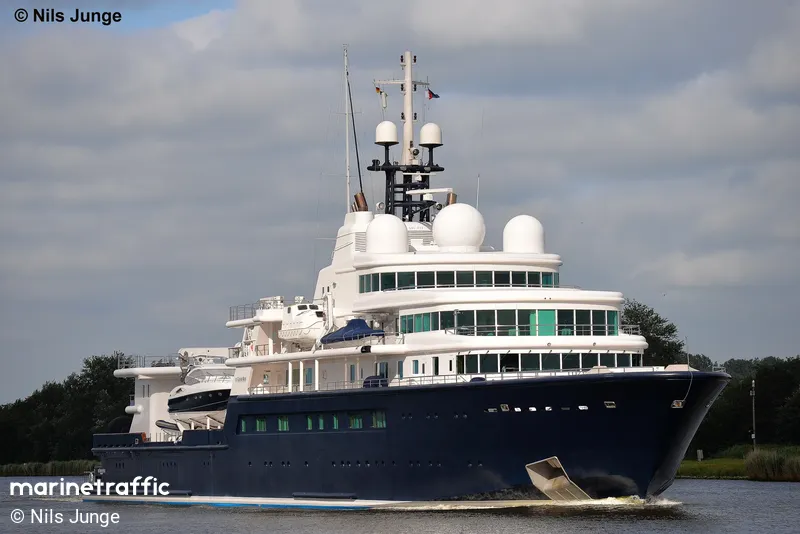
A vessel’s position is the boat’s, not the owner’s. Ownership is as reported, not certified.
Le Grand Bleu, owned by Eugene Shvidler, has been held under United Kingdom sanctions since April 2022. The asset freeze prevents her owner from selling her or moving her out of jurisdiction. This forces a chain of shell companies and flag changes that turn a 108-metre vessel into a stationary liability.
Le Grand Bleu has not moved since late 2022. She sits at anchor in the Caribbean Sea. The coordinates are fixed at 18.46° N, 66.10° W. Her AIS transponder shows she is still there. She has been there for more than two years.
The reason for her stillness is simple. The United Kingdom froze her assets in March 2022. The owner, Eugene Shvidler, is a Russian businessman. He holds dual British and American citizenship. The UK government sanctioned him for his ties to Roman Abramovich.
The freeze stops Shvidler from selling the yacht. It also stops him from moving her to another country. He cannot use her for travel. He cannot fly off her helipad. The only option left is to keep her safe where she is. Someone must pay for that safety.
Who owns Le Grand Bleu, and why was he sanctioned?
Eugene Shvidler bought Le Grand Bleu in June 2006. He won the yacht in a bet against Roman Abramovich. Abramovich had owned it since 2002. Shvidler paid nothing for the hull itself. He took on the running costs instead.
Shvidler and Abramovich were business partners for decades. They built an oil trading empire called Runicom S.A. in the mid-1990s. They later gained control of Sibneft, a major oil company. Shvidler served as president of Sibneft until 2005.
The UK government sanctioned Shvidler because of this link. They stated he obtained benefit from supporting the Russian Government. His lawyers argued he was a British national. They said he had not visited Russia in fifteen years. They said he never met President Putin after 2007.
The UK High Court rejected Shvidler's appeal in July 2023. The Court of Appeal rejected it again in February 2024. The court found the sanctions lawful. Shvidler remains under the freeze today. He lives in the USA now. He cannot touch the yacht.
Where is Le Grand Bleu, and how long has she been there?
Le Grand Bleu measures 108.3 metres in length. She weighs 5,556 gross tonnes. She was built at the Bremer Vulkan yard in Germany. She launched in the year 2000. Stefano Pastrovich designed her interior. Kusch Yachts constructed the hull.
She underwent a major refit in 2016. The work happened at Blohm & Voss in Hamburg. The yard added new systems and updated the layout. The cost of that refit was significant. It kept the yacht modern for another decade.
Her current flag is Malaysia. She is registered in Hamilton, Bermuda. This change happened after the sanctions began. The original flag was likely Western European. A flag change does not lift sanctions. It just moves the paperwork.
AIS data places her in the Caribbean Sea. She has stayed in this area since late 2022. The water is warm and calm. This reduces the stress on her hull. Cold water and ice cause more damage to steel.
What does it cost to keep a frozen yacht alive?
A yacht of this size needs constant care. Her engines are two Deutz units. Each produces 7,260 kW of power. These engines need regular exercise. If they sit too long, seals dry out. Metal parts seize up.
A crew of 65 people stays on board. They monitor the systems day and night. They clean the decks and polish the steel. They manage the fuel tanks. They handle the waste disposal. All of this costs money every single day.
The owners cannot use the yacht for income. They cannot charter her out. They cannot take paying guests. There is no revenue to cover the costs. The bill comes entirely from the owner's private funds.
Shvidler cannot access those funds freely. The UK freeze blocks his assets. This includes bank accounts and property. Managers must find creative ways to pay the bills. They may use offshore entities. They may use third-party intermediaries.
The total annual cost is hard to calculate. Industry estimates suggest millions per year. This figure covers crew wages, insurance, and port fees. It also covers maintenance repairs. Every bolt tightened adds to the debt.
How did the ownership structure change over time?
John McCaw Jr. commissioned the yacht first. He sold it to Roman Abramovich in 2002. Abramovich had HDW refit it in Kiel. He added a swim platform and updated the interiors. He owned it for four years.
Abramovich lost the yacht to Shvidler in 2006. Shvidler ran it for sixteen years. He added a green wastewater system in 2008. He hired a large crew. He used it for personal travel and hosting guests.
The sanctions changed everything in 2022. Shvidler could no longer make decisions. He had to step down from other companies too. He resigned from Millhouse LLC in March 2022. That company was linked to Abramovich.
New management took over the daily operations. They answer to trustees, not Shvidler. Their goal is preservation, not luxury. They keep the yacht seaworthy. They wait for the political situation to change.
The legal challenges have all failed so far. Shvidler tried to prove he was not a target. The courts disagreed. They cited his close ties to Abramovich. They cited his role in Evraz steel. The freeze remains in place.
What happens if the sanctions last forever?
Yachts age even when they do not sail. Salt air corrodes metal. UV light degrades rubber seals. Electronics fail without updates. A 108-metre vessel is a complex machine. Complexity requires constant attention.
If the freeze lasts for years, the hull suffers. The paint peels. The teak dries out. The generators rust. The cost of repair grows exponentially. A small leak becomes a major structural issue.
The value of the yacht drops each year. Insurance premiums rise. Port authorities charge higher fees for idle vessels. The financial burden increases. The managers must find more money to save less value.
There is no easy exit strategy. Selling to a neutral buyer is risky. Other countries may follow the UK lead. Shipping her to a friendly port is illegal under the freeze. The options are very limited.
Le Grand Bleu represents a high-risk asset. It cost millions to build. It costs millions to maintain. It generates zero income. It is a liability that grows heavier every day. The owner pays for his past decisions.
Reporting and data: CelebYachts, republished by On the record.
Sources
The numbers on this page point here. Each one links to the record it came from.
- 1