
 CelebYachts reportInvestigations
The detention of Phi
The UK government’s decision to impound a 58.5-metre Royal Huisman in Canary Wharf prioritised diplomatic signalling over asset preservation, leaving a 2021…
By On the record · Aug 31, 2026 · Data from CelebYachts1
A vessel’s position is the boat’s, not the owner’s. Ownership is as reported, not certified.
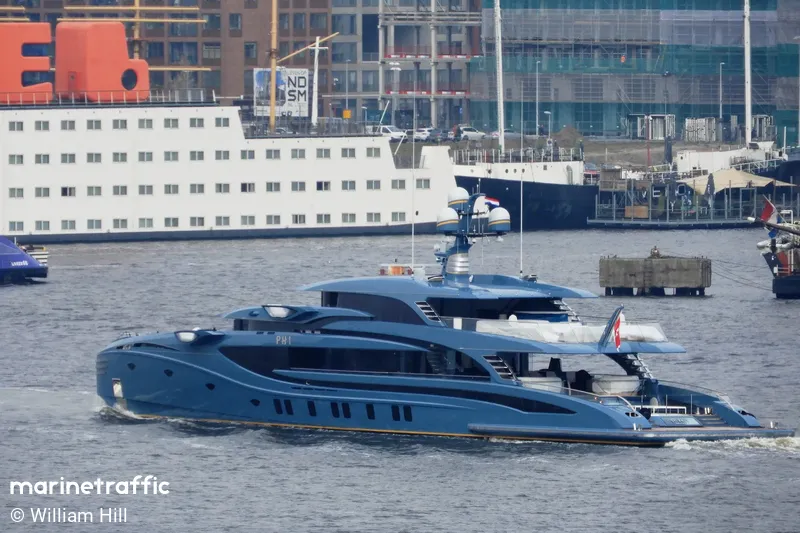
The superyacht Phi arrived in London for a winter stopover in December 2021 and never left. Its impoundment marks the first time British authorities have used sanctions to immobilise a vessel, a move that has triggered three rounds of litigation and accelerated the physical deterioration of a hull that cost £38 million to build. The state chose to immobilise the vessel rather than preserve its commercial value.
Phi measures 58.5 metres in length with a beam of 9.0 metres and carries 499 gross tonnes. She was delivered by Royal Huisman in 2021 at a reported cost of £38 million, which equates to roughly $50 million. Her exterior lines were drawn by Cor D. Rover Design, taking inspiration from a cobra, while the interior layout came from Lawson Robb. A seven-metre swimming pool sits on the main deck with a manoeuvrable floor that converts the space when needed, and a large wine cellar occupies part of the lower accommodation. Alongside her, a support vessel named the PHI Phantom was constructed by Alia Yachts in Antalya, Turkey, mirroring the exterior styling of the parent hull.
She arrived in London in December 2021 for a winter stopover, docking at Canary Wharf. On 28 March 2022 she was scheduled to depart for Malta. Before she could weigh anchor, the UK Department for Transport, working with the National Crime Agency and the Border Force Maritime Investigation Bureau, announced sanctions and ordered her immediate impounding. This action marked the first occasion the British government had used sanctions to detain a ship. The directive came from then Secretary of State for Transport Grant Shapps, who visited the vessel at the berth, filmed a video for his social media accounts, and addressed the assembled press. He stated that the yacht belonged to a Russian oligarch and a friend of Vladimir Putin, adding that the indefinite detention sent a clear and stark warning to the Russian president and his cronies.
The dock, not the drawing
The authorities initially declined to name the owner, describing him only as a Russian businessman whose assets were being targeted to pressure wealthy individuals following the invasion of Ukraine. The identity was later confirmed as Sergei Naumenko, a Russian property developer. The precise extent of Mr Naumenko's personal wealth has not been published, but his background in property established the capital base for the purchase. Naumenko himself was not listed on the UK Government's sanctions schedule at the time of the seizure. The yacht is registered to a company incorporated in Saint Kitts and Nevis and sails under a Maltese flag with Valletta as her home port.
The corporate architecture
The separation between the vessel and its registered owner became the central friction point during the subsequent legal proceedings. Naumenko requested a ministerial review of the sanctioning, which was rejected. He then took the matter to the High Court of Justice in London. In July 2023, the court heard the appeal brought by Dalston Projects, the entity representing Naumenko. His legal team argued that the confiscation was both unlawful and disproportionate, emphasising that their client was not subject to UK sanctions, was not a friend of Putin as claimed, and that the measures had been applied improperly.
Sir Ross Cranston, sitting in retirement, delivered the judgment. He ruled that the detention was lawful because Phi qualified as a high-value ship and her owner was connected with Russia. Sir Ross accepted that Grant Shapps had been factually incorrect when he described Naumenko as a friend of Putin, but classified the remark as excusable political hyperbole. He concluded that the Secretary of State possessed a broad margin of discretion in exercising detention powers to pursue foreign policy objectives. The judge dismissed Naumenko's other claims, noting that a ruling in favour of the owner would have sent a signal that the UK Government was softening its approach on sanctions, with direct implications for the aircraft detained by the British state under similar powers.
The corporate structure shielding the asset did not protect it from the reach of the Treasury. The registration in Saint Kitts and Nevis and the Maltese flag provided standard maritime privacy, but they offered no barrier to the DfT's enforcement machinery. The state treated the hull itself as the target, regardless of whether the beneficial owner carried a formal sanctions designation.
The court of public record
Naumenko appealed the High Court decision to the Court of Appeal. The hearing took place in January 2024 alongside the case of sanctioned Russian businessman Eugene Shvidler. On 27 February, Lord Justice Singh delivered the judgment. Singh criticised both the High Court's earlier ruling and the conduct of Grant Shapps during the initial seizure. He stated explicitly that Shapps' claim about Naumenko's relationship with the Russian president was not hyperbole but an incorrect factual assertion that ought not to have been made, let alone factored into the exercise of discretionary power. Despite these criticisms, Lord Justice Singh ruled against both appellants, observing that sanctions must often remain severe and open-ended if they are to function effectively.
The dispute proceeded to the Supreme Court, where the appeal was dismissed in July 2025. Lords Sales and Rose delivered the judgment of the Court. They characterised Phi as an archetypal emblem of conspicuous consumption at paragraph 190. The judges reasoned that preventing the income Mr Naumenko might earn through chartering the vessel would either feed into the Russian economy or enhance his prestige within Russian elite circles, making the detention rationally connected to the legitimate aim of deterring aggression in Ukraine at paragraph 182. The Court found no less intrusive means available to achieve this outcome at paragraph 203.
In assessing the proportionality of the measure, the judgment acknowledged that the direction impeded Mr Naumenko's ability to use the yacht as a status symbol and restricted his capacity to generate charter revenue. However, the Court observed that this restriction would not significantly alter his lifestyle given his considerable wealth. Referencing Lord Justice Singh's earlier observation, the judgment noted that the detention did not cause individual hardship in Mr Naumenko's daily life. Weighing these matters against each other, the Supreme Court agreed with the lower courts that the direction struck a straightforward and fair balance, upholding the lawfulness of the detention direction.
Following the dismissal, Captain Guy Booth announced plans to petition the European Court of Human Rights. As of March 2026, that application remains pending.
The slow rot
While the litigation progressed, the physical condition of Phi deteriorated steadily. The sanctions regime prohibits the vessel from moving, which has the effect of preventing significant maintenance work that would normally be performed. Industry brokers note that vessels typically require being taken out of the water annually for maintenance, with engines, water systems, fuels, and lubricants needing to run continuously to prevent seizing. None of these operations can take place while the hull sits permanently moored at Canary Wharf.
By March 2026, the yacht had suffered extensive damage during four years of continuous detention. She has lost her classification status and her protection and indemnity insurance coverage. Several critical onboard systems, including fire detection and suppression equipment, have been shut down. Stray electric currents flowing through the water have caused galvanic corrosion in the fuel and water tanks that form the sides of the hull. The vessel retains approximately 60,000 litres of diesel fuel, which cannot be pumped out due to the movement restrictions imposed by the sanctions.
Visible signs of decay are evident along the superstructure. Scaffolding has been erected around much of the upper decks to shield the vessel from falling debris, and several windows have been whitewashed to protect the interior from the elements. According to Captain Booth, the stationary target has attracted eighteen attempted intrusions during its detention. The sanctions regime places the responsibility for maintenance costs on Mr Naumenko, but he is legally barred from accessing or using the yacht, which remains his property under British law.
The situation of Phi reflects a wider pattern affecting detained Russian-linked vessels across Europe. Yacht brokerage firm Cecil Wright reports that fifteen impounded yachts have collectively lost approximately €580 million in value. Their combined estimated worth has fallen from €3.5 billion when properly maintained to around €2.9 billion. Phi remains the sole instance of UK government sanctions being deployed against a ship, and its prolonged immobilisation serves as a case study in the structural consequences of treating a floating asset as a static diplomatic lever.
Reporting and data: CelebYachts, republished by On the record.
Sources
The numbers on this page point here. Each one links to the record it came from.
- 1CelebYachtsCelebYachts: The detention of Phi