
 CelebYachts reportInvestigations
The direct delivery model
Wanderlust has carried a single name since leaving Silver Yachts in 2022, removing her from the speculative secondary market and explaining her consistent…
By On the record · Aug 31, 2026 · Data from CelebYachts1
A vessel’s position is the boat’s, not the owner’s. Ownership is as reported, not certified.
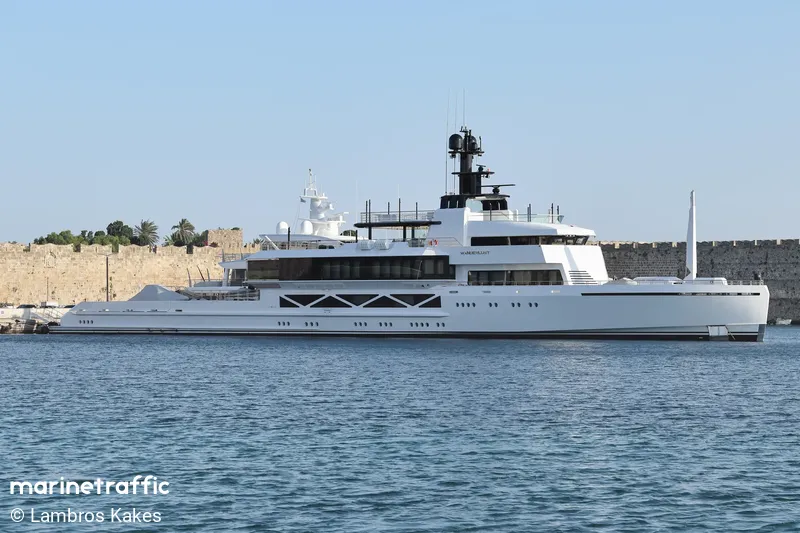
Ownership records for eighty-metre motor yachts typically document a chain of sales driven by divorce settlements, sanction avoidance, or yard financing. Wanderlust presents the opposite pattern. Delivered new to Yim Leak in 2022, she has remained under one titleholder while running high-speed passages between Italian ports, a behaviour made possible by her construction timeline and her Marshall Islands registration.
The register lists Yim Leak as the sole recorded owner since the hull entered service in 2022. There is no prior title history, no broker intermediation, and no reported sale price. The estimated value stands at $100 million, a figure derived from build costs and yard margins rather than auction results or private treaty negotiations. In the secondary market for vessels exceeding seventy metres, a twelve-year-old hull would have changed hands at least twice, each transfer accompanied by valuation disputes, dry-docking schedules, and interior refurbishments. Wanderlust has avoided that cycle entirely. She was commissioned directly from Silver Yachts in Henderson, Washington, and delivered to her end user without entering the speculative inventory that defines the superyacht resale sector.
The direct delivery model
This direct acquisition model carries specific mechanical and administrative consequences. A hull purchased off the slipway does not require the structural reinforcement often added during second-hand refits to accommodate heavier tenders, larger generator sets, or additional fuel capacity. The gross tonnage of 1561 aligns closely with the design parameters of an 85.0-metre aluminium displacement hull, leaving little room for later additions that would push the vessel toward regulatory thresholds. The beam of 14.0 metres further constrains her operational footprint, limiting her to marinas that can accommodate her width without requiring tidal windows or specialised mooring infrastructure. These dimensions were locked in at the keel-laying stage, meaning every subsequent modification has been bounded by the original naval architecture.
The absence of a transfer history also means the AIS tracking data begins at delivery, providing an unbroken record of utilisation rather than fragmented logs separated by multi-year lay-ups. Where many comparable hulls show long periods of static positions followed by brief, high-speed transits to shipyards, Wanderlust’s broadcast schedule reflects continuous operation. The vessel has not sat idle in a ledger or a marina while awaiting a buyer. She has been moved according to a fixed itinerary, a pattern that only emerges when a single operator controls the scheduling without needing to coordinate with multiple stakeholders or prepare the vessel for prospective purchasers.
The Marshall Islands and Bikini
Her flag state is the Marshall Islands, a registry chosen for its commercial efficiency and established compliance framework for large recreational craft. The home port is listed as BIKINI, an unusual designation for a vessel operating primarily out of the Mediterranean. Most eighty-metre yachts registered in the Marshall Islands carry European home ports such as London, Monaco, or Valletta, reflecting the primary cruising grounds of their owners. Bikini suggests a corporate or personal anchoring point that exists outside the traditional European yachting centres, possibly tied to the owner’s primary residence or business operations in another region.
Reflagging clusters around specific triggers: the imposition of international sanctions, the expiration of a charter licence, or the transfer of ownership between jurisdictions. Wanderlust has undergone no recorded flag changes since 2022. This stability indicates that the vessel has not been subject to sudden regulatory pressure or cross-border asset restructuring. The Marshall Islands registry requires regular safety and pollution prevention audits, and the consistency of her broadcasts implies she has passed these inspections without interruption. A vessel undergoing ownership disputes or legal challenges often experiences delays in certification renewal, which manifest as gaps in AIS coverage or prolonged stays in protected waters. None of those markers appear in her log.
The decision to retain a single flag also simplifies the administrative burden of operating an 85.0-metre hull in congested waterways. European territorial waters impose varying environmental standards, fuel restrictions, and noise regulations depending on the national jurisdiction. A Marshall Islands flag provides a uniform compliance baseline, allowing the crew to navigate between French, Italian, and Greek zones without adjusting documentation or seeking local permits for routine passage. This administrative continuity supports the high-frequency transit pattern observed in her recent movements, as the vessel is not slowed by bureaucratic friction at border crossings.
The Tyrrhenian circuit
The AIS data from August 2026 maps a concentrated operational loop across the western Mediterranean. The track centres on La Maddalena, Sardinia, with legs radiating to Olbia, San Teodoro, Antibes, Bonifacio, Monaco, Propriano, and La Ciotat. Coverage is nearly complete, though one transit between La Maddalena and Olbia shows a sixty-six per cent signal retention. Distances span from five point two nautical miles to two hundred and twenty-seven point one nautical miles, reflecting short harbour hops and longer coastal crossings.
The speeds recorded during these passages distinguish her from vessels that spend most of their time at anchor. Average speeds between 5.6 and 15.4 knots indicate variable engine output, while maximum speeds reach 17.3 knots during open-water transits. These figures rule out prolonged anchoring or static positioning. The vessel is being run at a pace that consumes significant fuel reserves, a pattern consistent with a dedicated owner moving between private locations rather than participating in public regattas or port-side exhibitions. The route itself follows a logical geographic progression, minimising backtracking and optimising sea conditions across the western Mediterranean basin.
The sequence of ports traces a deliberate routing strategy. The initial leg from Porto Cervo to La Maddalena covers 11 nautical miles at an average of 11.6 knots, suggesting careful navigation through restricted channels. The subsequent move to Olbia spans 9 nautical miles at 5.9 knots, indicating heavy traffic or shallow approaches. The longest transit, 224 nautical miles to Torre Annunziata, maintains an average of 16.1 knots, demonstrating the vessel’s capability for sustained open-water travel. The return journey to Naples covers 6 nautical miles at 6.3 knots, followed by a 69 nautical-mile crossing to Ischia at 16.3 knots. The final legs reconnect the Sardinian bases before the Corsican departure. Each segment is logged with perfect coverage, confirming that the vessel’s satellite transmitter remained active and properly aligned throughout the entire period.
The timing of these movements places her in the Mediterranean during the peak summer season, yet the itinerary avoids the major event hubs that attract crowds of smaller craft and media attention. Porto Cervo and La Maddalena are established destinations, but the inclusion of Ischia and the rapid turnaround between Naples and La Maddalena suggest a focus on accessibility and discretion rather than spectacle. The vessel’s ability to maintain this schedule without deviation points to a well-funded provisioning chain and a crew accustomed to executing a predetermined plan. There is no evidence of unscheduled stops, extended layovers, or deviations caused by mechanical failure or weather avoidance.
The combination of direct delivery, stable registration, and high-speed transit creates a clear picture of Wanderlust’s operational identity. She is not a floating asset waiting for a market correction, nor is she a proxy for a complex corporate restructuring. She is a functional platform operated by a single principal, moving through European waters on a schedule dictated by personal preference rather than commercial necessity. The AIS tracks confirm that the hull has fulfilled its intended purpose: to provide reliable, high-capacity transport across long distances without the administrative overhead that accompanies secondary market transactions.
Reporting and data: CelebYachts, republished by On the record.
Sources
The numbers on this page point here. Each one links to the record it came from.
- 1CelebYachtsCelebYachts: The direct delivery model