
 CelebYachts reportInvestigations
The direct delivery problem
ABEONA’s ownership record shows a single transfer because she never entered the secondary market, a structural feature of modern superyacht economics that…
By On the record · Sep 4, 2026 · Data from CelebYachts1
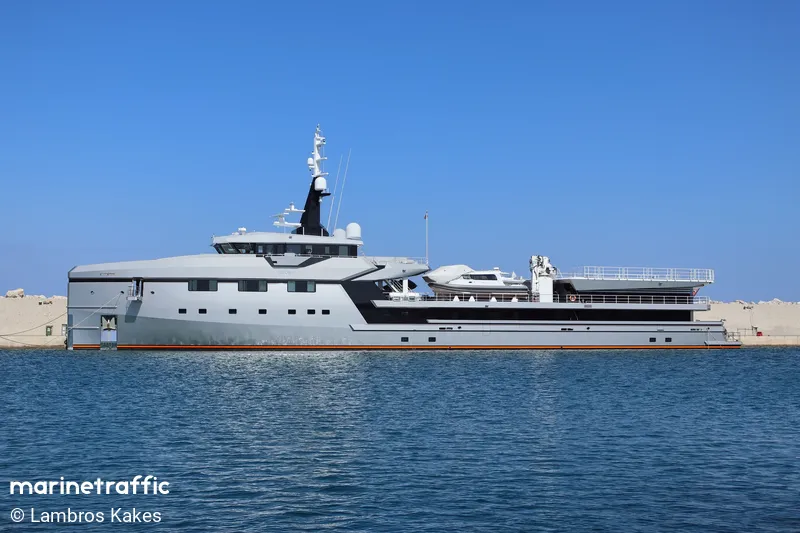
A vessel’s position is the boat’s, not the owner’s. Ownership is as reported, not certified.
The hull delivered by Damen Yachting in 2023 carries a single registered proprietor and a straight-line construction log. That absence of a brokerage trail is not a reporting gap. It is the predictable outcome of a business model that routes new tonnage directly from the slipway into private trusts, bypassing the resale market entirely.
AIS broadcasts for ABEONA show a continuous track beginning only after her builder handed over the keys. The vessel first appeared on maritime tracking networks in late 2023, immediately following her completion at the Damen Yachting facility. There are no transits recorded prior to that date, no long-distance movements between brokers, and no anchorage stays typical of pre-delivery sea trials or buyer inspections. The data pattern matches a direct delivery: the yard completed the hull, the buyer accepted it, and the registration was processed. This linear trajectory explains why the public record contains exactly one owner. Recent AIS data confirms active operation, with a voyage recorded from Thursday Island, Queensland, Australia, covering 580.6 nautical miles at an average speed of 14.7 knots.
The slipway, not the broker
Yachts built under custom programmes rarely circulate through the secondary market. ABEONA carries the yard number YS 7512, which places her within Damen's production sequence for their larger motor yacht series. The shipyard constructs these vessels to specific client requirements, often working with a dedicated project manager who coordinates naval architecture, interior fit-out, and classification surveys before the first engine start. When the build concludes, the contract typically transfers directly to a holding company established by the end user. The hull does not sit on a brokerage listing. It moves straight from the fitting-out berth to a flag state registry.
The final sale price has never been published; the $75,000,000 figure is an external estimate rather than a disclosed contract value. New-build contracts frequently include options, tender packages, and commissioning fees that push the delivered cost well above the base hull price. Because the transaction occurred privately between the yard and the buyer's legal representatives, no bill of sale entered the public domain. The absence of a resale history means there is no renovation timeline to decode, no change of management company to trace, and no previous owner's operational habits reflected in the AIS track. The boat arrived fully specified and registered.
The geometry of a seventy-five-metre run
A length of 75.25 metres and a beam of 12.81 metres produce a ratio that prioritises interior volume over extreme speed. The gross tonnage of 1901 reflects the total enclosed volume of the vessel, calculated according to international measurement rules that account for all closed spaces above and below the main deck. This tonnage band sits in a crowded segment of the market, where yards compete on layout efficiency and fuel economy rather than raw displacement. The beam width allows for wider guest cabins and larger saloon areas without extending the overall length, which keeps the vessel manageable in marinas and reduces hydrodynamic resistance at cruising speeds.
The hull form dictates how the vessel handles different sea States. A beam exceeding twelve metres provides initial stability that makes the upper decks less sensitive to rolling, which matters when the yacht operates in open water far from sheltered anchorages. The draft required to support 1901 tons of steel and aluminium structure determines which ports can accept the vessel without tidal restrictions. Classification societies assess the framing spacing, bulkhead placement, and machinery mounting points during the design phase, ensuring the structure meets fatigue and damage control standards. These engineering decisions are baked into the steel before the hull ever leaves the slipway, leaving no room for later modification without compromising the original survey.
The registration architecture
ABEONA flies the Cayman Islands flag, with George Town listed as her home port. The Cayman Maritime Authority processes new-build registrations rapidly, often issuing certificates within days of delivery because the paperwork consists primarily of the builder's declaration, proof of insurance, and the name of the managing agent. Flags cluster here for newly constructed yachts because the jurisdiction offers tax neutrality, straightforward corporate structuring, and English-language legal frameworks that align with international maritime law. The MMSI identifier 319225500 belongs to the Cayman range, which assigns sequential numbers to vessels registered under that flag.
AIS transponders on newly registered vessels begin broadcasting immediately upon commissioning, provided the crew activates the equipment and inputs the correct call sign and MMSI. The track shows the vessel operating in the Solomon Sea, a location that falls outside the standard Mediterranean summer circuit and the Caribbean winter season. Vessels in this size class frequently undertake extended passages to remote anchorages, using their range and fuel capacity to reach destinations that smaller boats cannot access. The positioning data confirms active operation rather than a prolonged lay-up, which would typically show the transponder switched to static mode or the vessel moored for months without movement.
The capital origin
Jeff Bezos acquired ABEONA as part of a broader procurement strategy that treats large vessels as operational assets rather than decorative purchases. His wealth originated from Amazon's initial public offering in 1997, which raised $54,000,000 and converted his early equity stake into liquid capital. The subsequent growth of the e-commerce and cloud computing divisions multiplied that initial valuation, placing him at the top of global wealth rankings for several consecutive years. The capital required to fund a new-build superyacht represents a negligible fraction of his net worth, estimated at $204,600,000,000, which removes financial constraints from the acquisition process.
Tech founders approach yacht procurement differently from traditional industrialists. The emphasis falls on reliability, range, and technological integration rather than historical prestige or heritage branding. ABEONA fits into a category explicitly labelled Tech founders — flagships, indicating a pattern of acquiring vessels that serve as mobile offices or expedition platforms. The decision to order directly from a commercial shipyard like Damen Yachting, rather than commissioning a one-off from a historic Italian or French builder, reflects a preference for standardised engineering, predictable delivery schedules, and modular maintenance protocols. The hull is a tool, not a trophy, and its specifications are chosen to match the operational requirements of its owner.
Reporting and data: CelebYachts, republished by On the record.
Sources
The numbers on this page point here. Each one links to the record it came from.
- 1CelebYachtsCelebYachts: The direct delivery problem