
 CelebYachts reportInvestigations
The direct link: how Lady M’s register triggered a seizure
The register names Alexei Mordashov directly, bypassing the standard offshore labyrinth. That transparency explains why Italian police seized the vessel days after the EU blacklist, freezing a 716-tonne hull instead of tracing a trust.
By On the record · Oct 29, 2026 · Data from CelebYachts1
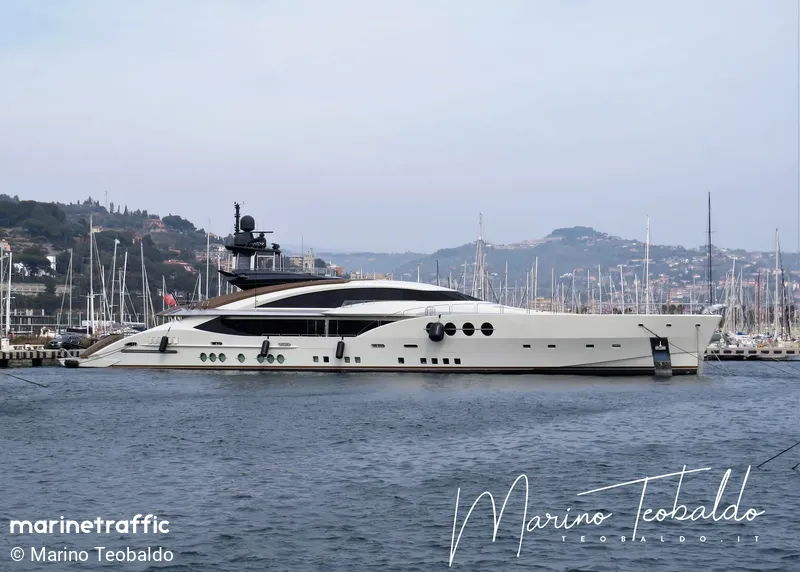
A vessel’s position is the boat’s, not the owner’s. Ownership is as reported, not certified.
Ownership of a seven-hundred-gross-tonne yacht rarely appears on a public register without layers of corporate shielding. Lady M breaks that pattern. Her direct link to a sanctioned Russian steel baron removed the usual legal friction, allowing authorities to immobilise the asset the moment Brussels issued its embargo.
The register lists the owner of Lady M as Alexei Mordashov. This is an uncommon entry for a vessel of 716 gross tonnes. Mega-yachts of this scale are typically held by foundations in Liechtenstein or trusts in the British Virgin Islands, creating a buffer between the beneficial owner and the steel. The Cayman Islands flag and the George Town home port sit above a structure that, in this instance, terminates at a single name. That termination is the reason the yacht has been immobilised since March 2022. When the European Union blacklisted Mordashov on 28 February 2022, Italian police executed a seizure in the following days without needing to pierce a corporate veil or litigate the provenance of offshore accounts. The asset appeared on a sanctions list exactly where the register said it would. Another of Mordashov’s yachts, Nord, was outside the European Union’s jurisdiction at the time, anchored in the Seychelles, and therefore remained free to move. Lady M was not.
The Wisconsin build
The hull itself places the asset firmly within a specific window of Mordashov’s commercial expansion. Palmer Johnson in Sturgeon Bay, Wisconsin, launched her on 13 May 2013 as Project Stimulus. The exterior and interior were designed by Nuvolari & Lenard. The construction uses aluminium for both the hull and the superstructure, with teak laid decks. She measures 65.5 metres in length and 10.0 metres in beam, drawing 2.9 metres of water. Her estimated value sits at $65 million. Two MTU 16V 4000 M93L engines provide 9,222 horsepower, driving her to a maximum speed of 28 knots and a regular cruising speed of 24 knots. Her range is listed at 2,534 nautical miles. She accommodates twelve guests in six cabins alongside a crew of fourteen. The cabin configuration consists of one master suite, one VIP stateroom, two doubles, and two twins. The vessel carries the IMO identifier 1012012 and the MMSI number 319297000. She is Lloyd's registered and complies with the MCA LY2 code. She is not for charter.
The timing of the build coincides with the liquidation of Mordashov’s most significant Western industrial holdings. Between 2004 and 2014, Severstal invested up to $3 billion in plants in Dearborn, Michigan, and Columbus, Mississippi. Mordashov secured a loan exceeding $370 million from the United States Department of Energy to refurbish the Rouge Plant in Dearborn. Political tensions caused the loan to be revoked in 2012. By 2014, all Severstal investments in the United States had been sold to the Renco Group for a total of $2.3 billion. The capital released from those North American operations fed directly into the acquisition of new assets. In 2013, the same year Lady M was delivered, Mordashov purchased fifty percent of Tele2 Russia, the country’s fourth largest mobile phone operator. He also consolidated Severstal’s gold mining assets into Nord Gold N.V., which was listed on the London Stock Exchange before being delisted in 2017 citing unfair valuation.
The capital stack
The corporate architecture surrounding Mordashov’s wealth relies on layered vehicles, even if the yacht register does not show them. His initial fortune originated from the privatisation of the Cherepovetskiy Metallurgical Plant in December 1991. After joining the plant as an economist in 1988, he became finance director in 1992. When the director instructed him to acquire shares to prevent an outsider takeover, Mordashov formed two investment funds and bought up workers’ shares, building a major stake. He was appointed chief executive officer in 1996 and expanded the conglomerate into coal and mining. The subsequent decades saw him accumulate stakes across multiple sectors. He became a co-owner of Rossiya Bank in 2003. In April 2010, structures associated with Mordashov gained a forty-five percent stake in the Video International group, controlling seventy percent of the Russian advertising market. Through his S-Group Travel entity, he increased his stake in TUI Travel until it was absorbed by TUI Group in 2014. He held a blocking stake of more than twenty-five percent at the time of absorption.
The European freeze
The transfer of these business interests away from his personal name illustrates the standard mechanism of oligarch wealth preservation, contrasting sharply with the direct registration of Lady M. Between 2018 and 2019, a holding company called KN-holding was created for his sons Kirill and Nikita. Mordashov transferred his shares in Nordgold and TUI to this vehicle. In 2021, Nikita lost his share after leaving for military service. More recently, the International Consortium of Investigative Journalists reported that Mordashov transferred most of his ownership stake in the tourism conglomerate TUI to a Caribbean shell company controlled by Marina Mordashova, reportedly the mother of some of his children. These structural shifts demonstrate a deliberate separation between operating capital and personal assets, a separation that Lady M never participated in.
The regulatory blockade
The seizure of Lady M by Italian authorities in early March 2022 was a direct consequence of that missing separation. The European Union blacklist froze all assets belonging to Mordashov on 28 February 2022. Because the yacht was registered to him personally, the legal threshold for confiscation was met immediately. The UK government applied parallel sanctions later that year. The vessel’s current AIS broadcast places her at 43.88° N, 8.02° E in the Ligurian Sea, but the transmission carries no operational status. She sits under a regulatory blockade rather than a dry-docking schedule. The distinction between a sanctioned individual’s direct holdings and their indirect corporate investments is now visible in the movement patterns of the Mediterranean fleet. Yachts held by offshore entities can often find flags of convenience or jurisdictions outside the sanctioning regime. A hull tied directly to a blacklisted name cannot. The register entry that usually serves as a formality has become the sole determinant of her operational capacity.
Reporting and data: CelebYachts, republished by On the record.
Sources
The numbers on this page point here. Each one links to the record it came from.
- 1