
 CelebYachts reportThe Fleet
The distance between George Town and the Ligurian Sea
A Cayman-registered yacht does not sail to its home port; it sails to where the water is warmest and the customs officials are busiest.
By On the record · Oct 26, 2026 · Data from CelebYachts1
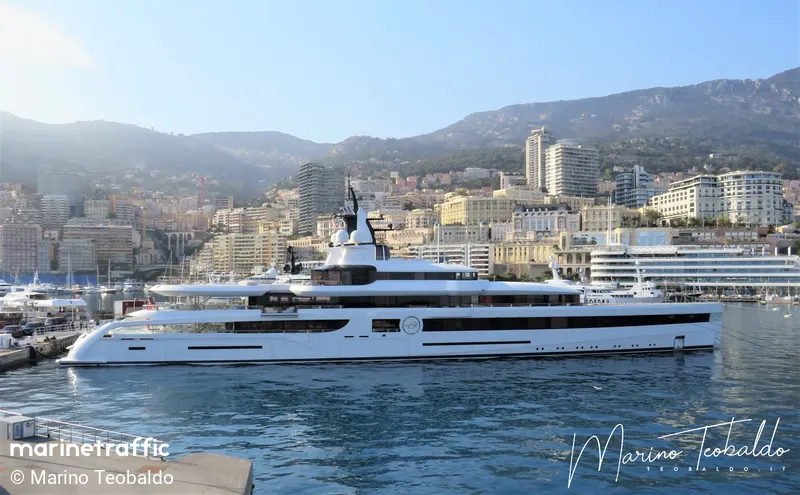
A vessel’s position is the boat’s, not the owner’s. Ownership is as reported, not certified.
Lady S has been logged in the Mediterranean for weeks while her painted port of registry sits more than eleven thousand nautical miles away in the Caribbean. The distance is not an oversight. It is the intended function of a flag state that demands paperwork, not proximity.
The AIS track places Lady S at 43.27° N, 6.62° E in the Ligurean Sea. Her registered port of registry, stamped under her name in paint, is George Town in the Cayman Islands. The straight-line distance between those two points exceeds eleven thousand nautical miles. She has spent the last month moving between Saint-Tropez, Antibes, Menton, Calvi, La Maddalena, and Portofino. The distance between the legal address and the actual location reflects the standard operating model for a superyacht registered in an offshore territory.
The geography of the gap
George Town functions as a jurisdictional marker rather than a physical anchor point. Registration in the Cayman Islands requires no evidence that the vessel ever visits the archipelago. The flag state processes the documentation, applies the relevant tonnage taxes, and leaves the operational decisions to the owner. This arrangement allows a vessel to remain legally domiciled in one hemisphere while spending its entire service life in another. Lady S illustrates the mechanism clearly. She was delivered in 2019 and has operated continuously out of European waters. The Cayman registry provides a stable legal framework that survives changes in crew nationality, charter contracts, and owner residence.
Dan Snyder owns the hull. He lives in London, having incorporated a private limited company there in November 2022 to formalise his residency. His wealth derives from two distinct transactions. He founded Snyder Communications in 1989 and sold it to the French group Havas in April 2000 for more than two billion dollars, taking a personal share estimated at three hundred million dollars. He used that capital base to purchase the Washington Commanders football franchise in 1999 for eight hundred million dollars, later selling the team to a group led by Josh Harris in 2023 for six billion and fifty million dollars. The yacht represents a fraction of that accumulated capital, yet its management follows the same logic of separation. Snyder resides in England. The boat operates in the Mediterranean. The flag sits in the Caribbean. The three jurisdictions do not overlap.
The mechanics of the flag
The choice of Cayman registration carries specific fiscal implications that explain why the port remains painted on the transom despite the geographical mismatch. Offshore registries typically offer deferred duty structures on fuel and provisions, simplified value-added tax handling for international itineraries, and streamlined transfer procedures when the underlying ownership company changes hands. None of these advantages require the vessel to visit the registering territory. The administrative cost of maintaining the flag is fixed, whether the yacht spends a year in the Aegean or a year in the Bahamas. The decision to keep George Town as the home port reflects a calculation about corporate continuity rather than geography. Snyder’s London incorporation in late 2022 demonstrates this principle in action. He established a UK entity to manage his post-sale assets while retaining a Cayman-flagged platform for his leisure marine activities. The two structures operate in parallel.
The builder and the build
The engineering constraints of the hull dictate where she can physically go, regardless of where she is legally registered. Measuring ninety-three metres in length and sixteen metres in beam, she displaces two thousand nine hundred ninety-nine gross tonnes. These dimensions require deep-water berths and specialised shore power infrastructure, facilities that are abundant along the French and Italian coasts but entirely absent in George Town. The Feadship cooperative, formed by Royal Van Lent Shipyard and Koninklijke De Vries Scheepsbouw, designed and constructed the vessel. The Amsterdam yard opened a new dry dock in early 2019 capable of accommodating vessels up to one hundred and sixty metres. Lady S fits comfortably within that slipway, alongside other custom builds that share the same design centre at De Voogt Naval Architects. The shipyard locations in Kaag, Aalsmeer, and Makkum handle the steelwork and outfitting, after which the completed hull departs for its permanent operational theatre.
The movement log
The movement log confirms the Mediterranean pattern. On fourteen August 2026, she departed Sestri Levante for Forte dei Marmi, covering thirty-five nautical miles at an average speed of nine point five knots. Two days later, she crossed from Viareggio to La Maddalena, a passage of one hundred and sixty-five nautical miles completed at twelve point zero knots average speed. The following day saw a short local run from La Maddalena back to the same harbour, logging seventeen nautical miles at six point zero knots average before heading north again. By mid-August, she was tracking between Calvi and Menton, covering eighty-five nautical miles at eleven point zero knots. The final recorded leg ran from Monaco to Nice, twenty nautical miles at ten point two knots average. The speeds remain consistent with a displacement hull optimised for efficient coastal transit rather than open-ocean sprinting. The routing avoids the longer stretches of the Tyrrhenian and Ionian seas, favouring the sheltered waters of the northern Mediterranean basin.

The hull’s current position also highlights the limitations of AIS tracking in congested waters. The archive records her movements with high coverage across the August passages, but the signal drops intermittently near coastlines where terrain blocks the transmitter line-of-sight. The coverage percentage falls to fifty-one per cent on the trip from Saint-Tropez to Antibes, compared to one hundred per cent on the open-water run from La Maddalena to Calvi. This technical variance does not indicate stationary periods or engine shutdowns. It simply reflects the geometry of the coastline relative to the satellite receivers processing the broadcast. The vessel remains active throughout the gap.
Lady S sits at a midpoint in the Feadship order book. The cooperative launched several custom motor yachts in the late 2010s, transitioning from traditional steel construction methods to newer modular assembly techniques at the Amsterdam facility. The ninety-three-metre length places her in a category that balances interior volume with manageable crew requirements. A beam of sixteen metres provides sufficient stability for the upper deck amenities without demanding the extreme draft restrictions of narrower designs. The two thousand nine hundred ninety-nine gross tonnage rating keeps her just under the three thousand mark, a threshold that often triggers additional classification surveys and safety equipment mandates under international maritime conventions. Staying below that line simplifies the compliance burden for an owner managing multiple vessels across different jurisdictions.
The record does not show any planned transit to the Caribbean. No AIS pings indicate a westbound route through the Strait of Gibraltar into the Atlantic. The seasonal pattern suggests she will remain in European waters until the autumn weather deteriorates. When she eventually moves to a wintering location, it will likely be a different Mediterranean harbour or a Turkish marina, neither of which is George Town. The painted port will remain unchanged. The distance between the legal address and the physical location will persist. That is the function of the flag. It provides a stable reference point in a business that moves constantly.
Reporting and data: CelebYachts, republished by On the record.
Sources
The numbers on this page point here. Each one links to the record it came from.
- 1