
 CelebYachts reportInvestigations
The distance between George Town and the Ligurian Sea
The Cayman Islands registry acts as a static legal wrapper for VANISH, allowing the 71.5-metre Feadship to operate in European waters without changing its flag, a configuration confirmed by her recent coastal hops between Italy and France.
By On the record · Oct 20, 2026 · Data from CelebYachts1
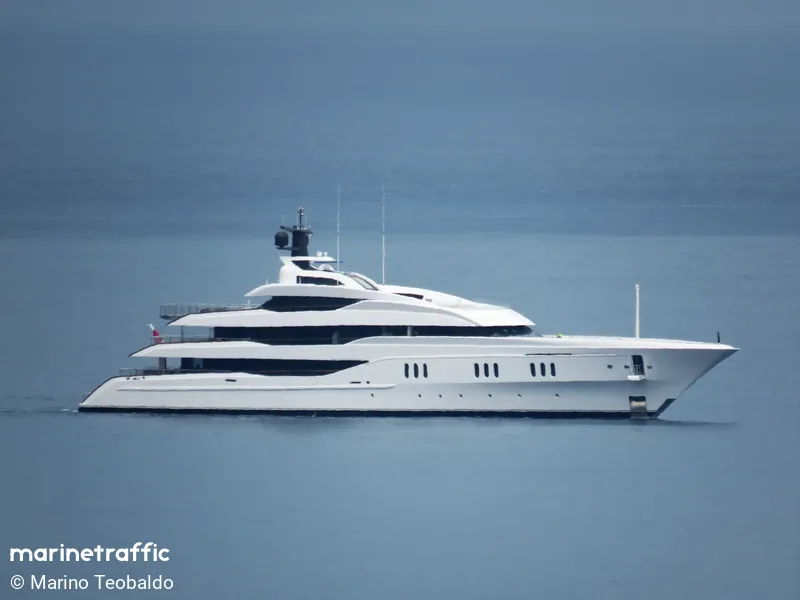
A vessel’s position is the boat’s, not the owner’s. Ownership is as reported, not certified.
VANISH carries a Cayman Islands flag and a home port of George Town, yet her AIS broadcasts place her in the Ligurean Sea, thousands of nautical miles away. The gap between the painted port and the actual position reveals how modern superyacht registration functions as a financial instrument rather than a geographical anchor.
VANISH measures 71.5 metres in length and carries a gross tonnage of 1728. She was built at the Feadship yard on Kaag Island in 2021 as hull 819. Her home port is recorded as George Town in the Cayman Islands. The last AIS broadcast places her at 43.59° N, 7.13° E, in the Ligurean Sea. The straight-line distance between George Town and her current position exceeds 6,000 nautical miles. The registry does not update when the hull crosses a meridian. The painted port remains a legal address that exists independently of the steel's location.
The mechanics of the flag
The register lists the flag as Cayman Islands and the home port as George Town. Source s1 confirms the vessel is registered in the Cayman Islands and classed by Lloyd's Register. The owner is listed as Larry Van Tuyl, an American Businessman. His citizenship is American. His occupations include Businessman, Entrepreneur, and Former Chairman of Berkshire Hathaway Automotive. He is also a Real estate developer. The category of owner is US tycoons, financiers & sports owners. The estimated value is 90 million dollars.
The flag state provides the legal framework for the vessel. The Cayman Islands registry processes the registration. The hull operates under the laws of the flag state. The physical position is in the Ligurean Sea. The distance between the two is immaterial to the daily operation. The registry office in George Town handles paperwork remotely. The flag state inspector visits the vessel only during scheduled surveys. The legal address and the physical position are decoupled. The hull operates under the laws of the flag state while physically present in the territorial waters of Italy and France.
The owner's wealth
Larry Van Tuyl owns the hull. He is an American Businessman and the Former Chairman of Berkshire Hathaway Automotive. His wealth derives from the sale of Automotive dealerships, a sector that generated significant liquidity during his tenure at Berkshire Hathaway. The net worth figure for Van Tuyl has not been published. The source of the funds that bought the hull constrains the vessel's specification to a level consistent with Automotive industry profits rather than sovereign wealth. Van Tuyl held the vessel until selling it to Andrew Currie, according to records from the Wikipedia entry for the yacht Hampshire. The register currently lists Van Tuyl as the owner. The discrepancy between the register and the external record requires clarification.
The corporate architecture of Van Tuyl's wealth is distinct from the entertainment or technology sectors that often fund large yachts. Automotive dealership groups operate on thin margins and high volume. The capital required to purchase a 71.5-metre vessel comes from accumulated equity in these businesses. The transaction that transferred the hull to Andrew Currie has not been documented in public records. The register continues to show Van Tuyl, suggesting the transfer may be pending or held through a trust. The legal status of the ownership remains unresolved. The distinction between the registered owner and the beneficial owner is common in superyacht transactions. The register reflects the legal entity holding the title. The beneficial owner may be a separate trust or holding company.
The hull and the yard
Feadship constructed VANISH using a steel hull and an aluminium superstructure. The beam measures 10.0 metres. The draught is 3.45 metres. She is powered by twin 1,850 hp MTU 12V4000 M53 engines. The interior and exterior were designed by Harrison Eidsgaard. The yard on Kaag Island has deep-water access that accommodates vessels of this size. The construction shed allows for the assembly of steel and aluminium hybrid structures. The classification society is Lloyd's Register. The vessel was delivered in 2021. The estimated value is 90 million dollars.
Feadship is a cooperative venture between Royal Van Lent Shipyard and Koninklijke De Vries Scheepsbouw. The Kaag yard has roots dating back to 1849. It specialises in custom-built motor yachts. The facility includes dry docks and slipways for vessels up to 100 metres in length. The engineering centre, De Voogt Naval Architects, is located in Hoofddorp. The design team coordinates the structural integration of the steel hull and aluminium superstructure. The MTU engines provide propulsion for the displacement hull. The maximum speed recorded during recent voyages was 14.8 knots. The average speed on longer legs was 11.9 knots. Feadship was founded in 1949 by naval architect Henri de Voogt as an export association. The organisation merged with other shipyards over the decades. Royal Van Lent received a royal charter in 2001. De Vries Scheepsbouw followed in 2006. LVMH acquired Royal Van Lent in 2008. In September 2025, Feadship joined the Nuclear Energy Maritime Organization. The yard's history reflects the evolution of European yacht building.
The recent track
AIS data shows VANISH moving along the northern Mediterranean coast. On 2 August 2026, she departed Olbia and arrived at La Maddalena, covering 11 nautical miles. On 4 August 2026, she left La Maddalena and reached Antibes, a passage of 228 nautical miles. The average speed on the longer leg was 11.9 knots. The maximum speed recorded was 14.8 knots. These distances are short coastal hops. The vessel relies on marinas in Sardinia and the French Riviera for services. She has not crossed the Atlantic since the start of the tracking period. The absence of long-distance passages confirms that the Cayman flag serves a permanent legal function rather than facilitating frequent repositioning.
The voyage from La Maddalena to Antibes started at 16:27 on 4 August 2026 and ended at 10:10 on 5 August 2026. The route follows the coastline through the Ligurian Sea. The vessel maintained a steady pace suitable for fuel efficiency. The coverage percentage for both tracked voyages was 100 per cent. The data indicates continuous monitoring by AIS receivers along the coast. The hull did not deviate into open water. The proximity to shore suggests reliance on local support infrastructure. The distance between the marinas in Sardinia and the French Riviera is manageable within a single tank of fuel. The operational range of the vessel supports this pattern of movement. The short hop from Olbia to La Maddalena took 1 hour and 19 minutes. The average speed on that leg was 10.2 knots. The vessel operates within a familiar network of ports.
The gap
The home port of George Town sits on the western edge of the Caribbean basin. The Ligurean Sea borders the Italian Riviera. The registry office in George Town processes paperwork remotely. The flag state inspector visits the vessel only during scheduled surveys. The distance between the two locations is measured in time zones and flight hours, not in the daily routine of the crew. The hull operates under the laws of the flag state while physically present in the territorial waters of Italy and France. The legal address and the physical position are decoupled.
The Cayman Islands registry provides a stable legal framework for international owners. The hull can change hands without altering the flag. The management company can relocate its office without affecting the registration. The vessel's physical location is determined by the owner's preferences and the seasonal availability of marinas. The distance to George Town is irrelevant to the technical operation of the yacht. The registry exists to facilitate trade and investment, not to track the vessel's movements. The AIS data confirms that the hull is active and moving, while the registry remains static. The painted port is a symbol of legal jurisdiction. The actual position is a result of commercial and personal choice.

The final point
The distance between George Town and the Ligurian Sea is a measure of legal separation, not operational limitation. VANISH operates effectively under a Cayman Islands flag while conducting business in European waters. The hull's specifications, built by Feadship and designed by Harrison Eidsgaard, support this dual existence. The owner, Larry Van Tuyl, has used the vehicle to store capital derived from the Automotive industry. The registry provides the necessary anonymity and stability. The physical position changes with the seasons. The painted port remains unchanged.
Reporting and data: CelebYachts, republished by On the record.
Sources
The numbers on this page point here. Each one links to the record it came from.
- 1