
 CelebYachts reportDestinations
The distance between Jaluit and the Balearics
A registered port of call in Micronesia and a tracking log full of short hops around Mallorca reveal how a legal address functions as a static point while the vessel operates elsewhere.
By On the record · Oct 26, 2026 · Data from CelebYachts1
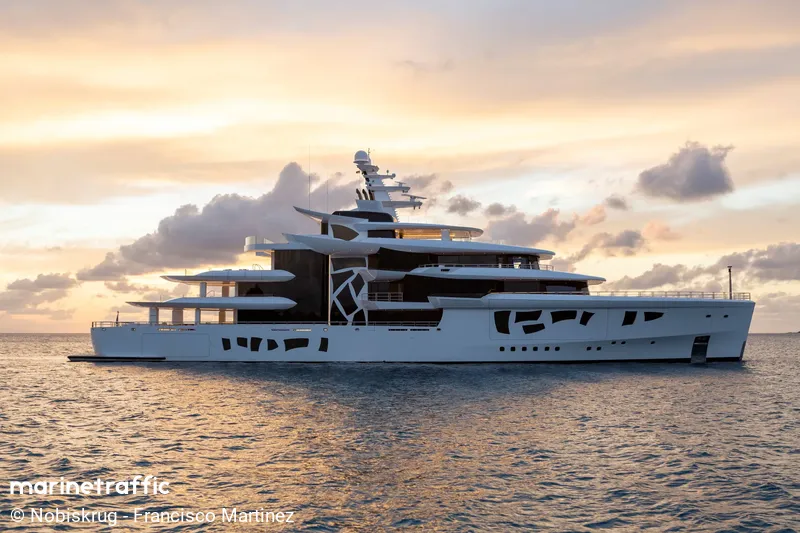
A vessel’s position is the boat’s, not the owner’s. Ownership is as reported, not certified.
Artefact carries Jaluit Atoll under her name and flies the Marshall Islands flag, yet her AIS broadcasts place her in the western Mediterranean. The gap between the registry and the track is measured in geography, not secrecy.
Artefact’s home port is Jaluit Atoll. The name appears in the register next to the Marshall Islands flag and sits beside the IMO number 9804332. It is a legal address. The vessel has never been observed docking at the ATOLL, nor has she crossed the Pacific to reach it. Her position archive shows a different reality. She operates in the Balearic Sea, anchored and motoring around the Spanish archipelago. The distance between Jaluit and her current coordinates at 39.51° N, 2.56° E spans two oceans. A port of registry establishes jurisdiction and tax liability without dictating cruising grounds.
The legal address
Mike Lazaridis owns the hull. He is a Canadian businessman who co-founded Research In Motion, the company that manufactured the BlackBerry wireless handheld device. His wealth originated from that technology launch and the subsequent commercialisation of the BlackBerry platform between 1999 and 2002. He served as co-chairman and co-CEO until 2012, after which he shifted capital toward academic physics and quantum computing ventures. The purchase of Artefact falls within his post-operational portfolio.
Lazaridis dropped out of the University of Waterloo in 1984 after securing a General Motors contract for a network computer control display system. He launched Research in Motion with Douglas Fregin and Mike Barnstijn, initially developing barcode technology for the film industry before pivoting to wireless data transmission. He donated CA$100 million in 1999 to establish the Perimeter Institute for Theoretical Physics and funded the Institute for Quantum Computing at Waterloo. He co-founded Quantum Valley Investments in March 2013 to support quantum information science commercialisation. His recognition includes an Emmy and an Oscar for the high-speed barcode reader, an investiture as an Officer of the Order of Canada in 2006, and election as a Fellow of the Royal Society in 2014.
The operational radius
The AIS data for Artefact covers a tight cluster of movements around the Balearic Islands in August 2026. She departed Valencia for Genoa on 24 August, covering 525 nautical miles at an average speed of 11.0 knots before turning back into Spanish waters. Prior to that passage, she conducted a series of short hops between Palma de Mallorca, Santa Ponça, Ibiza, and Mahón. One leg ran just 14 nautical miles over ninety-eight minutes. Another loop started and ended in Palma, covering seven nautical miles at an average of 4.7 knots. These are local transits. They require no ocean-crossing capability beyond standard sea-keeping, and they keep the vessel well within the range of Mediterranean service yards.
Her last recorded position places her off the coast of Spain. The archive shows continuous tracking through the month, with coverage percentages ranging from thirty-seven per cent to one hundred per cent on individual passages. Daily operations are tracked by the AIS broadcast rather than the registry. There is no signal indicating a westward turn toward the Atlantic, let alone a route south through the Suez Canal to the Indian Ocean and across the Pacific to Micronesia. The vessel stays where the infrastructure supports her size. The maximum speed recorded on any tracked leg was 15.1 knots, consistent with a displacement hull operating in coastal waters rather than open-ocean transit.
The routing pattern reflects a vessel utilising the Balearic archipelago as a summer base. Passages between Mahón and Mahón covered nine nautical miles at 7.2 knots. A trip from eighty-two nautical miles off Palma de Mallorca back to the harbour took 106 nautical miles at an average of 13.1 knots. The tracks do not suggest long-range blue-water deployment. They map a circuit around established marinas and anchorages. The registered port remains static while the hull executes these short, repetitive legs.
The yard and the machinery
Nobiskrug built Artefact in Rendsburg, Germany, delivering her in 2020. The shipyard sits on the Eider River and has operated since 1905, when founder Otto Storck established the facility. Early production focused on pontoons, barges, and lighters, expanding to cargo steamers and auxiliary ships for the Kaiserliche Marine during the First World War. The interwar period saw contracts for three-mast schooner yachts and German Ministry of Finance customs cruisers. World War II orders included ocean-going tugs and tankers for the Kriegsmarine and Luftwaffe.
Post-war activity concentrated on conversions and repairs. The yard advanced into larger vessels in the 1950s, launching the research vessel Polarstern and diving support vessels in the early 1980s. Financial collapse threatened the business in 1986, leading to its acquisition by Howaldtswerke-Deutsche Werft the following year. Staffing levels dropped from over 1,200 to approximately 400 as the maritime division specialised in refits. The yard delivered its first superyacht, the 92-metre Tatoosh, in 2000, followed by the passenger ship MS Deutschland forward half in 1997.
Artefact represents the yard’s shift toward hybrid engineering. She displaces 2900 gross tons on an eighty-metre length and sixteen-point-eight-two-metre beam, making her the highest-volume yacht in her length class. Her propulsion relies on diesel-electric variable-speed Azipod units paired with a dynamic-positioning system. The design includes a wastewater recycling system for technical water, onboard batteries, and solar panels. The yard’s corporate trajectory continued to shift; it filed for insolvency in 2021, was acquired by Flensburger Schiffbau-Gesellschaft in July 2021, and entered insolvency again in 2024 before being taken over by Lürssen.
The static point and the moving hull
Jaluit Atoll remains the registered home port. It provides a jurisdictional anchor for the Marshall Islands flag state. The vessel itself moves through the Balearic Sea, conducting local passages at speeds rarely exceeding fifteen knots. The gap between the painted port and the live track reflects standard practice in the sector. The hull stays in the Mediterranean because the Mediterranean offers the berths, the climate, and the proximity to Lazaridis’s European interests. The address in Micronesia stays on paper.
Reporting and data: CelebYachts, republished by On the record.
Sources
The numbers on this page point here. Each one links to the record it came from.
- 1