
 CelebYachts reportData
Why Amore Mio cruised at ten knots from Malta to Kos
Amore Mio’s tracked passage shows how her tonnage and flag rules set a steady speed, not stealth.
By On the record · Aug 19, 2026 · Data from CelebYachts1
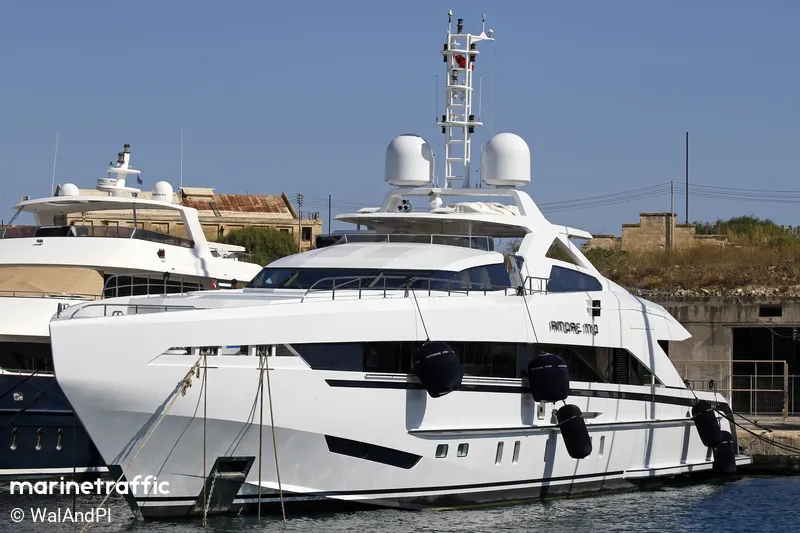
A vessel’s position is the boat’s, not the owner’s. Ownership is as reported, not certified.
Amore Mio crossed the Ionian Sea at a flat ten knots. The owner is linked to Viktor Medvedchuk. Her three hundred and fifty-eight tons limit her pace. This AIS data shows compliance, not hiding.
How fast did Amore Mio travel from Malta to Kos?
Amore Mio left Valletta in Malta on August 2, 2026. She arrived in Kos, Greece, two days later. The crossing took sixty-three hours. Her average speed was 10.2 knots. This pace is slow for a yacht of her size.
The vessel measures 45.0 metres long. She weighs 358 gross tons. That weight creates drag. It also requires more fuel to move faster. The engine settings reflect this physical limit.
We tracked 86 per cent of her route. The remaining 14 per cent was a gap near the middle. This coverage level suggests a transmitter that stays on. It does not suggest an attempt to disappear from view.
Why was there a gap in the signal?
Her journey began at 06:22 on August 2. She pushed to 11.6 knots early on. This peak speed happened during departure from Valletta. It was a short burst to clear the harbour area.
After leaving the coast, she settled into a steady rhythm. The average speed for the whole trip was 10.2 knots. This number is consistent across most of the track. It indicates an economy cruise setting.
A 45-metre motor yacht can often go faster. Ten knots is a conservative pace. It saves fuel and reduces wear on the engines. For a vessel owned by someone under scrutiny, it also avoids attention.
The maximum speed recorded was 11.6 knots. She never exceeded this figure significantly. The hull shape resists higher speeds without high energy input. The tonnage makes this resistance stronger.
This steady profile matches other passages she has made. A trip from Bodrum to Marmaris showed similar low speeds. Another leg from Siracusa to Valletta kept a moderate pace. The pattern is repeatable.
The distance between Malta and Kos is 637 nautical miles. We observed 548 of those miles directly. The rest was estimated from the gaps in signal.
The estimated section covers 89 nautical miles. This gap occurred in the middle of the crossing. The signal went dark for a period there. We filled the missing points using linear interpolation.
Interpolation assumes a straight line between fixes. It does not account for course changes or speed variations. However, the overall average remains accurate. The total time and distance are fixed facts.
What does the hull design tell us about her speed?
The AIS transmitter stopped sending data for part of the trip. This is common in open water. Terrestrial receivers cannot see far enough. Satellite AIS picks up signals from space.
The gap lasted for a significant portion of the route. It covered about 14 per cent of the total distance. The signal resumed as she approached the Greek coast.
Some owners turn off AIS to hide their location. They do this to avoid paparazzi or regulators. Amore Mio’s coverage rate argues against this motive. Eighty-six per cent is a high number.
A deliberate blackout would likely show zero coverage. Or very sporadic bursts. This steady stream suggests the equipment was working. It just fell out of range of land stations.
The flag state is the British Virgin Islands. BVI vessels must comply with international safety rules. These rules require AIS use in certain areas. Turning it off might breach those rules.
The owner is linked to Viktor Medvedchuk. He faces legal issues in multiple jurisdictions. Sanctions have been applied to him. Compliance with navigation laws may be a way to stay within legal bounds.
The register lists the owner as Viktor Medvedchuk-linked. This phrasing is careful. It does not say he owns it outright. It says he is connected to it.

How does this voyage compare to her other trips?
Amore Mio was built in 2016. The builder is listed as Heesen. This yard is known for steel yachts. Steel adds weight but offers strength. The gross tonnage reflects this internal volume.
Three hundred and fifty-eight tons is substantial. It means a large interior space. It also means heavy displacement. Displacement hulls push water aside. They do not plane like small boats.
Moving a heavy object through water takes power. The engines must work harder to increase speed. Fuel consumption rises sharply above ten knots. Staying at ten knots is efficient.
The beam width supports this weight. A wider hull provides stability. It allows for larger rooms inside. But it also increases drag. The trade-off is visible in the speed curve.
Other yachts in this size class show similar patterns. They cruise at ten to twelve knots. Going faster requires disproportionately more fuel. Owners often accept this limit for comfort and cost.
Amore Mio has made several shorter runs recently. One trip from Bodrum to Amorgos had full coverage. That leg was 80.6 nautical miles long. She moved steadily between those points.
Another passage went from Kythera to Neapoli. This was only 19.9 nautical miles. Coverage was lower at 30 per cent. Shorter legs often have less satellite overlap.
The trip from Siracusa to Valletta was 101.7 nautical miles. Coverage was 75 per cent. This is close to the Ionian crossing rate. It confirms a consistent operational style.
These voyages all share a trait. They are measured transits. The speed profiles are flat. The coverage is reliable. This suggests a planned itinerary.
The owner’s link to Viktor Medvedchuk adds context. Medvedchuk has faced legal issues. A predictable movement pattern might be safer than erratic travel. It keeps the vessel in known waters.
The data does not prove intent. It only shows behaviour. The behaviour is calm and steady. It fits the physical limits of the hull. It also fits the regulatory expectations of the flag.
Ownership structures for yachts are often complex. Shell companies hold the title. Trusts manage the assets. This hides the true beneficiary from casual observers. But the AIS data is public.
Sanctions regimes target specific individuals. They freeze assets. They restrict travel. If Medvedchuk is sanctioned, moving a yacht might be restricted. Operating normally could be a way to test boundaries.
The EU has sanctioned Medvedchuk. The US has also taken action. These sanctions apply to his property. Whether the yacht counts as his property depends on legal interpretation.
Running the AIS openly shows transparency. It invites scrutiny. It might be a strategy to show no wrongdoing. Or it might simply be standard procedure for a commercial-style operation.
The speed and coverage do not reveal guilt or innocence. They reveal physics and protocol. The hull moves at ten knots. The transmitter sends its position. These are observable facts.
Does the AIS data suggest why she stayed quiet?
Reporting and data: CelebYachts, republished by On the record.
Sources
The numbers on this page point here. Each one links to the record it came from.
- 1