
 CelebYachts reportYards & Design
How Dubai's eight decks solved a sovereign brief
Platinum Yachts stacked functions vertically to meet the Ruler’s demand for independence at sea.
By On the record · Oct 20, 2026 · Data from CelebYachts1
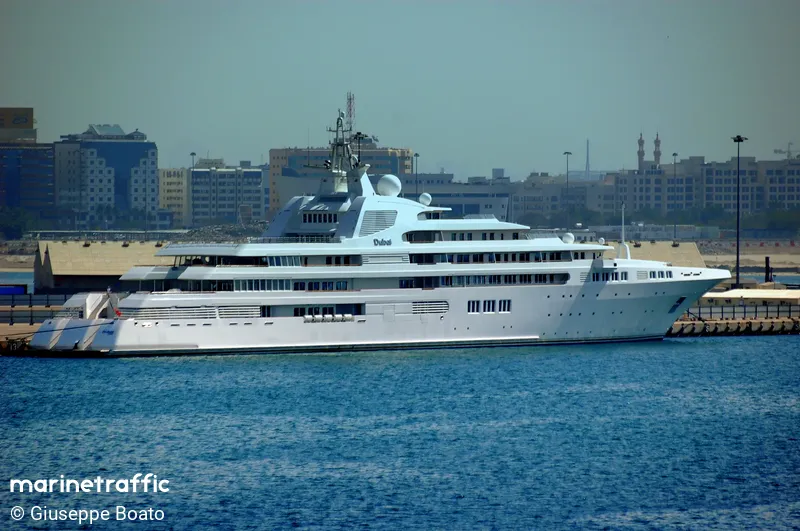
A vessel’s position is the boat’s, not the owner’s. Ownership is as reported, not certified.
Dubai, owned by Sheikh Mohammed bin Rashid Al Maktoum, held the largest yacht record from 2006 until Eclipse took it. The interior layout was shaped by a geometric limit rather than a stylistic brief. With 12,488 gross tonnes distributed across a fixed beam of 22.49 metres, the architect could not expand the footprint. Functions were stacked vertically, placing a 9.5-tonne helicopter deck above a 10-metre swimming pool and a ninety-guest dining saloon next to the engine casings.
The interior layout of Dubai was shaped by a geometric limit rather than a stylistic brief.
With 12,488 gross tonnes distributed across a fixed beam of 22.49 metres, the architect could not expand the footprint.
Functions were stacked vertically, placing a 9.5-tonne helicopter deck above a 10-metre swimming pool and a ninety-guest dining saloon next to the engine casings.
Who ordered Dubai, and why did the plan change?
Dubai was commissioned in 1995 under various project names including Panhandle, Platinum, and Golden Star.
The original client was Prince Jefri Bolkiah of Brunei, who stopped the purchase contract before 1996.
The shipyards Blohm+Voss and Lürssen had already started work on the hull.
In 2001, the yacht went to its current owner, Sheikh Mohammed bin Rashid Al Maktoum.
He serves as the vice president of the United Arab Emirates.
He is also the prime minister and the minister of defense.
He is the Ruler of Dubai.
The yacht was designed by Andrew Winch.
The interior design was handled by Platinum Yachts.
The cost was approximately $400 million U.S. dollars.
The ship, including the floating dock, was transported by the MV Blue Marlin.
It traveled via Turkey to Dubai.
The Dubai-based Platinum Yachts FZCO shipyard continued the build.
They used the former project name Platinum.
They handed her over to the owner in 2006.
From 2006 to 2009, Dubai was the largest yacht in the world.
Her length was 162 meters.
She was replaced by Eclipse and Azzam.
The yacht is kept in front of the northern of the two artificial islands, the private island of Mohammed bin Rashid Al Maktoum.
Why does Dubai have eight decks?
Dubai is divided into eight decks.
This vertical stacking meets a specific demand.
The owner wanted sovereign independence at sea.
He needed a self-contained state.
The limited beam of 22.49 metres made horizontal expansion impossible.
Architects had to stack functions instead.
This created a unique internal geometry.
A 9.5-tonne helicopter deck sits high up.
Below it lies a 10-metre swimming pool.
A dining room for 90 guests is nearby.
This saloon sits next to the engine casings.
The arrangement maximizes every square metre.
It places heavy machinery near the stern.
It keeps guest areas forward and upward.
The yacht provides space for up to 88 crew members.
It also accommodates 115 guests.
This ratio supports long-range travel.
The crew can maintain operations without port calls.
The sovereign requirements drive the layout.
Every deck serves a distinct purpose.
Privacy and function are balanced through height.
The equipment includes two 10-metre long motor boats.
There is also a disco and a cinema.
Twenty water bikes are available for use.
A submarine is part of the fleet.
A lobster tank adds a touch of luxury.
A squash court completes the recreational suite.
How much volume does the machinery take?
Four MTU-20V diesel engines power the vessel.
Each engine delivers 6,301 kW.
This gives the ship a speed of up to 26 knots.
The machinery requires significant space.
It occupies the lower decks.
This leaves the upper decks for guests.
The diesel tanks hold 1.2 million litres.
This allows a range of 8,500 nautical miles.
The large fuel capacity supports global travel.
It reduces the need for frequent refueling.
The engine room size is fixed by power needs.
It cannot be reduced without losing speed.
Gross tonnage measures the inside volume.
Dubai has 12,488 gross tonnes.
This figure includes all enclosed spaces.
It reflects the total internal capacity.
The beam limits the width.
The length allows for efficient hull form.
The volume is distributed across eight levels.
The remaining volume after machinery is key.
It houses the living quarters.
It includes the dining saloon.
It contains the entertainment venues.
The layout is tight but functional.
No space is wasted on aesthetics alone.
Every cubic metre serves a role.
Where is Dubai now, and what does it mean?
The last position recorded was in the Persian Gulf.
The coordinates are 25.13° N, 52.86° E.
The status shows no movement recently.
This consistency matches her role.
She acts as a private sovereign residence.
She stays near her owner's island.
The yacht is kept in front of the northern island.
This is one of two artificial islands.
Both belong to Mohammed bin Rashid Al Maktoum.
The location offers security and privacy.
It avoids public scrutiny.
The vessel remains a floating palace.
Her flag is the United Arab Emirates.
The home port is Dubai.
This registration reinforces her status.
She is an extension of the state.
The owner uses her for diplomacy.
He also uses her for leisure.
The dual purpose shapes her design.
The eight-deck constraint defines her character.
It forces vertical complexity.
It creates a layered experience.
Guests move between worlds.
The crew works below.
The owner rests above.
The structure mirrors the hierarchy.
Platinum Yachts fitted an eight-deck interior.
They did this into a 160-metre hull.
They used vertical stacking to meet demands.
The Ruler’s desire for independence drove the choice.
The result is a unique vessel.
It stands apart from standard yachts.
The design by Andrew Winch complements the structure.
Platinum Yachts handled the interiors.
Their work focuses on functionality.
Luxury is secondary to purpose.
The yacht serves its owner first.
It is a tool of statecraft.
It is also a home.
The value is estimated at $400 million.
This reflects the scale and complexity.
It includes the technology onboard.
It covers the materials used.
It accounts for the brand.
Blohm+Voss and Lürssen built the hull.
Platinum finished the fit-out.
No other yacht matches this specific layout.
The eight decks are rare.
Most superyachts have five or six.
Dubai pushes the limit.
It proves that volume can be managed.
It shows how constraints breed innovation.
The sovereign brief was met.
Reporting and data: CelebYachts, republished by On the record.
Sources
The numbers on this page point here. Each one links to the record it came from.
- 1