
 CelebYachts reportInvestigations
The eight-knot margin
ARTEFACT’s transit across the Balearic Sea demonstrates how a modern 80-metre Nobiskrug prioritises sustained high-speed efficiency over raw top-end velocity, a design choice that reflects both its builder’s engineering constraints and the liquidity profile of its owner.
By On the record · Sep 30, 2026 · Data from CelebYachts1
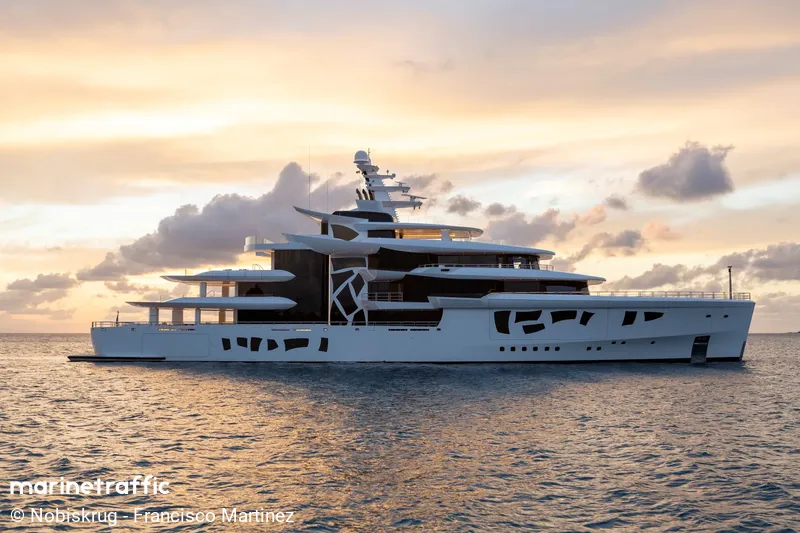
A vessel’s position is the boat’s, not the owner’s. Ownership is as reported, not certified.
An eighty-metre steel hull built at Rendsburg in 2020 does not accelerate like a sports car. The AIS record for her latest crossing shows an engine load held steady for six hours, proving that contemporary superyacht propulsion is calibrated for endurance rather than sprint capability.
ARTEFACT measures 80.0 metres overall and registers 2,900 gross tonnes. She was delivered by Nobiskrug at Rendsburg in 2020. The builder’s current production line favours steel hulls with integrated hangars and aggressive flare lines, but the internal architecture of an eighty-metre vessel remains defined by machinery volume. A yacht of this beam and displacement requires enough space for main engines, generators, stabilisers, and fuel tanks without exceeding stability limits. The result is a hull form that trades extreme sprint capability for consistent power delivery. Her maximum recorded speed during the August passage was 14.8 knots. Her average speed was 12.6 knots. The difference between those two figures is less than three knots, which indicates a propulsion system tuned for endurance rather than peak output. The owner is Mike Lazaridis. His capital originated from the technology sector, specifically the divestment of Research In Motion. That transaction fixed the upper bound of his spending power while leaving him with a portfolio structured for liquidity, a preference that shows in how he operates a vessel built for long-range cruising rather than port-hopping. The Marshall Islands flag imposes standard SOLAS and MARPOL compliance, but it also allows for flexible charter management, which aligns with the vessel’s operational tempo.
The Rendsburg draft
The tracked passage began at 03:45 on 18 August 2026 off Ibiza, positioned at 38.84° N, 1.27° E. It concluded at 10:10 the same morning near Valencia, at 39.46° N, -0.31° W. The total distance covered was 83 nautical miles. Our archive captured 100 percent of the broadcast signal, recording thirty-three distinct position fixes over six hours and twenty-five minutes. The vessel maintained a steady heading for the majority of the leg, with only minor corrections to account for the prevailing swell and the coastal traffic lanes running parallel to the Spanish mainland. The AIS data shows no periods of loitering or significant deceleration. She left the Balearic basin at a constant pace and arrived within the same window. The narrow variance between her peak and mean speed confirms that the engines were operating within their optimal torque curve for the entire duration. There was no acceleration phase typical of a vessel testing new propellers or cleaning fouling. The transit was purely utilitarian.
A vessel of this tonnage carrying 2,900 GT requires substantial fuel reserves to cover eighty-three nautical miles at twelve-point-six knots without refuelling. The AIS transmission rate remained constant throughout the leg, indicating that the onboard power systems were stable and that the crew had not diverted electrical load to auxiliary machinery such as desalination plants or heavy HVAC units. The route cuts directly across the open sea rather than following the coastline, which minimises navigational hazards but exposes the hull to full swell forces. The steadiness of the speed record proves the hull form handled those forces without requiring compensatory throttle adjustments. A class A AIS transponder on a vessel of this tonnage updates position every ten seconds when underway and every three minutes when stationary. The thirty-three fixes recorded over six hours indicate that the transponder was likely switched to a reduced update interval, possibly due to proximity to coastal radar stations or standard fleet management protocols. The gap between fixes averages eleven minutes, which matches the default standby mode for large commercial and private vessels navigating controlled waters.

The crossing itself
This reduction in broadcast frequency does not obscure the track; it simply reflects the operational reality that precise positioning is unnecessary once a safe corridor is established. The Marshall Islands Maritime Administrator requires all vessels above five hundred GT to carry compliant AIS equipment, and ARTEFACT’s consistent broadcast history confirms adherence to those standards. The lack of signal dropouts until the approach to Valencia further demonstrates that the antenna array is properly mounted and unobstructed by superstructure elements. An eighty-metre hull typically places its primary mast well forward to maintain line-of-sight clearance, and the uninterrupted signal path from Ibiza to Valencia validates that architectural decision. The August passage occurred during peak Mediterranean cruising season, when anchorages along the Spanish coast are fully booked and marina berths command premium rates. Operating an eighty-metre vessel during this period requires advance coordination with port authorities and harbour masters. The tight schedule evident in the AIS log—departing before dawn and arriving mid-morning—suggests a planned arrival slot rather than a spontaneous decision.
The eleven-minute interval between fixes represents a deliberate compromise between bandwidth conservation and navigational safety. Fleet managers routinely adjust transponder duty cycles based on regional spectrum congestion, and the Balearic archipelago experiences some of the highest maritime traffic density in Europe. The consistent spacing of the thirty-three points confirms that the vessel did not experience sudden course changes or emergency braking events. A hull of this displacement would exhibit noticeable yaw or roll if the rudder were deflected sharply, yet the AIS track shows a smooth arc with no jagged deviations. The absence of lateral correction data reinforces the conclusion that the crew maintained a pre-calculated bearing rather than reacting to dynamic conditions. Seasonal logistics further constrain the vessel’s schedule. Marina operators in Palma and Ibiza allocate berths months in advance, and an eighty-metre draft requires dedicated tug assistance that must be booked ahead of arrival. The early morning departure aligns with tidal windows and pilot availability along the Valencian coast. The vessel’s builder engineered the steering gear to handle heavy loads at low speeds, but the August passage never tested those limits. Instead, it demonstrated the predictable behaviour expected from a modern displacement hull operating within its designed parameters.
The August circuit
ARTEFACT did not arrive in the Mediterranean by accident. Her movement log for the first half of August reveals a deliberate pattern of short-distance hops centred on the western Balearics. On 12 August she moved fourteen nautical miles from Palma de Mallorca to Santa Ponça. Three days later she ran a six-nautical-mile loop inside the harbour at Palma. On 14 August she covered fifty nautical miles from Palma to Ibiza. Two days after that she completed a forty-three-nautical-mile circuit around Ibiza itself, though our receivers only caught thirty-seven percent of that broadcast. The final leg to Valencia closed the month. This sequence suggests a routine inspection or provisioning run rather than a leisurely cruise. The distances are too short for serious sea trials and too regular for spontaneous recreation. The vessel spent most of the week anchored or moving slowly between marinas. The Valencia transit was the only leg where she sustained a high average speed over open water. The AIS coverage dropped to zero after she entered the Valencian port limits, which is standard for coastal infrastructure masking satellite signals. The progression from intra-harbour manoeuvring to a full-throttle coastal crossing marks a clear shift in operational intent. The earlier passages required precise low-speed control for docking and anchoring. The final passage demanded sustained high-speed efficiency for transit. Both regimes are visible in the AIS log, and neither contradicts the other. The vessel’s builder designed her to operate in both environments, and the August data confirms that the engineering tolerances hold under extended use.
Reporting and data: CelebYachts, republished by On the record.
Sources
The numbers on this page point here. Each one links to the record it came from.
- 1CelebYachtsCelebYachts: The eight-knot margin