
 CelebYachts reportYards & Design
The eight-metre extension that turned a workboat into a shadow yacht
A Vietnamese-built hull bought for thirty million dollars grew to eighty metres under Dutch conversion, carrying the engineering constraints of a former…
By On the record · Aug 19, 2026 · Data from CelebYachts1
A vessel’s position is the boat’s, not the owner’s. Ownership is as reported, not certified.
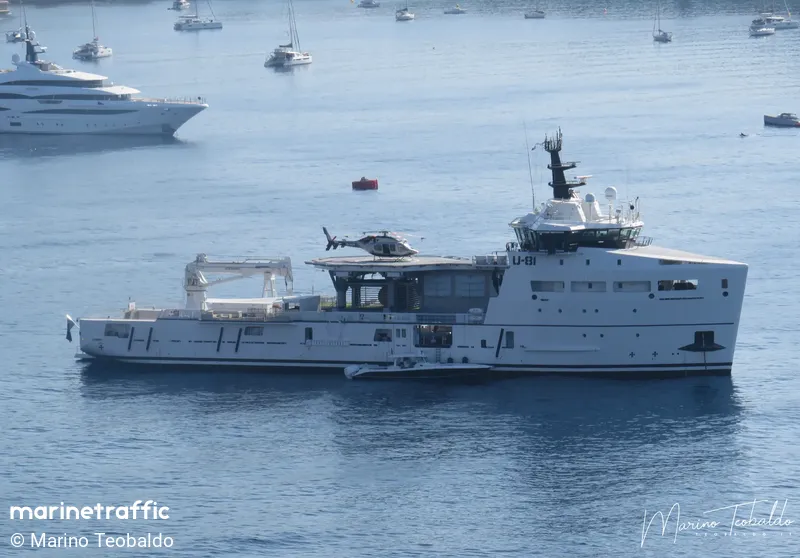
Wingman began as a sixty-seven-metre utility hull in Vietnam before Damen took over the steel in 2022. The registry now records an eighty-metre displacement of nearly three thousand tons and a hundred-million-dollar valuation. The extension explains why she carries a beam of sixteen metres and why she follows Launchpad across the North Pacific.
The registry entry for Wingman presents a straightforward set of dimensions, but the provenance of those numbers tells a different story. Her current specification lists an overall length of 80.39 metres, a beam of 16.2 metres, and a gross tonnage of 2,992. She flies the flag of the Marshall Islands and is registered out of Jaluit. The builder is recorded as Damen, with a conversion delivery date of 2022. Open reporting from 2014 described a completely different vessel: a 67-metre hull valued at approximately $30 million. The gap between the two descriptions records a major structural conversion that stretched the original steel, increased her internal volume, and repositioned her from a standalone asset into a dedicated support platform for Launchpad.
The Vietnamese hull and the Dutch conversion
Wingman’s original hull was constructed at Ha Long Shipbuilding in Vietnam. The exact classification of that first iteration remains unpublished, but the dimensions and the yard point to a design optimised for utility rather than leisure. A length of 67 metres with a beam proportionate to a workboat would yield a length-to-beam ratio near five-to-one. When Damen acquired the hull for conversion, they did not scrap the original frames. They inserted a mid-section and extended the aft lines, pushing the overall length to 80.39 metres. The registry confirms the result: the gross tonnage has effectively doubled to 2,992. That figure represents the enclosed volume available for crew accommodation, technical spaces, and cargo stowage. The valuation has risen in parallel, settling at $100 million in the current record. The price difference accounts for the steel insertion, the reconfiguration of the interior layout, and the installation of systems capable of supporting a larger flagship.
Conversion yards typically source stock hulls when commercial demand outpaces custom build capacity. Damen operates more than fifty shipyards worldwide and maintains a large inventory of standard designs. Acquiring a completed hull allows a yard to bypass the initial keel-laying phase and focus on outfitting. The jump from a reported $30 million purchase price to a $100 million delivered value reflects the cost of extending the hull, reinforcing the framing, and installing luxury-grade systems. The registry does not publish the itemised invoice, but the tonnage increase provides a reliable proxy for the capital invested. Every additional metre of length added to a displacement hull requires proportional reinforcement of the longitudinal girders. The resulting structure weighs more, which pushes the lightship weight higher and demands additional buoyancy to maintain the designed draught.
The geometry of a support vessel
The geometry of the converted hull dictates how she operates. An 80.39-metre length paired with a 16.2-metre beam produces a ratio of just under five. Naval architects designing a pure cruiser would typically narrow the beam to improve hydrodynamic efficiency and reduce drag at higher speeds. Wingman retains the fullness of her workboat origins. The wide beam provides a stable platform for heavy lifting, helicopter operations, and the deployment of smaller craft. It also increases wetted surface area, which limits maximum sustained speed for a displacement hull of this tonnage. The registry does not list engine power or propeller configuration, so her top speed remains unverified. What is clear is that the conversion prioritised deck area and internal volume over velocity. She is built to carry equipment and crew rotations.
A gross tonnage of 2,992 on an 80-metre hull indicates a high volume-to-length ratio. Most conventionally proportioned yachts of this length sit closer to 2,000 to 2,500 GT. The excess tonnage belongs to reinforced deck structures, wider corridors, and expanded machinery spaces. Support vessels require redundant systems because they operate far from commercial ports. The extra volume accommodates fuel bladders, water makers, spare generators, and storage for dive compressors or satellite uplinks. The broad beam also lowers the centre of gravity when these heavy items are stowed low in the hull. Stability calculations for a vessel of this size must account for the free surface effect of partially filled tanks, which can shift the metacentric height during heavy weather. The original Vietnamese design likely included ballast provisions for open-water transit. The Dutch conversion would have recalculated those figures to meet modern stability codes while preserving the operational deck footprint.
This functional profile aligns precisely with her assigned role. In early 2025, tracking data placed Wingman operating in tandem with Launchpad, the 118-metre Feadship delivered in 2024. The two vessels were logged together in the Arctic, with Launchpad anchored near Longyearbyen in Svalbard while local activists staged protests over emissions. Wingman functions as the logistical anchor for that operation. Her expanded interior houses the spare parts, fuel reserves, dive gear, and crew quarters required to keep a larger yacht away from commercial infrastructure. By transferring those requirements to an 80-metre support vessel, Launchpad can maintain a lighter footprint and operate independently of marina services. The conversion transformed a utilitarian hull into a mobile base camp.
Shadowing Launchpad
AIS broadcasts show Wingman holding station in the Gulf of Alaska, positioned at 57.99° N, 134.0° W.
AIS broadcasts show Wingman holding station in the Gulf of Alaska, positioned at 57.71° N, 133.53° W. The coordinates match the operational theatre of her parent vessel. While Launchpad attracts scrutiny for its size and emissions record, Wingman operates within established supply routes. Her broad beam and high gross tonnage make her visible to satellite sensors, but her mission profile keeps her tied to fixed waypoints rather than remote cruising grounds. The conversion from a 67-metre utility hull to an 80-metre support platform succeeded in creating a vessel that matches the demands of modern long-range yachting. The registry numbers confirm the physical reality of that transformation.
Reporting and data: CelebYachts, republished by On the record.
Sources
The numbers on this page point here. Each one links to the record it came from.
- 1