
 CelebYachts reportInvestigations
Why Ocean Victory has been stuck off India since 2022
Viktor Rashnikov’s 140-metre yacht sits motionless. Sanctions froze her assets and left the hull idle.
By On the record · Oct 27, 2026 · Data from CelebYachts1
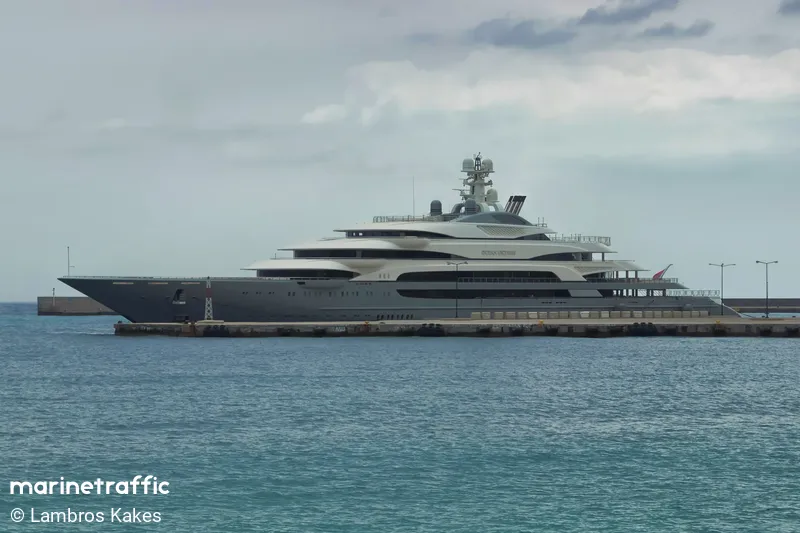
A vessel’s position is the boat’s, not the owner’s. Ownership is as reported, not certified.
Ocean Victory measures 140 metres but carries only 8,506 gross tonnes. She was delivered in 2014, the same year her builder listed on the Milan stock exchange. Twelve years later she holds a single coordinate off the coast of Gujarat, frozen by sanctions that turned her owner’s steel fortune into a liability.
Ocean Victory has not moved since March 2022. Her AIS signal shows a fixed point at 4.27° N, 73.54° E. This spot lies off the west coast of India, near Gujarat. The vessel is a 140-metre motor yacht. She belongs to Viktor Rashnikov.
Rashnikov is a Russian billionaire. He made his wealth in iron and steel. He owns Magnitogorsk Iron & Steel Works (MMK). MMK is one of the world's largest steel producers. His fortune comes from this industrial base.
The EU froze Rashnikov’s assets after Russia invaded Ukraine in February 2022. The UK and USA applied similar sanctions. These moves targeted his business interests. They also restricted his luxury assets. Ocean Victory became one of those assets.
How can a 140-metre yacht weigh so little?
Ocean Victory is long but light. She measures 140 metres in length. Her beam is 20 metres. Her gross tonnage is just 8,506. Gross tonnage measures internal volume. It is not weight. A larger yacht might carry more space.
This low number is unusual for her size. Most yachts of this length are heavier. The design prioritises speed over space. Fincantieri built her with a focus on performance. The hull form reduces drag.
The trade-off is interior volume. Owners get less room for amenities. The layout must be efficient. Every square metre counts. This choice reflects Rashnikov’s preference for utility. He values engineering over excess.
The estimated value of Ocean Victory is $300 million. This figure covers construction and fit-out. It does not include operational expenses. Running a yacht of this class costs millions annually. Crew, fuel, and maintenance add up quickly.
The low tonnage also affects classification. Lloyd’s Register sets the standards. They check safety and stability. Ocean Victory meets all international maritime laws. These rules ensure passenger safety.
A hull of that length usually demands more volume. Ocean Victory proves that speed can replace space.
Why did Fincantieri build her in 2014?
Fincantieri delivered Ocean Victory in 2014. The yard is based in Trieste, Italy. It is Europe’s largest shipbuilder. Fincantieri builds cruise ships, naval vessels, and yachts. Its history dates back to 1959.
The Mega Yachts division started in 2005. It focused on large luxury vessels. Ocean Victory was an early product. She followed MY Serene, delivered in 2012. Serene won a design award. Ocean Victory continued that trend.
2014 was a key year for Fincantieri. The company listed on the Milan Stock Exchange. The listing began on 16 June 2014. It ended on 27 June 2014. This move raised capital for expansion.
The stock market debut coincided with deliveries. Ocean Victory arrived in June 2014. This timing matched investor expectations. It showed the yard’s capacity. Investors saw growth potential in luxury yachts.
Fincantieri also bought STX OSV in 2013. That deal cost €900 million. It brought Vard yards into the group. Vard specialises in offshore support vessels. This expanded Fincantieri’s reach beyond yachts.
The acquisition used loans from banks. BNP Paribas and Banca Carige were involved. These lenders backed the deal. They also financed the listing process. The financial structure supported rapid growth.
Rashnikov chose Fincantieri for its reputation. The yard had built other megayachts. It offered technical expertise. The 140-metre hull required precision. Fincantieri delivered on time. The project stayed within budget.
Where did the money for Ocean Victory come from?
Viktor Rashnikov was born in 1948. He is a Russian engineer. He started at MMK in 1967. He worked in the repair shop as a fitter. He rose through management roles.
He became Chief Engineer in 1991. He took over as General Director in 1997. By 2005 he chaired the board. He controlled MMK’s output. Steel prices drove his wealth.
MMK produces iron and steel globally. It supplies construction and industry. The company is listed on exchanges. Rashnikov holds the majority stake. His net worth peaked around $9 billion in 2019.
The yacht cost roughly $300 million. This is a fraction of his peak wealth. He could afford it easily. But the source of funds matters now. Sanctions trace money back to its origin.
EU sanctions target oligarchs directly. They freeze assets held in Europe. They block transactions with Russian banks. Rashnikov’s name is on the list. MMK is also sanctioned.
The UK added him to its list too. The USA applied similar sanctions. These bodies track beneficial owners. They look through shell companies. Ocean Victory flies the Cayman Islands flag. This does not hide the owner.
Regulators see through the flag. The IMO number links to the builder. The MMSI code links to the operator. All data points to Rashnikov. The sanction applies regardless of where she sails.
What do the sanctions mean for Ocean Victory?
Sanctions stopped Ocean Victory’s movement. She was active before 2022. Then the invasion happened. The EU acted in February. Hungary tried to remove Rashnikov in September 2022. The effort failed.
Frozen assets cannot be sold. They cannot be moved freely. Crew changes become difficult. Insurance coverage may lapse. Maintenance requires spare parts. These parts often come from Europe.
Indian waters offer a neutral port. India is not part of the EU. It does not enforce these sanctions. But the flag state matters. The Cayman Islands follow international law. They respect EU orders.
So the yacht stays put. She cannot leave Indian territory without permission. Permission is unlikely. The risk of seizure is high. Port authorities would comply with EU requests.
The hull sits idle. Rust and corrosion are threats. Salt air damages steel. Engines need regular runs. Without them, systems fail. Repair costs will rise.
Rashnikov still owns her. The title has not changed. But he cannot use her. The asset is stranded. It represents billions in frozen capital. The steel fortune has become a liability.
Will Ocean Victory ever sail again?
No one knows the answer. Sanctions depend on politics. The war in Ukraine continues. The EU maintains its list. Removal requires political change. Hungary’s appeal was rejected.
Rashnikov might negotiate. He could sell shares in MMK. He could transfer ownership. But buyers are scarce. No bank will finance the deal. No insurer will cover the voyage.
The yard, Fincantieri, is distant. It built the yacht years ago. It has no current role. The connection is historical. The future is uncertain.
AIS data shows no movement. The last signal was in March 2022. Coordinates remain static. The map confirms the standstill. She is a ghost in the water.
Ocean Victory illustrates the power of sanctions. They reach across oceans. They freeze assets wherever they hide. The 140-metre hull is a symbol. It marks the end of an era for Russian oligarchs.
Reporting and data: CelebYachts, republished by On the record.
Sources
The numbers on this page point here. Each one links to the record it came from.
- 1