
 CelebYachts reportData
Why Ray Dalio's OceanXplorer stays in Malaysia
AIS data shows the 85-metre vessel operating in tight, low-speed loops around Sabah. This pattern confirms its role as a research tool.
By On the record · Oct 28, 2026 · Data from CelebYachts1
A vessel’s position is the boat’s, not the owner’s. Ownership is as reported, not certified.
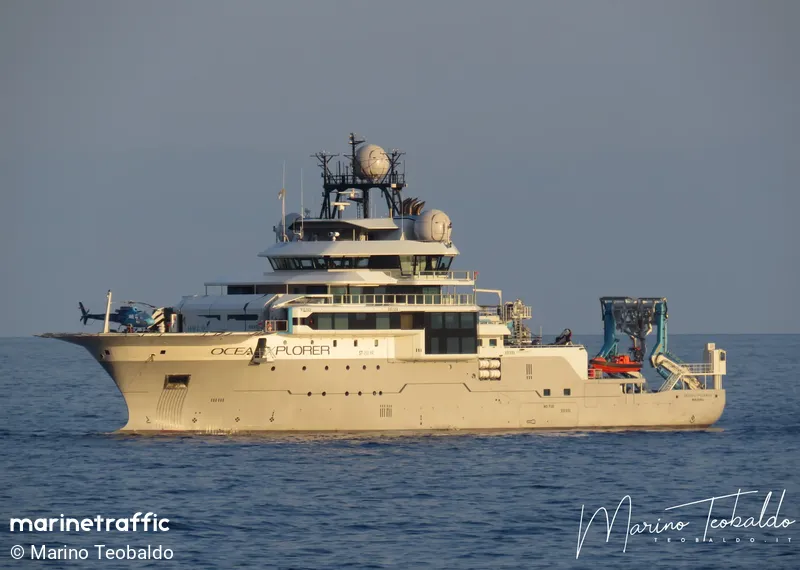
Ray Dalio owns the 85-metre OceanXplorer. It was built for offshore work and converted for science. Its August movements show station-keeping, not leisure cruising. The data reveals its true purpose.
OceanXplorer has not moved far from the Riau Archipelago since August. She holds her position near the coast of Malaysia. Her last known coordinates place her at 6.0° N, 116.08° E. This location matches her recent operational pattern.
The vessel belongs to Ray Dalio. He is an American investor and founder of Bridgewater Associates. His net worth stands at roughly $14 billion as of early 2026. He uses this yacht for scientific exploration rather than standard luxury travel.
Who owns OceanXplorer and why?
Ray Dalio is an American investor and founder of Bridgewater Associates. He runs one of the world's largest hedge funds. His wealth comes from managing money for institutions. He uses his fortune to fund marine science through OceanX.
Dalio’s OceanX program funds marine biology. It studies cetaceans and deep-sea ecosystems. The yacht serves as a floating lab. It carries submersibles and sensors. The AIS tracks confirm this use. The data matches the mission.
How did OceanXplorer become a research ship?
Freire shipyard in Spain built OceanXplorer in 2010. The yard laid her keel in December 2008. Construction finished after delays caused by the 2008 financial crisis. She entered service in October 2011. GC Rieber Shipping owned her initially.
She started life as an offshore support vessel. Her design focused on stability and deck space. She served the oil and gas industry. She transported personnel to wind farms in the North Sea. She provided accommodation for workers.
Damen converted her between 2019 and 2020. The conversion changed her interior and systems. It kept her wide beam. This shape helps with stability during research operations. It allows for large open decks. The hull number remains 703 from her original build.
Dalio acquired the vessel through his OceanX initiative. He funds marine biology projects directly. The yacht supports these efforts on the water. It carries equipment for deep-sea study. The structure suits heavy gear well. It does not suit fast long-distance travel.
August 2026 showed clear operational patterns. She stayed near Kota Kinabalu in Sabah, Malaysia. She made several short trips. Each trip lasted less than a day. She returned to the same starting point.
Voyage 2335 logged 34.1 nautical miles. It took place on August 22. She averaged 7.1 knots. This speed is low for a yacht of her size. High speeds waste fuel and create wake. Low speeds allow precise positioning.
Voyage 2719 was even slower. She traveled only 15.4 nautical miles. Her average speed dropped to 4.2 knots. Her maximum speed reached just 6 knots. This pace suggests active sampling or deployment. It does not suggest transit.
Ray Dalio acquired the vessel through his OceanX initiative. He funds marine science projects. The yacht supports these efforts. It carries equipment for deep-sea study. The structure suits heavy gear. It does not suit fast long-distance travel.
Leisure yachts usually cover long distances. They move between ports. They visit new locations each week. OceanXplorer repeated the same area. She looped around fixed points. She did not seek new destinations.
Research vessels need stable platforms. They deploy instruments into the water. They collect samples from specific spots. This requires holding position. It requires slow, controlled movement. Fast travel disrupts the work.
How does this differ from leisure cruising?
Her gross tonnage is 5,399. This volume supports labs and storage. It accommodates crew and scientists. The layout prioritizes function over comfort. The wide beam aids this function. It keeps the deck level in rough seas.

September brought different movements. Voyage 3043 started in Kota Kinabalu. She traveled 43.2 nautical miles. She returned to the same port. The average speed rose to 10.3 knots. This is still moderate.
Voyage 3082 began in Miri, Sarawak. She traveled 37.5 nautical miles. She ended back in Miri. The average speed was 11.3 knots. This is faster than August. But she still returned home.
Voyage 3130 went to Singapore. She traveled 445.9 nautical miles. This was a longer transit. She arrived on September 4. The average speed was 8.8 knots. She did not stop at intermediate ports.
She now holds station in the Riau Archipelago. Her last position was recorded in late March 2026. She has not moved significantly since then. This suggests ongoing work or preparation. The pattern remains consistent with research duties.
The data clarifies her identity. She is a floating laboratory. Her owner uses her to study the ocean. The AIS records prove this use. They show the work, not the play.
Where has OceanXplorer been recently?
Voyage 2517 covered 16.8 nautical miles. It started in Kuala Penyu, Sabah. She returned to the same port. The average speed was 8.8 knots. This was another short, local loop.
Voyage 2072 started 47 nm off Kota Kinabalu. She traveled 23.8 nautical miles. She ended up in Kota Kinabalu. The average speed was 4.5 knots. This slow approach suggests careful navigation.
These movements are not random. They follow a schedule. The vessel returns to base frequently. This is typical for research deployments. The crew needs rest and supplies. The science needs fresh data.
What happens after August?
Reporting and data: CelebYachts, republished by On the record.
Sources
The numbers on this page point here. Each one links to the record it came from.
- 1