
 CelebYachts reportData
The eighty-six-metre constraint
AIS tracks reveal a 2010 American-built hull operating on a local circuit, where short coastal hops and consistent transit speeds reflect engineering limits…
By On the record · Jul 6, 2026 · Data from CelebYachts1
A vessel’s position is the boat’s, not the owner’s. Ownership is as reported, not certified.
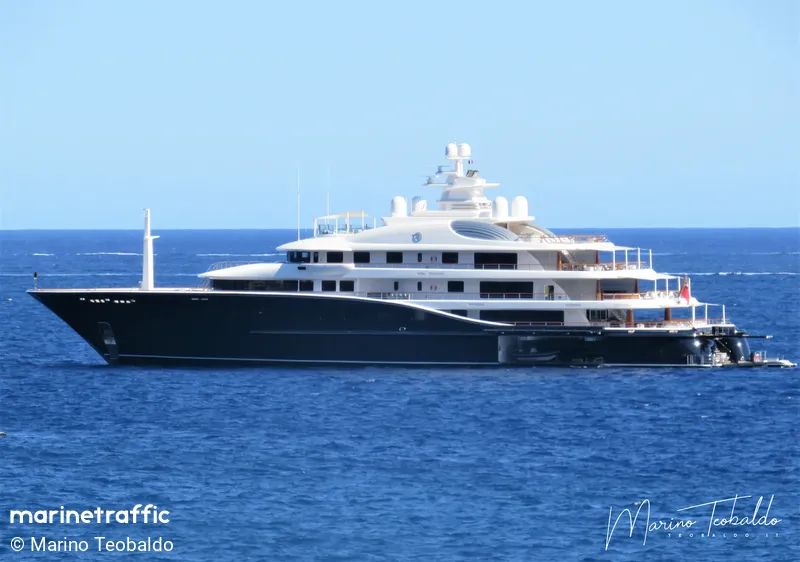
Aquila’s position archive for July and August 2026 shows a vessel that moved four times across ninety nautical miles, spending the vast majority of the period stationary. The pattern exposes the operational reality of a Derecktor hull: a displacement profile that favours stability over range, and an owner whose wealth derives from North American franchises rather than maritime tradition.
Aquila flies the flag of the United Kingdom and carries a home port registration in Douglas. The holding structure separates the vessel from the personal balance sheets of Stan Kroenke and Ann Walton Kroenke, who appear together on the registry. Kroenke was born in 1947 and built his wealth through real estate before consolidating control of Kroenke Sports & Entertainment. The holding company manages Arsenal Football Club, the Los Angeles Rams, the Denver Nuggets, the Colorado Avalanche, the Colorado Rapids, and the Colorado Mammoth. Walton brings a separate lineage to the partnership; she is the daughter of James Walton, who co-founded Walmart with his brother Sam. Her inheritance sits alongside Kroenke’s accumulated equity to produce a combined net worth reported at twenty-one billion three hundred million dollars. The scale of that capital explains the acquisition of an eighty-six-metre steel motor yacht in 2010, but it does not dictate her routing. American sports ownership rarely requires seasonal Mediterranean presence, and the AIS record confirms that assumption. The vessel spends weeks anchored in the same coordinates, moving only when a specific port call or regulatory requirement forces a change of location. The UK flag provides a familiar administrative framework for a North American owner, while the Douglas home port offers a jurisdiction with established superyacht registration protocols. The combination allows the hull to operate under standard EU and UK maritime conventions without establishing a permanent European domicile.
The corporate architecture
The registration choices reflect a broader strategy of asset management divorced from daily operation. Kroenke’s portfolio spans five major US sports markets, generating revenue streams that are largely insulated from European seasonal cycles. The yacht functions as a discrete capital allocation rather than a lifestyle fixture. This distinction becomes visible in the vessel’s movement patterns, which prioritise minimal transit over extended cruising. The owners do not require the hull to maintain a continuous presence in Italian or French harbours. Instead, they deploy her for targeted visits, often coinciding with crew changes, technical inspections, or brief family itineraries. The AIS data captures this behaviour through long periods of zero displacement punctuated by short, high-coverage passages. The vessel does not loiter in international waters; she holds station near recognised ports. This operational rhythm aligns with the financial structure behind her purchase, where liquidity remains tied to North American equities and franchise valuations rather than maritime tourism or charter income. The hull is maintained, not marketed.
The dock, not the drawing
Derecktor Shipyards constructed Aquila in 2010. The yard traces its origins to 1947, when Robert E. Derecktor founded the company in Mamaroneck, New York. The facility has historically balanced custom yacht construction with commercial vessel production, a dual mandate that shapes the engineering priorities of its larger projects. The company currently operates three sites: a primary yard in Mamaroneck, a maintenance and refit centre in Dania Beach, Florida, dedicated to vessels up to sixty-one metres, and a third location in Fort Pierce, Florida, equipped for sailing and motor yachts exceeding sixty-one metres. Aquila measures eighty-six metres and displaces enough mass to require specialised dry dock capacity beyond the standard Florida refit bays. The 2010 build date places her construction before the widespread adoption of ultra-low sulphur fuel systems and hybrid propulsion architectures that define contemporary European mega-yacht design. The resulting hull form carries two thousand nine hundred ninety-eight gross tonnes against a beam of fifteen metres. That beam-to-length ratio produces a stable platform but increases hydrodynamic resistance at higher speeds. The engineering trade-off favours interior volume and seakeeping comfort over fuel efficiency, a characteristic that becomes visible in the vessel’s transit patterns. The hull does not run at sustained cruise speeds across open water. It operates within a constrained radius, relying on pilotage assistance and controlled manoeuvring rather than long-range endurance. The structural simplicity of a late-2000s American build also means fewer complex auxiliary systems compared to modern European counterparts, reducing maintenance overhead but limiting speed flexibility. The vessel’s estimated value of one hundred and fifty million dollars reflects this era of construction, where raw tonnage and provenance outweighed the premium placed on cutting-edge propulsion.
The track, not the itinerary
The position archive for July and August 2026 records five discrete movements, none of which exceed one hundred and thirty-five nautical miles. The first tracked segment begins on 30 July in Valletta, Malta, and ends in the same harbour thirteen nautical miles later. The average speed registers at seven point four knots, indicating harbour work or a brief coastal exercise. Two days later, the vessel departs Valletta for Siracusa, Italy, covering ninety-six nautical miles at an average of twelve point five knots. Upon arrival, Aquila remains in the vicinity of Siracusa for forty-eight hours. She executes a thirty-nautical-mile loop around the same bay at thirteen knots, then proceeds to Messina, travelling one hundred and thirty-four nautical miles at eleven point four knots. The final recorded leg moves her twenty-seven nautical miles toward Reggio Calabria on 3 August. Each passage maintains a coverage percentage above eighty-five percent, confirming continuous AIS transmission throughout the manoeuvres. The speeds cluster between eleven and fourteen knots, a band consistent with coastal transit and pilotage operations rather than open-sea cruising. The distances suggest a vessel working within the Strait of Messina and the surrounding Tyrrhenian approaches, likely awaiting berth availability, provisioning, or crew changes. The lack of longer passages aligns with the displacement characteristics of a 2010 American-built hull. The vessel does not cross basins; it shifts between ports. The chart below displays the passage from Siracusa to Messina, highlighting the steady speed profile and full signal retention.

The AIS record leaves no ambiguity about how Aquila operates. She is not designed for transoceanic runs or rapid repositioning across the Mediterranean. Her beam, tonnage, and propulsion architecture favour a slow, deliberate pace within protected waters. The owners’ North American base further reduces the incentive for extended European deployment. The result is a vessel that appears frequently in port databases but rarely crosses open sea. The data confirms a pattern of strategic stillness, broken only by necessary adjustments to location. The hull remains a functional asset, maintained to specification, deployed on demand, and held in place until the next requirement arises. There is no hidden schedule or undisclosed itinerary. The positions speak for themselves.
Reporting and data: CelebYachts, republished by On the record.
Sources
The numbers on this page point here. Each one links to the record it came from.
- 1CelebYachtsCelebYachts: The eighty-six-metre constraint