
 CelebYachts reportYards & Design
Why Andrea Recordati's yacht Senses stays under ten knots
A 1999 Schweers hull carries a beam that caps its speed. The 2015 and 2020–21 conversions added volume, not velocity.
By On the record · Sep 29, 2026 · Data from CelebYachts1
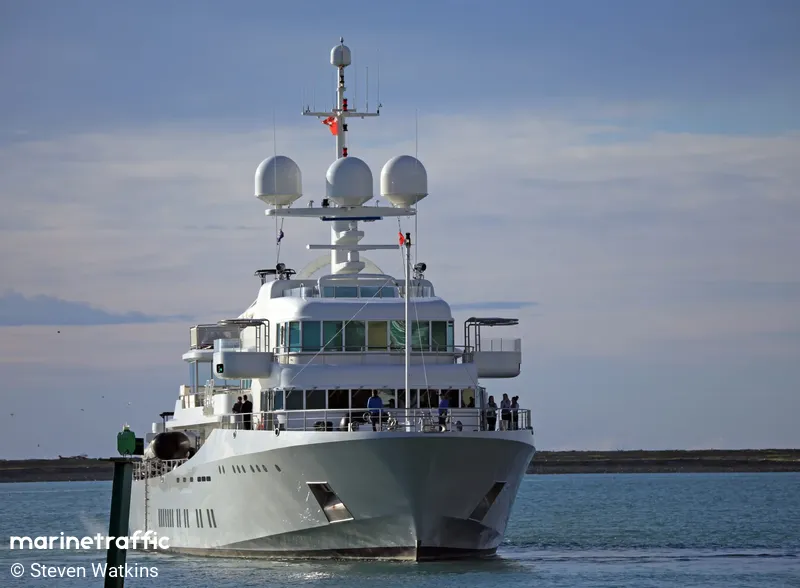
A vessel’s position is the boat’s, not the owner’s. Ownership is as reported, not certified.
Senses measures fifty-nine metres long and twelve point seven metres wide. Her gross tonnage sits at nine hundred and ninety-three. Andrea Recordati bought her to sail competitively. The hull shape limits her speed to about ten knots.
Senses is a fifty-nine-metre motor yacht. She carries a beam of twelve point seven metres. This width gives her a length-to-beam ratio of roughly forty-six to one. That number defines her physical limits.
The hull was launched in nineteen ninety-nine by Schweers in Germany. Martin Francis designed the original exterior. Andrea Recordati owns the vessel today. He is a Pharmaceutical Executive and competitive sailor.
Andrea Recordati is a Pharmaceutical Executive. He serves as Chairman of Recordati S.p.A., a global specialty Pharmaceutical group. He joined the family-owned company in 1998 following early management training at SmithKline Beecham. He is also an avid competitive sailor.
Recordati has owned Senses since two thousand fifteen. He added a superstructure in two thousand twenty-one. These changes increased her volume. They did not change her hydrodynamics. The wide body still resists acceleration.
What was Senses before she became a yacht?
Schweers built Senses in nineteen ninety-nine. The yard is known for sturdy steel vessels. They often build research ships and patrol boats. Senses shares traits with those working hulls. Her design prioritises stability over speed.
A length-to-beam ratio of forty-six to one is unusual for a luxury yacht. Most fast yachts aim for ratios above sixty. A lower ratio means more water resistance at higher speeds. It also means more room inside.
The wide beam creates a flat bottom section. This shape helps the boat stay steady in rough seas. It does not help the boat cut through waves quickly. The hull form acts like a paddle rather than a knife.
Martin Francis designed the original lines. His work often features clean decks and practical layouts. He understood the need for space on long voyages. He did not design for planing or high-speed cruising.
The AIS data shows her flag is the Cayman Islands. Her home port is George Town. The IMO number is one million six thousand six hundred seventy-three. The MMSI is three million one hundred ninety-eight thousand three hundred.
The gross tonnage is nine hundred and ninety-three. This measures the internal volume of the ship. It includes all enclosed spaces. A higher number usually means more luxury amenities. It also means more weight to move.
Recordati acquired the vessel in two thousand fifteen. He likely wanted a large platform for sailing. He is a serious competitor in maxi-yacht regattas. He sailed Indio and Bullitt before buying Senses.
His wealth comes from Recordati S.p.A. The family company makes specialty drugs. He joined the firm in nineteen ninety-eight. He became Chairman later. The money allowed him to buy a large steel hull.
He is listed as an avid competitive sailor. He was elected Commodore of the Yacht Club Costa Smeralda in August two thousand twenty-four. This club is in Italy. It hosts major international races. Recordati fits the culture of speed.
He previously competed in national and international maxi-yacht regattas aboard the Wally 100-foot Indio. He has owned the Wally 93-foot Bullitt since 2022. Senses represents his entry into larger superyacht ownership.
Senses serves as a liveaboard cruiser. Her design suits slow, comfortable travel. She can carry many guests in comfort. She cannot chase windward marks at high speed.
How did the conversions change her performance?
Recordati commissioned refits in two thousand fifteen and two thousand twenty-one. The first refit likely updated systems. The second refit expanded the superstructure. This added significant volume above the waterline.
The beam widens noticeably on the upper decks. This is visible in photos of the aft deck. The expansion creates more living space. It also raises the centre of gravity slightly.
Engine upgrades are common in these refits. Owners often install newer, more powerful diesels. This can improve top-end speed slightly. It rarely changes the hull’s fundamental behaviour. The wide beam still pushes against the water.
The AIS track shows max speeds around eleven knots. Average speeds are lower, near eight knots. This confirms the design limit. Even with strong engines, the hull drags.
Voyage four thousand one hundred thirty-three went from Tairua to Whangarei. It covered seventy-one nautical miles. The average speed was seven point six knots. The max speed was eleven point three knots.
Voyage three thousand nine hundred twenty-two stayed in Nuku'alofa. It covered sixty-seven nautical miles. The average speed was ten point one knots. The max speed was ten point nine knots.
These numbers are consistent across all tracked passages. No voyage exceeds twelve knots significantly. The hull physics cap the velocity. The conversions added comfort, not velocity.
The estimated value is forty-five million dollars. This reflects the brand and the condition. It does not reflect potential resale value. Large beam yachts have a niche market. Buyers who want speed look elsewhere.
The hull constraints are permanent. You cannot narrow a steel beam easily. You cannot reshape the underwater profile cheaply. The design decisions of nineteen ninety-nine still rule.
Where is Senses now and what does it mean?
Senses is currently in the South Pacific. Her last known position is near twenty-one degrees south. She is at one hundred seventy-five degrees west. This area is remote and open.
She has been stationary for some time. The AIS signal shows no movement. This is typical for yachts in anchorages. It may also indicate maintenance or crew changes.
Her previous movements were in New Zealand and Tonga. She visited Lifuka and Pangai in August. She moved between Waikato and Northland in September. These are popular cruising grounds.
The slow pace suits the destination. The South Pacific offers calm waters and beautiful reefs. A wide, stable hull is ideal here. Speed is not required for exploration.
Recordati uses Senses for leisure and family. He sails with friends and crew. The yacht provides a safe platform. The lack of speed is irrelevant in these conditions.
The conversion calculus favours volume. Recordati paid for space and comfort. He accepted the speed penalty. This is a rational trade-off for a cruiser.
Senses remains a unique vessel. She combines industrial strength with luxury. She is a floating apartment block. Her identity is clear in every knot she loses.
Reporting and data: CelebYachts, republished by On the record.
Sources
The numbers on this page point here. Each one links to the record it came from.
- 1