
 CelebYachts reportProfiles
The liquidation anchor
Firebird has held station off Patagonia since summer 2026, reflecting a systematic divestment of her owner’s Russian and Italian holdings rather than…
By On the record · Jul 22, 2026 · Data from CelebYachts1
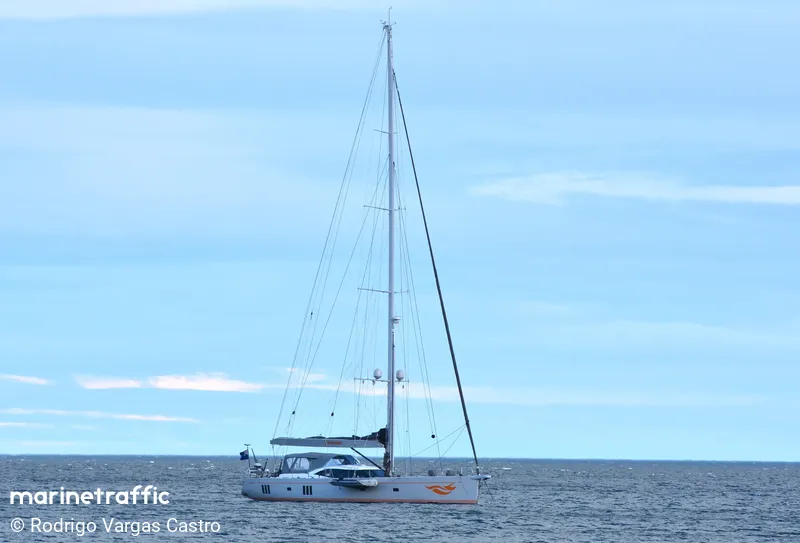
A vessel’s position is the boat’s, not the owner’s. Ownership is as reported, not certified.
AIS broadcasts show Firebird making short, slow runs around Puerto Natales in August 2026. The pattern matches a different kind of stasis: a Sanctioned owner liquidating a portfolio that includes a St Petersburg hotel and an Umbrian resort, leaving a twenty-seven-metre motor yacht waiting in the Southern Hemisphere while the paperwork clears.
The last AIS broadcast for Firebird places her at -44.72° S, 73.58° W, in the fjords of West South America. The timestamp corresponds to early August 2026. Over a forty-eight-hour window between 1 August and 2 August, the vessel recorded three separate movements. None of them took her beyond sight of Puerto Natales. The sequence reveals a hull that is operational but deliberately restricted. A yacht of this size can cover hundreds of nautical miles in a single day. Firebird covered fewer than fifty nautical miles across three legs. The low speeds and short distances indicate either heavy weather in the channels or a deliberate decision to remain close to port. There is no public record of a mechanical fault. There is also no record of a dry-docking schedule. The most direct explanation is that the owner is managing a transaction that requires his presence, or that the legal framework surrounding the hull prevents a longer passage.
The track off Puerto Natales
Voyage 262 began at 01:32 and ended at 13:33 on 1 August. She covered 22 nautical miles at a steady 8.1 knots. The coverage percentage for that passage is zero, meaning the satellite receivers missed the transmission entirely, yet the start and end points are logged. Gaps in VHF coverage are common in narrow fjords where steep terrain blocks the signal, but they also suggest the transmitter was not broadcasting continuously. Voyage 298 started at 19:15 on 1 August and concluded at 09:49 the following day. She travelled 16 nautical miles, averaging 6.3 knots with a peak of 7.3 knots. An overnight passage at those speeds typically indicates anchoring, drifting, or moving between moorings in sheltered water. Voyage 342 ran from 11:16 to 13:41 on 2 August. The distance recorded is 12 nautical miles. Her average speed dropped to 4.6 knots, with a maximum of 7.0 knots. All three passages originated and terminated within sight of Puerto Natales. She did not leave the region. She did not head for a shipyard in Europe or a marina in the Mediterranean. She remained anchored or drifting in the same stretch of water for forty-eight hours. The sequence suggests a vessel that is operational but restricted.
A yacht of this specification would normally be found crossing the Atlantic or rounding Cape Horn. Instead, she is holding station off Chile. The AIS transmitter continues to broadcast, which means the power systems are active and the antenna is clear of obstructions. Crew members must be on board to maintain the generator, filter the fuel, and monitor the hull integrity. If the owner is absent, a manager is handling the daily operations. If the owner is present, he is likely dealing with the administrative aftermath of recent property transfers. The physical reality of the vessel remains unchanged. She is a displacement hull, engineered for stability in rough seas, now idle in sheltered waters. The engineering constraints of a twenty-seven-metre yacht do not change because the owner’s cash flow has shifted. The bilge pumps still run. The stabilisers still require hydraulic fluid. The propellers still corrode if left static for months. The difference is purely financial.
The sale of Viym’s holdings
Andrey Yakunin owns Firebird. He holds dual citizenship in Russia and the United Kingdom. He moved to London in 2007 and naturalised in 2015. His wealth traces back to Viym, a private equity and real estate investment firm he co-founded in 2006 with Yair Ziv. The company focused on hospitality and consumer businesses across Russia and Italy. Between 2024 and 2025, Viym dismantled its core assets. The Four Seasons Hotel Lion Palace in St Petersburg changed ownership in 2024. The Nikolsky Ryady development was sold by 2025. In October 2025, Il Sole 24 Ore reported that Mohamed Alabbar acquired Antognolla Resort & Residences in Umbria from Yakunin. These transactions occurred while Firebird was broadcasting from the southern tip of South America. The timing is not coincidental. Owners of Sanctioned vessels typically liquidate non-maritime assets to fund maintenance, pay crew, or satisfy compliance requirements.
A twenty-seven-metre Oyster Marine built in 2016 costs more to keep afloat than most people earn in a year. Fuel, insurance, berthing fees, and classification surveys run continuously regardless of whether the yacht moves. When the underlying business is being wound down, the yacht becomes a line item on a balance sheet rather than a leisure craft. Viym’s restructuring began years before the recent sales. Forbes Russia reported in 2015 that the firm planned to divest its stake in Agro-Alliance. Yakunin served as chairman of the National Alternative Investment Management Association in Russia from 2013 to 2018. That role placed him at the centre of domestic capital markets during a period of significant regulatory change. By 2022, he had publicly stated that he opposed the invasion of Ukraine and had never worked in Russia’s public sector. That statement did not prevent his name from appearing on the second tier of Sanctioned and seized yachts. The designation restricts where he can dock, which banks will process payments, and which yards will accept work orders. It leaves him with a hull in Patagonia and a portfolio of hotels that have already been sold.
The hull and the flag
Firebird measures 27.0 metres in length and 6.0 metres in beam. She was built by Oyster Marine as an 885 RS model, with naval architecture by R. Humphreys. The hull is registered in the United Kingdom. Her category is listed as Sanctioned and seized yachts, second tier. The registration does not disclose a gross tonnage figure. It does not list a home port. The absence of these fields is standard for vessels that spend extended periods outside commercial registries or that operate under temporary flags. The 885 RS design prioritises storage, fuel capacity, and seakeeping over luxury amenities. A yacht of this specification would normally be found crossing the Atlantic or rounding Cape Horn. Instead, she is holding station off Chile. The AIS transmitter continues to broadcast, which means the power systems are active and the antenna is clear of obstructions. Crew members must be on board to maintain the generator, filter the fuel, and monitor the hull integrity. If the owner is absent, a manager is handling the daily operations. If the owner is present, he is likely dealing with the administrative aftermath of the Antognolla sale or the Lion Palace transfer.
The physical reality of the vessel remains unchanged. She is a steel or aluminium displacement hull, engineered for stability in rough seas, now idle in sheltered waters. The engineering constraints of a twenty-seven-metre yacht do not change because the owner’s cash flow has shifted. The bilge pumps still run. The stabilisers still require hydraulic fluid. The propellers still corrode if left static for months. The difference is purely financial. The capital that bought the hull has been converted into property deals in Italy and Russia. The capital needed to sail her further has not yet been secured.
Reporting and data: CelebYachts, republished by On the record.
Sources
The numbers on this page point here. Each one links to the record it came from.
- 1CelebYachtsCelebYachts: The liquidation anchor