
 CelebYachts reportThe Fleet
The five-hull arithmetic of the Omani flag
The register holds five vessels, all over fifty metres, selected for a jurisdiction that trades administrative simplicity for port-state scrutiny.
By On the record · Sep 28, 2026 · Data from CelebYachts1
A vessel’s position is the boat’s, not the owner’s. Ownership is as reported, not certified.
A tally of five hulls might suggest a marginal presence in the global fleet, but the Omani flag’s composition reveals a deliberate concentration of large displacement yachts. The registry operates as a standard open flag, prioritising low overhead and flexible crewing rules over national ownership requirements, and it subjects its vessels to the same international inspection regimes that govern commercial shipping.
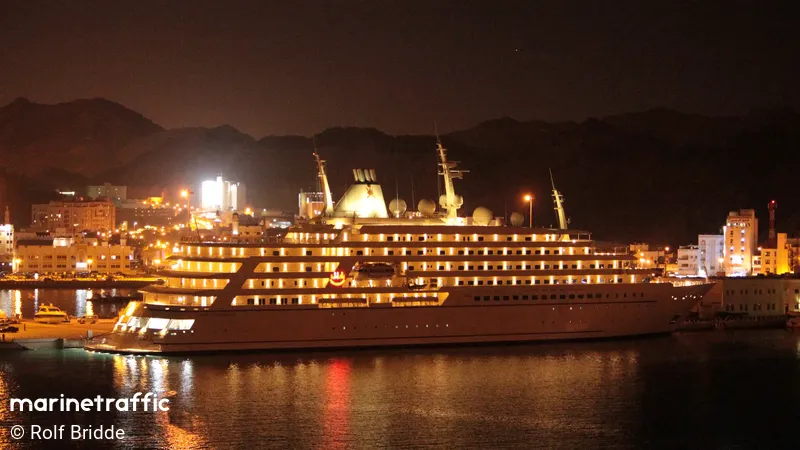
The Omani flag appears in our tracking data as a concentrated cohort rather than a scattered collection of small craft. The register contains exactly five tracked hulls, representing roughly two percent of the site’s total coverage. The distribution skews heavily toward large displacement. Four of the five vessels exceed one hundred metres in length. Fulk Al Salamah measures 164.0 metres. Al Saïd sits at 155.0 metres. Al Dhaferah runs 136.33 metres. Loaloat Al Behar completes the group at 103.82 metres. The fifth vessel, Zinat al Bihaar, measures 52.6 metres. The register does not host a scatter of small tender boats or day cruisers; it holds a cluster of substantial yachts. The absence of smaller hulls suggests that owners using this flag are weighing the fixed administrative costs of an open registry against the operational scale of their vessels.
An open registry charges flat fees for documentation and certification. Those fees become negligible relative to the running costs of a 164-metre hull, but significant for a vessel under sixty metres. The register therefore functions as a practical solution for larger projects rather than a discretionary choice for smaller ones. Owners select an open registry to bypass the regulatory and fiscal constraints of their home jurisdiction. International law requires every merchant ship to be registered in a country, and the flag state exercises regulatory control over the vessel. The Omani registry follows the established pattern of open flags by removing nationality or residency requirements for ship registration. This allows owners to employ crews from lower-wage countries and avoid higher taxes imposed by traditional maritime nations. Traditional closed registries typically require a ship to be owned and constructed by national interests, and at least partially crewed by citizens. The Omani flag removes those barriers.
The mechanics of the open registry
Registration can proceed online with minimal questioning, reducing the time between purchase and sea trials. The administrative product is designed to clear quickly, which matters when a new build is ready for delivery and every week of delay increases yard hire and financing costs. The registry does not demand a genuine link between the owner and the state, a principle that dates back to the 1958 Geneva Convention on the High Seas and was repeated in Article 91 of the United Nations Convention on the Law of the Sea. That convention attempted to solidify the genuine link concept in 1986, requiring a flag state to have an economic stake or provide mariners, but it has not entered into force. The Omani register therefore operates without that constraint. It sits alongside other vehicle registers that track identification numbers, titles, inspections, and liability insurance, while remaining distinct from ultimate beneficial owner registers maintained to counteract money laundering and terrorist financing.
The accumulated advantages of this model are well documented in maritime economics. Open registries lower registration and maintenance costs, which in turn reduces overall transportation costs. The practice originated in the early twentieth century when shipowners sought to sidestep stringent labour laws and wage scales. The Seamen's Act of 1915 regulated working hours, payment, food standards, and safety equipment for American-flagged vessels, putting US ships at an economic disadvantage. Ships started to be re-registered in Panama's open registry from 1919 to avoid those requirements. The modern corporate structure for such flags emerged later, with entities like The Liberia Corporation created to manage state-backed registrations. The Omani flag follows the same template: a streamlined administrative channel that accepts foreign ownership, permits international crewing, and processes transfers rapidly.
Port state control and inspection
Choosing an open flag does not remove a vessel from international oversight. Every ship flying any flag remains subject to port state control inspections when it visits foreign ports. The Paris Memorandum of Understanding on port state control established a system where visiting states inspect ships for Safety of Life at Sea, pollution prevention, and living conditions. In 2015 alone, member states conducted nearly eighteen thousand inspections, recording tens of thousands of deficiencies and detaining over a thousand vessels. The Tokyo Memorandum of Understanding recorded similar figures. These inspections apply equally to vessels flying the Omani flag. Deficiencies found during an inspection can lead to detention until repairs are completed. The environmental disaster caused by the 1978 sinking of the MV Amoco Cadiz, which flew the Liberian flag, directly spurred the creation of the Paris MOU. The precedent shows that flag state choice does not grant immunity from physical inspection.
A yacht registered in Muscat undergoes the same checks as one registered in Panama or Liberia. The registry’s value lies in the ease of initial compliance and ongoing paperwork, not in evading port state scrutiny. The register also exists within a broader ecosystem of official business records. Company registers establish legal capacity and representation, while tax registers track revenue collection and social insurance contributions. Insolvency registers record companies that have entered bankruptcy or liquidation. The Omani maritime register operates as a vehicle register within that framework, maintaining entries for title, type approval, and inspections. It does not publish interior layouts or machinery specifications. Where the data ends, the mechanics of the flag continue to operate.
The limits of the record
The public record for the Omani register stops at names, lengths, and flag status. The sale prices for Fulk Al Salamah, Al Saïd, Al Dhaferah, Loaloat Al Behar, and Zinat al Bihaar have never been confirmed. The beneficial owners behind the holding companies that purchased these hulls are not disclosed in open sources. The specific tonnage tax rates applied by the Omani authority, the exact survey schedule mandated by its classification society, and the precise crewing agreements filed with the registry remain unpublished. The gap in the record is structural to open registries, which prioritise commercial confidentiality over transparency. Owners file their documents, pay their fees, and sail under the civil ensign. The five hulls in the register demonstrate that the administrative product works as intended: it clears transfers, accepts large displacements, and leaves the vessel subject to the same international inspection regimes that govern the wider fleet.
Reporting and data: CelebYachts, republished by On the record.
Sources
The numbers on this page point here. Each one links to the record it came from.
- 1