
 CelebYachts reportData
The forty-one-hour run to Barcelona
A new Oceanco leaves the Gulf of Naples for Catalonia, covering five hundred and fifty-eight nautical miles at nearly fourteen knots while the signal holds.
By On the record · Oct 7, 2026 · Data from CelebYachts1
A vessel’s position is the boat’s, not the owner’s. Ownership is as reported, not certified.
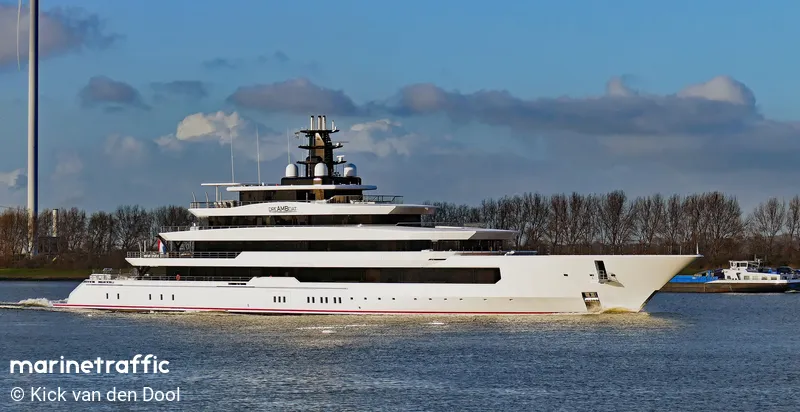
DREAMBOAT crossed from Naples to Barcelona in just over forty-one hours, averaging 13.9 knots and reaching 16.6. The ninety-three per cent AIS coverage tracks a straight-line transit that follows a week of local island-hopping, marking the shift from Oceanco’s delivery run to independent service.
The passage from Naples to Barcelona is not a cruising itinerary but a delivery run completed at sustained high speed. DREAMBOAT covered five hundred and fifty-eight nautical miles between 14:09 on 23 August and 07:29 on 25 August 2026, maintaining an average of 13.9 knots and peaking at 16.6. The telemetry shows a vessel operating outside the constraints of a leisure schedule, moving directly across the Ligurian Sea and the Gulf of Lion with minimal deviation. The ninety-three per cent AIS coverage confirms that the transponder remained active for most of the line, leaving only a forty-nautical-mile gap where the signal was lost. This is the moment a newly built hull transitions from a shipyard’s controlled environment to open-water operation.

The speed profile and the missing segment
An average of 13.9 knots over a distance of five hundred and fifty-eight nautical miles requires a continuous engine output that leaves little room for the stop-start rhythm typical of coastal navigation. The maximum recorded speed of 16.6 knots appears only in brief bursts, suggesting the engines were held at a steady cruise setting rather than pushed to trial conditions. Two hundred and one position fixes were logged across the forty-one-hour window, producing a track that reads as a single, unbroken vector. The vessel did not anchor, did not slow for traffic, and did not alter course for weather. The data points align with a direct routing from the Campanian coast to the Catalan capital, prioritising time over scenic approach.
The missing forty nautical miles account for the seven per cent of the track that fell outside our observation window. The gap occurred roughly midway through the crossing, where the vessel would have passed the southern approaches to the Balearic Islands or the eastern tip of Corsica. AIS reception degrades when a Class A transponder moves beyond line-of-sight from terrestrial repeaters and relies solely on satellite uplinks, which can introduce latency or drop packets during heavy cloud cover or equipment recalibration. The gap does not indicate a system failure; the signal resumed immediately upon arrival in Barcelona, confirming that the transponder functioned throughout. The estimated distance of forty nautical miles bridges the observed segment of five hundred and eighteen nautical miles, completing the geometric line without altering the calculated average speed.
The context of the preceding week
The context of the crossing becomes clear when placed against the week that preceded it. Between 13 and 21 August, DREAMBOAT made ten separate passages, none exceeding sixty-six nautical miles. The vessel moved between Ischia, Ponza, Ventotene, Salerno, Sorrento, Amalfi, Castellammare di Stabia, and Naples, often turning back on itself within a matter of hours. These short hops, mostly recorded at one hundred per cent coverage, form a classic shakedown pattern. New builds undergo sea trials close to home waters so that engineers can monitor vibration, fuel consumption, and steering response without committing to a long ocean leg. The eighteenth saw a forty-three-nautical-mile run from Ischia to Ponza, followed by a return trip on the twentieth. The twenty-first brought the vessel back to Naples, where she sat for two days before casting off for Barcelona. The sequence matches the standard protocol for handing over a superyacht to a buyer: verify systems in protected waters, then execute a longer transit to prove seaworthiness.
Hull dimensions and propulsion implications
The hull itself sets the parameters for this performance. Measuring one hundred and ten metres overall and displacing four thousand five hundred and twenty-five gross tonnes, DREAMBOAT falls into the upper tier of modern motor yachts. Built by Oceanco and delivered in 2025, she carries the Cayman Islands flag and is reported to be owned by Arthur Blank. The length and beam of a vessel of this class require a propulsion plant capable of sustaining thirteen to sixteen knots without excessive fuel burn, which explains the steady speed profile observed on the Barcelona run. The gross tonnage indicates a volume that accommodates extensive interior spaces and auxiliary craft, adding weight that the engines must overcome during acceleration. The fact that she achieved 16.6 knots suggests a conservative power margin, allowing for higher speeds if required while keeping noise and vibration within acceptable limits for guest comfort.
Ownership structures for vessels of this magnitude rarely appear in public records, and the name Arthur Blank is the only attribution available. The Cayman Islands registry places her under a jurisdiction known for commercial privacy, meaning beneficial ownership details remain undisclosed. This opacity does not affect the technical reading of the AIS data, but it does mean that any speculation about charter activity or operational intent rests on inference rather than documentation. The passage to Barcelona, however, speaks for itself. A private owner acquiring a 2025 Oceanco typically expects immediate usability, and the absence of prolonged lay-up or extended builder retention supports that expectation. The vessel left the slipway, completed her local trials, and moved to a major European port in a single operational cycle.
Telemetry standards and future baselines
The telemetry also reveals how modern tracking handles long-distance crossings. The ninety-three per cent coverage rate is standard for Mediterranean transits, where terrestrial AIS stations provide reliable line-of-sight coverage along the Italian and Spanish coasts. The drop-off occurs in open water, where satellite AIS fills the gap but introduces variability in fix quality. Our archive captured two hundred and one points across the voyage, enough to reconstruct the track with precision despite the missing segment. The average speed of 13.9 knots remains accurate because the estimated distance and time are derived from the same mathematical model that calculates the observed portion. The peak speed of 16.6 knots stands as a verified maximum, recorded by the vessel’s own logging system and transmitted via AIS.
The transition from Naples to Barcelona marks the end of the builder’s responsibility and the beginning of independent operation. Oceanco’s delivery runs follow a predictable script: short tests in sheltered waters, verification of all systems, and a final long-distance transit to confirm stability and endurance. DREAMBOAT executed that script exactly. The week of island-hopping served as the verification phase. The forty-one-hour run to Catalonia served as the confirmation. The data shows a vessel that met its design parameters, carried its load efficiently, and maintained communication with shore for the vast majority of the journey. There is no indication of mechanical fault, regulatory delay, or crew unfamiliarity with the systems. The passage is clean, direct, and consistent with a new build entering service.
The record of this voyage will sit alongside the other movements tracked by our archive. Future passages will show whether the vessel operates primarily in the western Mediterranean, ventures into the Atlantic, or remains concentrated around the Italian coast. For now, the Barcelona run stands as a baseline measurement. It establishes the normal cruise speed, the maximum sustainable pace, and the reliability of the transponder over a five hundred and fifty-eight nautical mile line. Any future deviation from this profile will be measurable against it. The hull has proven its capability. The next question is simply where she will take it.
Reporting and data: CelebYachts, republished by On the record.
Sources
The numbers on this page point here. Each one links to the record it came from.
- 1