
 CelebYachts reportProfiles
The forty-seven-metre constraint
Valoria B’s 2018 delivery reveals how Feadship allocates capacity for sub-fifty-metre yachts, where dry-dock availability dictates the schedule more than the owner’s brief.
By On the record · Oct 27, 2026 · Data from CelebYachts1
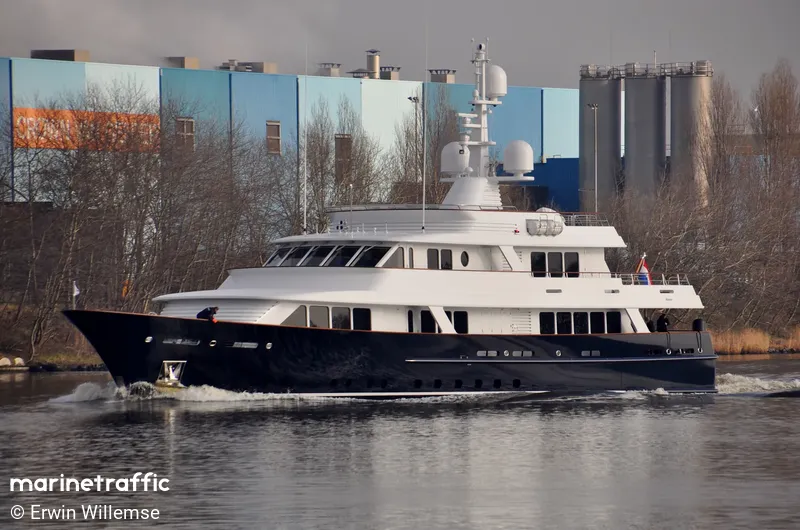
A vessel’s position is the boat’s, not the owner’s. Ownership is as reported, not certified.
The construction record for Amancio Ortega’s 47.35-metre Feadship contains no published dates for keel laying, launch, or sea trials. The absence of a public build log shifts the focus from the vessel itself to the Dutch shipyard network that produced it. In 2018, the cooperative’s limited dry-dock space determined exactly what could be finished each year.
Feadship operates as a cooperative venture between two independent Dutch shipyards: Royal Van Lent Shipyard and Koninklijke De Vries Scheepsbouw. The organisation traces its roots to 1849, when the Akerboom family purchased a small yard off the Dutch coast, later merging with the Van Lent family in 1927 and forming the formal association in 1949 alongside the De Vries shipyard. This historical consolidation created a unified design and engineering centre, De Voogt Naval Architects, based in Hoofddorp. Every hull commissioned through the cooperative shares this baseline engineering framework, meaning the naval architecture remains consistent regardless of which physical slipway receives the steel. The cooperative released its complete order book on 10 January 2018, listing Valoria B among a broader portfolio of projects. The register confirms a 2018 delivery window, but the internal scheduling of that production cycle remains proprietary. A vessel measuring 47.35 metres in length and 9.2 metres in beam does not demand the extreme infrastructure reserved for the largest superyachts, yet she still requires a dedicated dry dock for final outfitting and launching. The physical turnover rate of the manufacturing sheds dictates the schedule, rather than the hull form.
The cooperative allocation
The cooperative stopped building yachts in wood by the mid-1950s, shifting entirely to steel and aluminium construction. This material transition established the structural rigidity that defines modern Feadship hulls. Valoria B benefits from this decades-long standardisation, inheriting a proven hull design that requires minimal custom engineering. The shared naval architecture centre ensures that stability calculations, weight distribution, and propulsion layouts follow established parameters. This reduces the risk of delays caused by novel design flaws, allowing the yard to focus strictly on production speed.
The 2018 footprint
During the build period leading up to the 2018 delivery, Feadship’s manufacturing capacity was distributed across three primary sites. Koninklijke De Vries maintained active operations in Aalsmeer and Makkum. The Makkum yard, which opened in 2005, features a 170-metre construction shed and a massive dry dock designed specifically for deep-water access. Royal Van Lent operated from Kaag and Amsterdam. The Kaag facility possessed two dry docks and two slipways capable of handling vessels up to 100 metres in length. The Amsterdam yard’s newest dock, capable of accommodating superyachts up to 160 metres, did not open until early 2019. Consequently, all deliveries completed in 2018, including Valoria B, had to be allocated within the existing Kaag and De Vries infrastructure. A gross tonnage of 582 places the motor yacht in a middle tier within this ecosystem. She is too substantial to be treated as a simple refit project, yet too compact to justify priority access to the deepest berths reserved for longer hulls. Her placement in the 2018 calendar reflects a standard allocation cycle where medium-length vessels fill the intervals between major launches, utilising the available dry-dock space efficiently without displacing larger programmes.
The unrecorded sequence
Open records provide no timeline for the physical progression of Valoria B. There is no documented date for the first cut of steel, the keel laying, or the hull launch. Sea trials are similarly absent from public registries. The International Maritime Organisation (IMO) identifier 9809978 and the Maritime Mobile Service Identity (MMSI) 224765000 serve only to track her movement after commissioning. The vessel flies the Spanish flag and lists Portonovo as her home port. These administrative details mark the conclusion of the manufacturing phase. The omission of construction milestones is consistent with Feadship’s approach to sub-fifty-metre clients. The cooperative treats the build schedule as an internal logistics problem, releasing updates only when necessary to manage expectations or secure financing. The AIS broadcast data begins recording positions only after the hull enters service, leaving the three-to-five-year construction window invisible to external observers.
The vessel has logged zero recorded voyages in the tracking database, indicating either restricted operational use or a deliberate minimisation of broadcast activity. Her last recorded position sits at 42.4° N, 8.8° W, placing her firmly within the UK Coast and Atlantic area. This stationary pattern contrasts sharply with the long-distance passages typical of larger expedition yachts, reinforcing the assessment that she functions primarily as a coastal cruiser. The absence of voyage charts further isolates her from the public tracking networks that document the movements of higher-profile fleet mates.
Capital and deployment
The capital that funded Valoria B traces directly to the initial public offering of Inditex in 2001. Amancio Ortega, the founder of the fashion group, retained significant equity through his investment vehicle, Pontegadea. His wealth derives from the rapid expansion of retail real estate and financial holdings across Europe and North America. The estimated value of the yacht stands at $35,000,000. This figure places her in a segment where owners prioritise proven engineering and standard propulsion systems. The 47.35-metre length allows for transatlantic capability without the fuel consumption penalties associated with heavier displacement hulls. Current AIS tracking places her off the UK coast and Atlantic seaboard, operating under the standard cruising patterns of European-based owners. The vessel’s operational life began in 2018 and continues without interruption, insulated from the public scrutiny that surrounds the construction of multi-hundred-million-dollar competitors.
Pontegadea consolidates Ortega’s assets through real estate investment and financial holdings. The company completed a $72.5 million deal for a downtown Chicago hotel in 2019, following purchases of office buildings in Washington and Seattle. Its portfolio includes Manhattan’s Haughwout Building and properties along Madrid’s Paseo de la Castellana and Barcelona’s Passeig de Gràcia. The liquidity generated from these commercial real estate transactions and energy grid acquisitions provides the capital reservoir for discretionary purchases like Valoria B. The $35,000,000 valuation reflects a conservative acquisition strategy, typical of owners who treat luxury vessels as utilitarian assets rather than status symbols.
Reporting and data: CelebYachts, republished by On the record.
Sources
The numbers on this page point here. Each one links to the record it came from.
- 1