
 CelebYachts reportProfiles
The corporate architecture of a static hull
A 46-metre Burma-teak cruiser has not moved since October 2019, anchored off Mumbai while its owner dismantles and remakes a textile empire.
By On the record · Jul 21, 2026 · Data from CelebYachts1
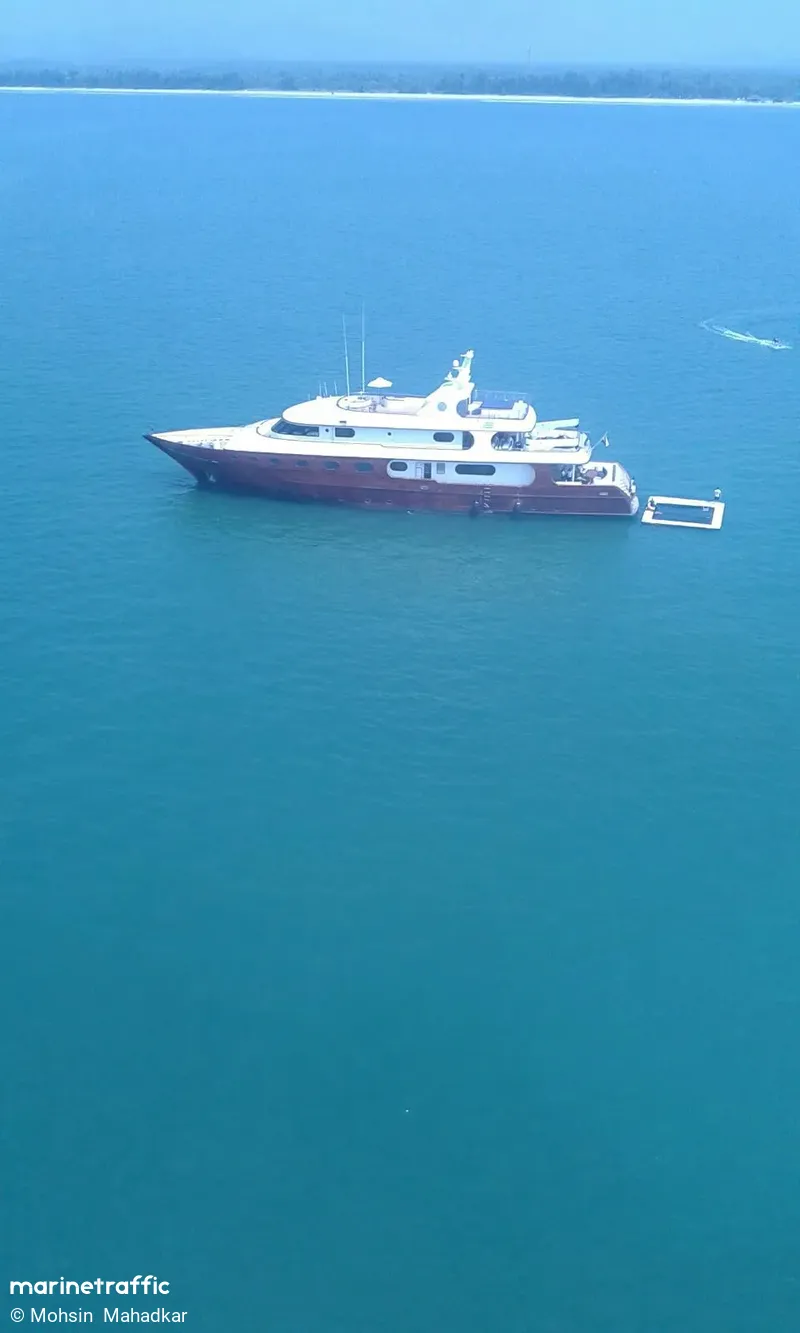
A vessel’s position is the boat’s, not the owner’s. Ownership is as reported, not certified.
The Ashena was launched in 2006 as a statement of traditional craftsmanship funded by the Raymond Group. Twelve years later she sits motionless in the Arabian Sea. Her stillness coincides with a ruthless corporate restructuring that extracted billions from Indian manufacturing, leaving the yacht as a fixed point in a shifting financial landscape.
The Ashena measures 46.0 metres in length and 9.0 metres in beam. She was launched in 2006. Her builder is recorded as a set of traditional boatyards in Gujarat, working in Burma teak, a detail reported by Wadia. The vessel carries no International Maritime Organisation identifier and flies the flag of the Comoros. Her home port is unlisted. The register holds no estimate of her current value.
The timber and the ledger
These physical facts sit beside a different kind of specification. The owner, Gautam Singhania, controls the Raymond Group, which produces the largest volume of suiting fabric globally. His capital did not arrive through a single flotation or sale. It accumulated through a sequence of acquisitions and divestments that began when he joined the family’s JK Group in 1986. He became a director of Raymond in 1990, managing director in July 1999, and chairman in September 2000. The year before he took the chair, he had already begun stripping the conglomerate. He sold the synthetics, steel, and cement divisions. He redirected the remaining cash flow into fabrics, branded apparel, prophylactics, and men’s toiletries. He signed joint ventures with UCO Textiles of Belgium for denim production and Gruppo Zambaiti of Italy for shirting. The Ashena was built during this transition, a timber cruiser funded by the consolidation of a textile supply chain.
The construction method prioritised material density and aesthetic continuity over speed or fuel efficiency, a design choice that aligns with the period in which it was commissioned. The use of imported hardwoods and manual joinery reflects a specific era of Indian luxury procurement. By 2012, Singhania’s net worth was estimated at $1.4 billion, a figure derived from his equity holdings rather than liquid assets. The yacht represents a conversion of industrial equity into a physical asset, purchased at the peak of the group’s textile expansion phase.
The corporate split
The vessel has not moved since 21 October 2019. Her last broadcast position placed her at 18.95° N, 72.84° E, resting in the waters off the West Coast of India. She has remained stationary for more than five years. No public record explains the pause. The absence of an AIS track coincides with the final phase of a structural overhaul that began inside the Raymond Group in 2023.
In June 2024, shareholders approved the reappointment of Singhania as managing director for a fifth consecutive five-year term, effective from 1 July 2024. The same month saw the formalisation of a strategy labelled Raymond 2.0. The plan required the demerger of the holding company into three separate listed entities: Raymond Ltd, which retained the engineering operations; Raymond Lifestyle, covering the consumer brands; and Raymond Realty, which held the property portfolio. The National Company Law Tribunal approved the real estate vertical, which officially listed in July 2025. During fiscal 2025, the new real estate business reported revenue of ₹2,313 crore, representing a 45 per cent increase on the previous year. Management has projected that the division will double its top line to ₹4,000 crore over the next five years, targeting a compound annual growth rate of 15 per cent.
The demerger locked capital into distinct equity vehicles. Assets that might have been liquidated to maintain a fleet of vessels were instead ring-fenced within newly created subsidiaries. The Ashena sat idle while the parent company divided itself on paper. A yacht of 46 metres requires continuous expenditure on crew, insurance, and dry-docking. Funding those costs during a multi-entity split demands either retained cash reserves or external borrowing. The published accounts show neither option being exercised for the vessel. The shipyard records do not exist in public databases. The registration file lists no gross tonnage. The financial machinery that bought the hull is now operating at a different frequency.
The succession dispute
The urgency of the corporate restructuring traces back to a family conflict that predated the demerger by nearly a decade. Vijaypat Singhania founded the Raymond Group and publicly accused his son of orchestrating a hostile takeover of the family empire. In 2015, Gautam Singhania acquired a 37 per cent stake in the holding company, a move that forced his father out of the executive suite and removed him from the 36-storey J.K. House in Mumbai. The separation triggered prolonged litigation. In March 2024, Vijaypat Singhania clarified that a photograph circulating online, which suggested the two men had reconciled, had been obtained under false pretences. He denied any restoration of relations.
The legal battle established a clear boundary between the founder and the operator. Gautam Singhania secured the voting rights necessary to execute the 2024 demerger without requiring paternal consent. The restructuring insulated the consumer and real estate assets from the liabilities attached to the original conglomerate structure. It also separated the operational cash flows from the personal estates controlled by the senior generation. The Ashena, registered in the owner’s name, sits outside the listed entities. She represents a personal asset that was purchased before the corporate firewall was erected. Her continued presence in Indian waters suggests that the operator retains sufficient liquidity to maintain the vessel, even as the broader group reallocates capital toward property development and branded retail.
The register provides no information regarding the yacht’s interior layout, propulsion system, or current maintenance status. The sale price remains unconfirmed. The available data stops at the hull dimensions and the corporate filings. What remains visible is the relationship between a static timber hull and a rapidly dividing industrial balance sheet. The owner has kept the vessel in port while the parent company splits its equity. The hull remains stationary while the corporate structure divides.
Reporting and data: CelebYachts, republished by On the record.
Sources
The numbers on this page point here. Each one links to the record it came from.
- 1