
 CelebYachts reportInvestigations
The frozen Steel of Shellest
A 46-metre Sanlorenzo holds station in the Black Sea while its corporate owner navigates the logistical collapse of Russian-flagged superyacht maintenance.
By On the record · Aug 12, 2026 · Data from CelebYachts1
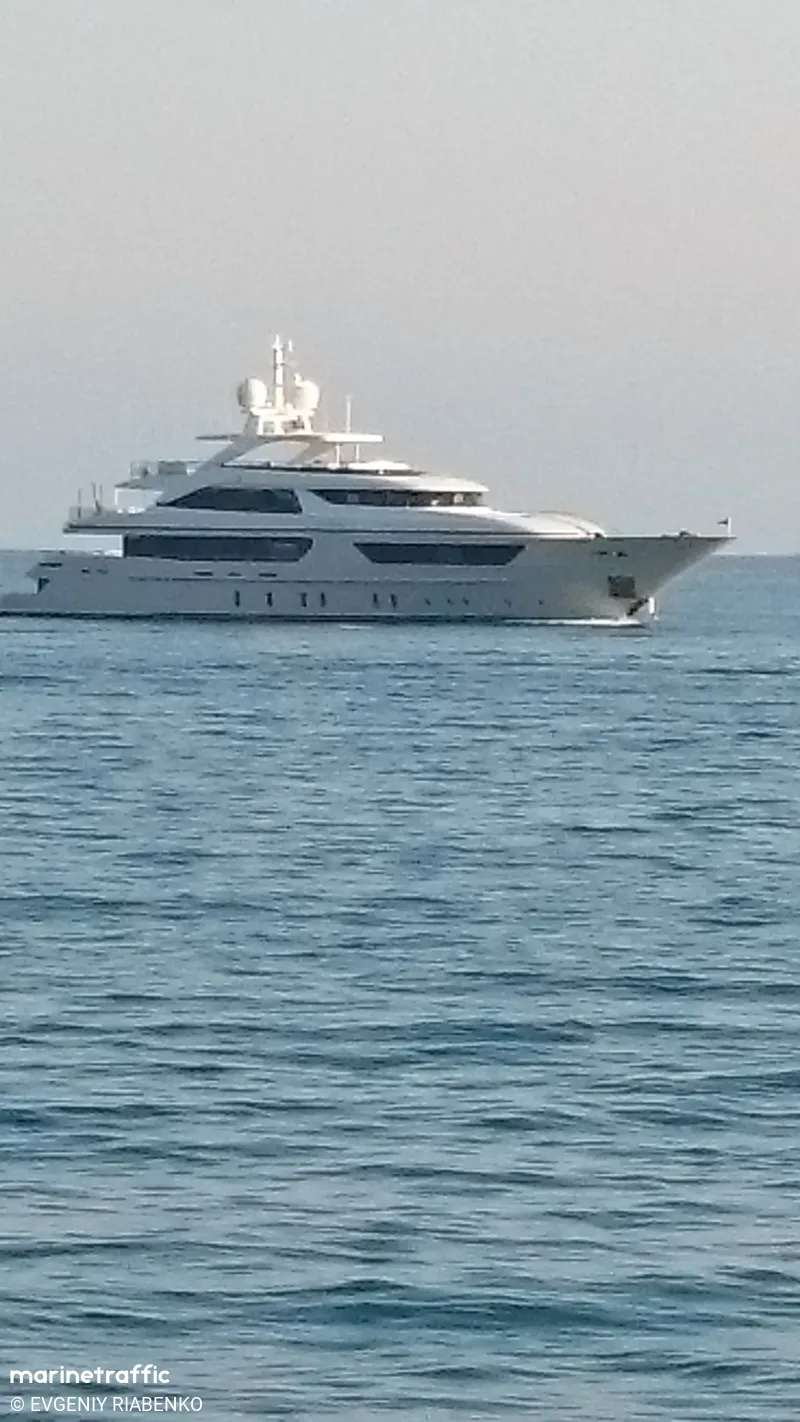
A vessel’s position is the boat’s, not the owner’s. Ownership is as reported, not certified.
Shellest has not moved since late October because of jurisdictional friction, not a dry-docking schedule. The vessel’s registration under Revival of Maritime Traditions / LLC Gelios illustrates how mid-tier Steel hulls are being stranded by insurance withdrawal and port restrictions, leaving owners to pay for static assets they can no longer legally operate.
Shellest sits at a fixed coordinate in the Black Sea because the machinery required to move her has been withdrawn by third parties. The vessel has not altered her position since late October, a stagnation that reflects a broader breakdown in the service economy supporting Russian-flagged yachts rather than a mechanical fault or a planned refit. Owners of vessels in this tonnage bracket now face a binary choice: absorb the escalating costs of maintaining a static asset within a closed regional market, or accept rapid depreciation. Shellest demonstrates the latter path, anchored by corporate and regulatory constraints that extend far beyond the waterline.
The corporate shell
The registered owner appears as Revival of Maritime Traditions / LLC Gelios. This dual-entity designation functions as a standard liability firewall, separating the operational management of the vessel from the underlying asset title. The structure indicates a deliberate effort to insulate the beneficial owner from direct exposure in commercial registries, a practice common among high-net-worth individuals operating across multiple jurisdictions. The company provides no public financial disclosures, and independent valuation models return a null result for net worth. The citizenship and occupational background of the individual behind the holding company remain unverified in open records.
The absence of a published sanction listing complicates the assessment of her operational status. Neither the US Office of Foreign Assets Control nor the European Union consolidated list contains an entry matching the vessel’s MMSI or the named holding entities. This silence does not confirm freedom from restriction; it confirms only that the specific identifiers have not triggered automated screening protocols in those particular databases. Other enforcement regimes may apply, or the vessel may simply fall below the reporting threshold for international blacklist publication. The practical effect remains identical regardless of the legal instrument: Western insurers will not underwrite a Russian-flagged hull of this age, and classification societies based in the EU or UK will not renew statutory certificates without physical surveys that are currently inaccessible.
Maintenance costs for a vessel of this scale do not decrease when she stops moving. Corrosion rates accelerate in stagnant brackish water. Marine growth fouls the propeller shafts and raw water cooling intakes. Diesel generators left running at low load suffer from wet stacking, where unburnt fuel deposits carbon on cylinder heads and exhaust valves. Crew wages continue to accrue. Port fees accumulate daily. The corporate entity holding the title must fund these outlays from reserves or secondary income streams, converting liquid capital into dead weight on a ledger. Every month spent at anchor reduces the eventual sale price by the total cost of preservation plus the depreciation penalty for a vessel that has proven unable to sail.
The Steel constraint
Shellest was constructed by Sanlorenzo under their 46 Steel programme, delivered in 2015. The hull measures 46 metres in length and 8 metres in beam. She displaces a significant volume of water compared to aluminium alternatives of the same footprint, a characteristic that dictates her performance envelope and her maintenance profile. Steel hulls require continuous cathodic protection systems and regular dry-docking to strip marine biofouling and repaint the underwater surfaces. The gross tonnage figure is absent from public registers, which obscures the exact internal volume but confirms a substantial superstructure mass above the waterline.
The choice of Steel over aluminium carries specific engineering trade-offs. Steel provides superior impact resistance and acoustic dampening, qualities valued in expeditionary platforms and security-conscious deployments. It also demands heavier structural framing and more powerful propulsion to achieve comparable speeds. The estimated value of the vessel stands at $30,000,000, a figure that reflects her original build cost adjusted for fifteen years of operational wear. That valuation assumes a functioning propulsion plant, intact classification society certificates, and a clear title chain. Each of those assumptions fractures under current conditions.
Dry-dock capacity for a 46-metre Steel hull is severely constrained in the Black Sea region. Major shipyards capable of handling vessels of this displacement are concentrated in Turkey, Italy, and Croatia. Turkish facilities accept Russian-flagged work, but scheduling priority goes to commercial tankers and container ships. Italian and Croatian yards enforce strict EU compliance checks that typically reject Russian flags outright due to insurance and re-export restrictions. The vessel cannot be floated out for inspection without triggering port state control scrutiny. Without a valid certificate of class, she cannot legally enter international waters. The Steel hull becomes a permanent fixture, subject to tidal forces and seasonal temperature swings that stress weld seams and deck fittings.
The basin lock
AIS broadcasts place Shellest at 44.45° N, 38.13° E. The MMSI identifier 273385420 routes her transmission through the Russian maritime traffic management network. Her flag state is recorded as Russia. The last confirmed signal arrived in late October, after which the broadcast stream ceased entirely. A vessel of this size does not power down her transponder voluntarily unless the crew abandons ship or the master disables the equipment to evade surveillance. More likely, the antenna has suffered physical damage, the power supply has failed, or the vessel has settled onto a soft seabed in shallow coastal waters.
The Black Sea presents a closed loop for maritime traffic. Commercial shipping lanes run parallel to the Turkish and Bulgarian coasts, while military patrols monitor the western approaches. A 46-metre yacht attempting to transit the Bosporus would attract immediate attention from Turkish coastguard vessels and potentially NATO monitoring assets. The political environment discourages casual passage. Even if the paperwork cleared, the lack of bunker suppliers willing to handle Russian-flagged vessels creates a fuel shortage that grounds most private craft. Diesel prices in the region have risen sharply, and credit terms for private yachting operators have evaporated.
The economic reality of the situation is straightforward. An asset valued at $30,000,000 generates zero revenue while consuming cash flow for storage, security, and administrative compliance. The corporate owner, Revival of Maritime Traditions / LLC Gelios, continues to file statutory declarations, but the filings describe a vessel that exists primarily on paper. The AIS data confirms the physical counterpart matches the registry description, yet the two are no longer functionally connected. The hull sits. The engines cool. The paint blisters. The ledger drains. Until a new flag state accepts her, or a buyer emerges willing to assume the insurance deficit, Shellest will remain a fixed point in the basin, a Steel monument to the limits of capital in a sanctioned market.
Reporting and data: CelebYachts, republished by On the record.
Sources
The numbers on this page point here. Each one links to the record it came from.
- 1CelebYachtsCelebYachts: The frozen Steel of Shellest